Category: Economic Opportunity

For blogs that talk about Economic Opportunity

  • Building Pathways to Economic Mobility: Supporting Returning Citizens

    Building Pathways to Economic Mobility: Supporting Returning Citizens

    For many Houstonians, the path to incarceration begins long before a conviction. Decades of research point to how childhood experiences—such as poverty, trauma, unstable housing, and limited access to quality educational or economic opportunity—significantly increase the likelihood of incarceration later in life. And once a person enters the criminal justice system, the barriers to rebuilding their life only grow steeper.

    Every year, thousands of individuals return home to Houston after serving time in prison—ready for a second chance, but too often they are met with closed doors. With limited access to jobs, housing, and support, these returning citizens1 face odds that are stacked against them.

    In a region like ours—where opportunity and resilience define the Houston spirit—these barriers not only harm individuals but also hold back families, communities, and our broader economy. Harris County’s incarceration rate is more than twice the national average, and without better reentry pathways, the cycle continues.

    But what if reentry looked different?

    For more than 20 years, the Prison Entrepreneurship Program (PEP) has worked to make that vision a reality—providing returning citizens with housing, support, mentorship, and the skills to succeed through employment and entrepreneurship. Their work is helping to transform lives, rebuild families, and strengthen the Houston region.

    The scope of mass incarceration

    Mass incarceration describes a period of rapid growth in the number of people incarcerated across the U.S. since the 1970s, driven by policies like mandatory minimum sentencing, the war on drugs, and tough-on-crime laws.

    Since then, the number of people incarcerated in the U.S. has grown sixfold from just under 200,000 in 1970 to nearly 1.2 million in 2022. Although the U.S. represents only 4% of the global population, it accounts for 16% of the world’s incarcerated people, ranking fifth in incarceration rates globally only behind El Salvador, Cuba, Rwanda, and Turkmenistan. In fact, every U.S. state incarcerates more people per capita than most countries.

    Texas leads the nation with the largest incarcerated population at 137,035 individuals in 2022 (most recent data available). To put it into perspective, Texas, as the second most populous state in the country, makes up just 9% of the U.S. population, yet it accounts for 12% of the country’s incarcerated individuals. By contrast, California, the most populous state in the country, makes up 12% of the population but just 8% of those incarcerated (97,483 individuals).

    In Texas, the incarceration rate is more than double the national average at 1,031 incarcerated individuals for every 100,000 people ages 15 to 64. Harris County’s rate is close to Texas’ at 947. In fact, Harris County operates the largest jail in Texas, housing roughly 10,000 people on any given day and processing over 70,000 individuals each year.

    Approximately 40,000 people are released from Texas state prisons annually, with an estimated 20% returning to Harris County. For many of these returning citizens, the challenges don’t end with their release. The consequences of incarceration—such as difficulty finding housing, employment, and stability—often continue long after someone has served their time.

    The impacts of mass incarceration

    Returning citizens face significant barriers to rebuilding their lives after release, especially when it comes to employment and economic opportunity. Many start with zero income and limited education, and also face challenges like lack of transportation, unstable housing, restricted job options, mental health concerns, social exclusion, and the persistent stigma of a criminal record.

    A U.S. Department of Justice study found that one-third of formerly incarcerated individuals never found employment within four years after release. The Prison Policy Initiative estimates that the unemployment rate for this population is around 27%, which is higher than the peak unemployment rates for the civilian population during the Great Recession (10%) and COVID-19 pandemic (8%). According to the U.S. Chamber of Commerce, excluding formerly incarcerated job seekers costs the economy $78 to $87 billion in lost GDP annually. Additionally, these employment challenges contribute to a vast array of other issues including housing insecurity. In fact, formerly incarcerated individuals are 10 times more likely to experience homelessness than the general public.

    It’s important to remember that justice involvement affects more than just the returning individual—it impacts entire families and communities. Today, more than 1 million children have a parent currently in prison, and over 5 million have experienced the incarceration of a parent at some point in their lives. Research shows these children are at greater risk of economic hardship, academic struggles, and even future involvement with the justice system—continuing cycles of poverty and incarceration across generations.

    Given the scale of the incarcerated population in Texas, and Houston, and the substantial challenges this population faces upon reentry, it is critical  to have the right support in place to ease their transition and reduce the challenges they, and their families, face. Research shows that providing access to services both before and after release is cost-effective and improves outcomes. A meta-analysis of 14 studies analyzing the benefit-to-cost ratio of correctional treatment programs (typically offered pre-release) found that for every dollar invested, society could see up to $270 in returns through reduced crime, lower incarceration costs, and fewer victims.2 Similarly, reentry programs (typically offered post-release) have been shown to increase employment and housing stability while lowering rates of recidivism.

    Helping people reintegrate after prison

    Reentry programs—designed to support individuals returning to their communities after serving time in prison—began in the mid-1900s and have changed over time. Early efforts focused on parole boards, which monitored and approved prisoner releases. Over time, these efforts evolved into more formal programs, with dedicated funding directed to government agencies and nonprofit organizations, to help returning citizens successfully reintegrate into communities.

    Reentry programs can give people the support they need to successfully return to their communities after incarceration and can greatly improve public safety and outcomes for returning citizens. These programs can be provided in a correctional institution or in the community upon release, but effective reentry planning should start long before release. While the primary function of reentry programs is to help individuals transition back into their community, reentry is also linked with the goal of preventing recidivism. Recidivism, or a return to criminal or delinquent activity and subsequent imprisonment, is calculated based on the number of individuals who return to incarceration within three full years of release or start of supervision.

    Research has shown that programs that support successful reentry must provide holistic services that address not just immediate needs, but also the broader challenges individuals face after incarceration. These include health, employment, housing, skill development, mentorship, and social networks. According to Harvard University’s Institute of Politics, reentry efforts are most effective when they begin prior to release, are tailored to the unique needs of the individual, and continue with strong community-based support. The report emphasizes that mentorship can be especially impactful when returning citizens are carefully paired with peer or professional mentors who are carefully matched. It also highlights that access to mental health care, job training and matching, and safe, stable housing are foundational for long-term stability.

    A local solution to creating pathways to successful reentry

    While incarceration rates remain high in Texas, our state has been successful in supporting returning citizens as can be seen in our low recidivism rate. According to the Texas Department of Criminal Justice’s (TDCJ) 2024 Biennial Reentry and Reintegration Services Report, recidivism rates for the TDCJ inmate population are among the lowest in the country at 14.7%, compared to a national average of 50%. This low recidivism rate is in part because of partnerships with nonprofit and faith-based organizations, expanded access to vocational training and education inside correctional facilities, and more coordinated release planning.

    Prison Entrepreneurship Program (PEP), a grant partner in Greater Houston Community Foundation’s High-Impact Grantmaking initiative and a long-time partner with TDCJ, has taken a revolutionary approach to prison reentry and aims to provide a pathway from poverty to prosperity for returning citizens. Their mission is to unite executive business volunteers and inmates through entrepreneurial passion and servant leadership to transform lives, restore families, and rebuild communities.

    PEP provides both pre- and post-release services. Their pre-release services provide education focusing on character development, entrepreneurship training, servant leadership, and family reunification. Their post-release services include transitional housing, wraparound services (e.g., transportation, medical services, support networks, etc.), employment support, entrepreneur mentorship, and access to capital. The goal is to provide participants with a comprehensive solution to re-entry into a structured environment of accountability.

    Bringing together in-prison and post-release education, mentorship, and comprehensive services, PEP successfully supports formerly incarcerated individuals in gaining employment and launching businesses that support increases in household income and wealth. Extensive evaluations of PEP programs by Initiative for a Competitive Inner City, American Enterprise Institute, Baylor University’s Institute for Studies of Religion have found that PEP’s program outcomes include:

    • 100% employment within 90 days of release.
    • An average starting wage of $17/hour, and $28/hour within three years.
    • A recidivism rate of less than 10% (compared to the national average of 50%) that results in $4.3M in annual savings to Texas taxpayers.
    • 46% home ownership, contributing to family wealth-building.
    • 700 new businesses formed by graduates, creating $122.5M in economic impact.
    • A return of nearly $8 in social and economic impact for every $1 invested.

    PEP’s program, Barbed Wire to Business (the Collider), focuses on both intrapreneurship (those seeking employment) and entrepreneurship (those starting businesses). While initially created for graduates of PEP’s in-prison programs, the Collider is now being expanded to serve all returning citizens in Harris County. The Collider provides participants with reentry support, education, employment, entrepreneurship training, mentors, business incubation, and capital access.

    Through the Collider program, PEP will serve 550 formerly incarcerated people in Harris County in 2025, impacting families with more than 2,100 individuals. This will lay the foundation to exponentially grow their impact with a goal of serving more than 100,000 individuals annually by 2029, breaking the cycle of poverty and incarceration for families served. PEP aims to support 189 citizen businesses launched, $568 million in cumulative wages earned, and more than 28,000 low-income individuals across Texas and beyond by 2029.

    “If I had not been in PEP, I’d be back in prison with a life sentence still running the game or killed. But I stand strong, and I hope I’m a light to everyone in my community, my family, how to live right. PEP changed my life.” 

    – Jeremy Jones, Life Caddy at Prison Entrepreneurship Program (PEP)

    Breaking the cycle through community investment

    Mass incarceration has left a lasting impact on families, communities, and economies across the country—especially here in Houston. As more individuals return home each year, these ripple effects only grow. By combining holistic, wraparound services with character development, entrepreneurship training, housing, mentorship, and access to capital, PEP is transforming lives and proving that with the right support, people can break free from cycles of poverty and incarceration.

    Through our High-Impact Grantmaking initiative, Greater Houston Community Foundation is proud to support innovative, data-driven solutions like PEP that expand opportunity, restore dignity, and strengthen economic mobility for Houston families. By investing in reentry and reintegration efforts, we’re not only improving individual outcomes—we’re helping build a more inclusive and prosperous Houston.

    Empower second chances and join the movement to break the cycle by getting involved in PEP’s work through a donation, supporting a returning citizen through employment, and/or volunteering as a mentor.


    1A returning citizen refers to an individual who is reentering society after being incarcerated in jail or prison and does not only reference those who are U.S. citizens. This term is increasingly used as a more respectful and humanizing alternative to labels like “ex-offenders” or “former inmate” recognizing that a person’s identity is not solely defined by their criminal record and emphasizes their role as a member of a community who is returning home.

    2The return on investment from these programs varies by the type of program being provided with returns ranging from $1.13 to $269.86. Of the 14 studies analyzed, 13 found a favorable benefit-cost ratio while one study did not.

  • Building Pathways to Economic Mobility: The Role of Public Benefits

    Building Pathways to Economic Mobility: The Role of Public Benefits

    Poverty is more than just a statistic. It is a daily struggle that impacts millions of Americans, shaping futures before they even begin. In Harris County, where poverty rates exceed the national average, nearly one in four children grow up in a household facing extreme financial hardships. And the stress of poverty has far-reaching consequences not just affecting the present but also long-term outcomes in limited educational opportunities, job prospects, and overall health for generations.

    Accessing public benefits can play a vital role in bridging the gap between struggle and stability. Programs like the Supplemental Nutrition Assistance Program and housing assistance have lifted millions out of poverty and provide the financial stability required for families to invest in opportunities that improve future outcomes. However, in Harris County alone, it is estimated that $1 billion in government benefit assistance goes unclaimed each year due to a lack of awareness, stigma, and complex application processes, leaving those in need without access.

    Connective, a Houston-based nonprofit, is working with partners across Harris County to provide a solution to the underutilization of public benefits by creating a local Public Benefits Hub that serves as a one-stop shop concept designed to simplify the process of accessing public benefits.

    Reducing poverty is not just a matter of improving the lives of affected individuals; it has profound benefits for our communities as a whole. When we invest in programs and policies that lift families out of poverty, the rewards echo throughout society. Lower poverty rates are linked to better community health, higher graduation rates, reduced crime, and improved infrastructure—all essential elements for fostering long-term growth and success for everyone.

    The scope and impacts of poverty

    Across the United States, 1 out of 8 Americans live in poverty. Harris County’s 2023 (most recent data available) poverty rate (16.0%) exceeded the national rate (12.5%), continuing a trend since 1990. Children are more likely to live in poverty, with 23% of children under the age of 18 living below the poverty threshold in Harris County.

    Poverty contributes to chronic stress that not only impacts adults but can also have generational impacts on children, who make up the largest group in the U.S. experiencing poverty. Due to extended exposure to hazardous living conditions or extreme financial problems, living in poverty can lead to physical, mental, and financial strain. The oppressive phenomena known as “poverty-related stress” is the result of these everyday stressors.

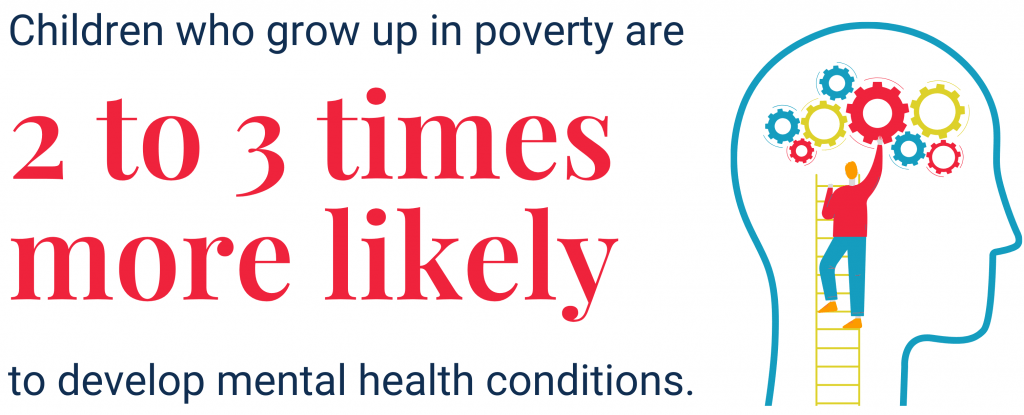
    Children who grow up in poverty are more likely to experience poverty as adults, have higher rates of ill health, lower educational attainment, lower labor force participation due to having less social capital and professional opportunities, and have greater exposures to violence. They are also two to three times more likely to develop mental health conditions.

    The impacts of public benefits on poverty

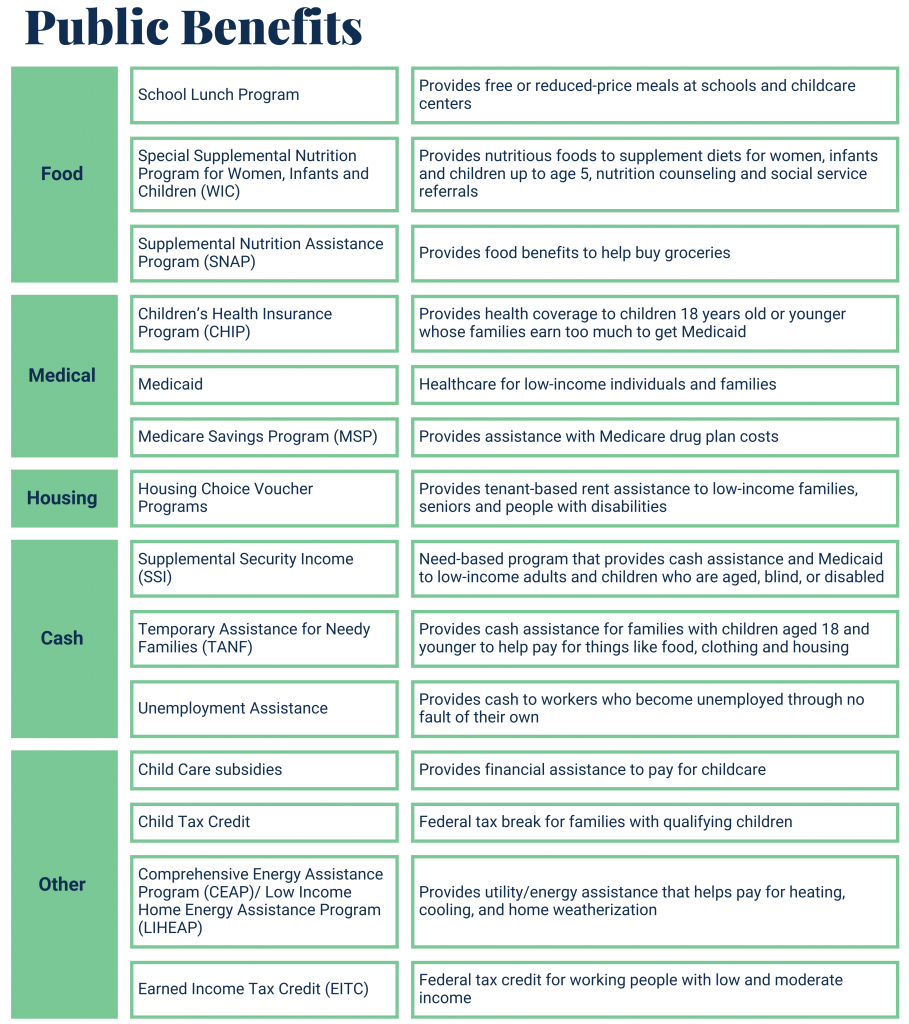
    Public benefits—government programs that offer financial assistance to help people meet their basic needs like food, housing, and healthcare—serve as a safety net to millions of Americans who are struggling financially. These benefits including programs like SNAP (Supplemental Nutrition Assistance Program), housing vouchers, or TANF (Temporary Assistance for Needy Families). (See Appendix A for a list of the types of public benefits that exist). One of the first official public benefit programs was the Social Security Act of 1935 which eventually brought millions of older adults out of poverty.

    Due to unprecedented economic challenges caused by the COVID-19 pandemic, the United States expanded several public benefit programs in 2020 and 2021 to mitigate financial hardships. During this time, the national poverty rate fell to its lowest level on record, with overall poverty rates declining to 7.8% in 2021 and child poverty dropping to 5.2%, thanks to increased benefits and greater flexibility in assistance programs during the pandemic. However, poverty rates rose in 2022 by 4.6 points up to 12.4% in just a single year due to the termination of pandemic-related assistance.

    To put this into perspective, the number of Americans living in poverty increased by more than 15 million between 2021 and 2022 and the number of children more than doubled to 9 million.

    To understand the role these expanded government benefits had in reducing the poverty level, we can compare poverty levels before and after people receive government assistance such as unemployment insurance, housing assistance, SNAP, WIC, etc.

    Before any taxes or benefits are factored in, the number of people living in poverty across the U.S. increased in 2020 and 2021 compared to 2019. However, taking into consideration government support like the expanded Child Tax Credit and stimulus payments, the number of individuals living in poverty decreased consistently between 2019 and 2021, with over 12.5 million fewer people living in poverty in 2021 compared to 2019.

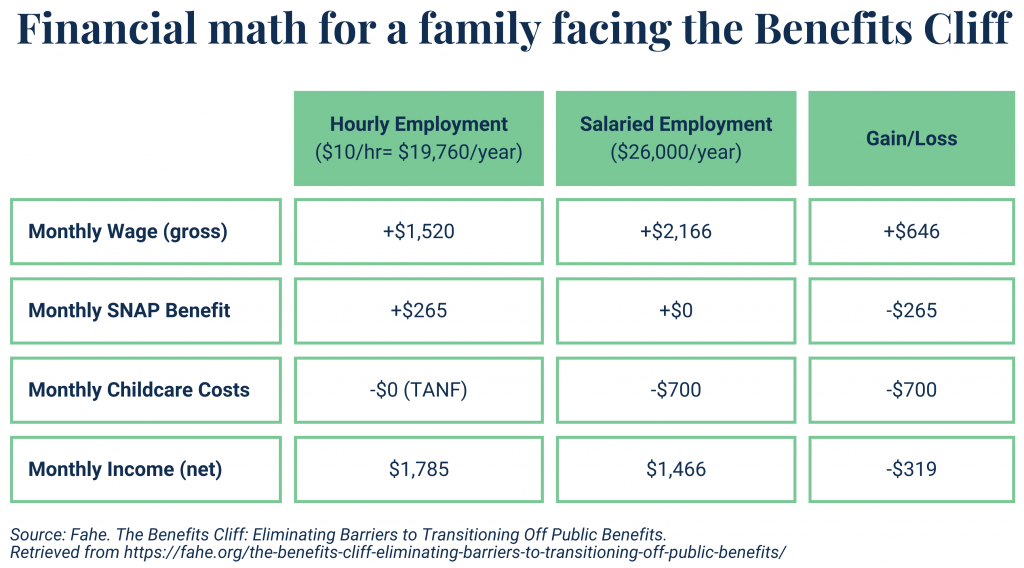
    While public assistance offers notable advantages, it also comes with perceived drawbacks. One common concern is that these programs may act as a disincentive to employment. A key examples is the “benefits cliff”—a situation where an increase in earnings pushes an individual or family above the eligibility for threshold for public benefits. As a result, people may lose access to critical support just when their income rises, even if they continue to struggle financially. This creates a challenge, as some individuals may hesitate to accept job offers or pay raises, knowing that doing so could leave them with less income overall.

    This benefits cliff, or gap, doesn’t negate the impact of these programs on providing financial security and reducing poverty but rather highlights how the programs are structured that can create barriers to economic mobility. Issues like inconsistent eligibility rules, benefits that disqualify recipients from other forms of aid due to income threshold, and the lack of a gradual phase-out system rather than a cliff can make it difficult for individuals to transition off assistance without experiencing financial hardship. Recommendations to address the benefits cliff include temporarily extending benefits after income increases, gradually reducing assistance preventing a sudden loss of wages, standardizing eligibility requirements to reduce confusion and unintended loss of benefits, and raising or eliminating asset limits to encourage savings without jeopardizing benefit eligibility.

    Public benefits can help stabilize individuals and families by providing basic needs, reducing stress related to unpredictable finances, and reducing the level of poverty they are experiencing. These programs help cost-burdened families move from survival mode to pursuing economic mobility by alleviating immediate financial pressures and avoiding cycles of housing instability and food insecurity. Once stabilized, residents can pursue opportunities—like education, skills training, or steady employment—that can break the cycle of intergenerational poverty and lead to economic mobility. Additionally, studies have shown that access to public benefit programs has several short- and long-term benefits for children and families that contribute to breaking cycles of intergenerational poverty and supporting upward mobility.

    Accessing public benefits won’t automatically lead individuals and families to achieve economic mobility. However, these benefits can play a vital role in creating a more stable financial foundation, providing them with opportunities to move towards upward mobility. When people have the support they need to thrive, it not only transforms their own lives but also brings positive change to their communities as a whole.

    Billions in public benefits go unused every year

    Although the use of public benefits, often called “safety net programs,” has the potential to reduce the poverty rate and improve economic mobility, it is estimated that nationally, $80 billion in public benefits go unused each year and thirteen million people in poverty do not access benefits they may be eligible for.

    In Harris County, almost $1 billion in government benefit assistance goes unclaimed each year with more than half a million Harris County residents missing out on benefits they are eligible for.

    $1 billion in government benefits goes unclaimed each year in Harris County

    Research shows that people are under-enrolled in benefits for three main reasons: lack of awareness of eligibility, social stigma, and the complex and lengthy application processes.

    Many individuals are often unaware of the available benefits and lack information on how or where to apply for them. Additionally, public benefits programs are highly complex, administered across federal, state, and local governments with differing income thresholds for eligibility, making the application process and requirements challenging to navigate. Unfortunately, there is a stigma associated with receiving public benefits, and despite their need, individuals may choose not to seek help or apply for benefits because of it.

    While applications can be completed online, which may make them appear more accessible, technology can be a barrier for some people, and the process can seem confusing. Additionally, not having transportation to appointments, knowing what paperwork is needed, and contacting organizations that can help with the application process can create other accessibility barriers.

    A local solution to help lift Harris County residents out of poverty

    Connective, a Houston-based nonprofit and grant partner in Greater Houston Community Foundation’s High-Impact Grantmaking initiative, aims to provide a solution to the underutilization of public benefits in Harris County by creating a local Public Benefits Hub (PBH). The PBH is a tool to assist people in determining what benefits they are eligible for, how to apply for them, and how to keep them. The PBH serves Harris County individuals and families living below the federal poverty line, those facing economic challenges due to low-wage jobs or unemployment, cost-burdened renters at risk of eviction, and individuals considered under-enrolled—that is, not enrolled in all of the benefits for which they may qualify. This initiative seeks to assist people in determining their eligibility for various benefits and enables them to apply for them independently, via a call center, or through an in-person navigator. Additionally, it will provide community-based organizations with tools for coordinated intake, closed-loop referrals, and system-wide data. Currently the PBH is partnering with Chinese Community Center, Catholic Charities, Harris County Public Health, and Wesley Community Center to enroll individuals with plans to add additional partner agencies as the program expands. Connective recognizes the benefits cliff challenge, where higher earnings can trigger a sudden loss of support, discouraging income growth. As the program expands, Connective proposes the addition of benefits navigators, housed at community-based organizations to help families navigate this transition.

    The positive impacts of the PBH are far-reaching, including:

    • The creation of a one-stop shop for public benefits that helps stabilize families’ financial circumstances and reduce stress and anxiety associated with financial instability.
    • Helping service providers operate more efficiently, enabling them to serve families more effectively.
    • An increase in successful enrollments due to outreach and simplified access to entitlement and local benefit programs

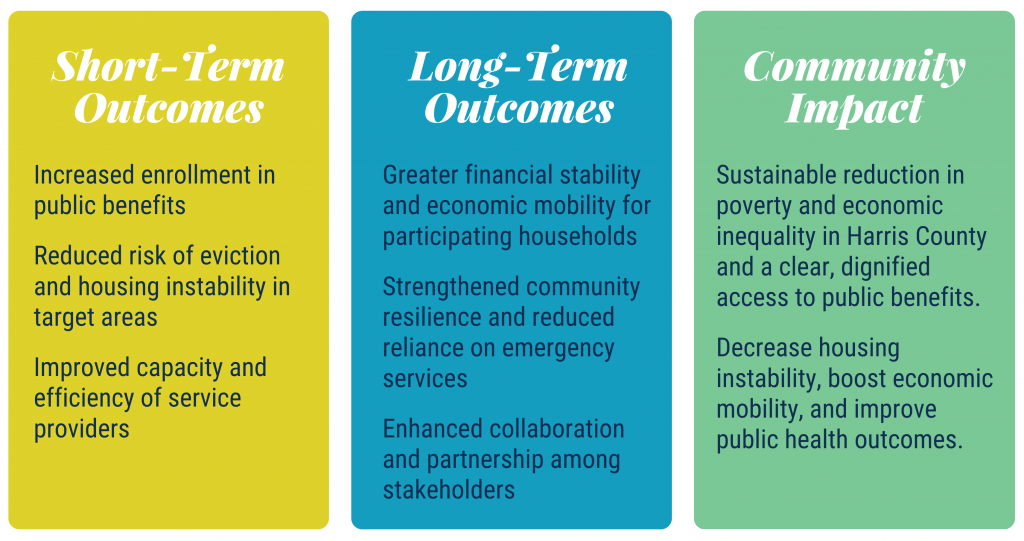
    Expanded access to benefits will provide short- and long-term outcomes to Harris County residents, creating a positive impact on the economic mobility of its residents, and providing systemic change as it relates to the public benefits application process. By 2030, Connective aims to enroll 100,000 new individuals in public benefits, unlocking $225 million each year from the $1 billion in public assistance that goes unclaimed annually in Harris County.

    Although Connective’s solution to the underutilization of public benefits is new to the Houston area, the idea is not a new model and has been successfully implemented in other major cities. Benefits Data Trust (BDT), a Philadelphia-based nonprofit founded in 2005, used three strategies to streamline access to benefits: Data-driven outreach to identify low-income individuals, partnerships with government agencies and nonprofits to streamline access, and new technologies to effectively and efficiently assess eligibility. A 2022 profile found that BDT helped over 1 million households in the seven states it served, accessing more than $7.5 billion in public benefits since its inception. While BDT abruptly ceased operations in 2024 due to financial strain, they paved the way to improving access to public benefits.

    BenePhilly, the first program launched by BDT in partnership with the City of Philadelphia in 2008, is still operational today using the technology developed by BDT. The program consists of a network of government agencies, nonprofits, and community-based organizations that help connect eligible Philadelphia residents with up to 29 different benefits. This is done using data-driven outreach, referrals from a network of organizations, and in-person and telephone application assistance. A 2022 case study of BenePhilly found that as of January 2021, the program helped more than 125,000 Philadelphia residents secure over $1.6 billion in benefits.

    Creating Opportunities for Upward Mobility

    Accessing public benefits has a significant impact on reducing poverty and promoting economic mobility. These benefits provide financial stability, allowing individuals to invest in opportunities, like education, skills training, and stable employment, that enhance their chances of upward mobility. The historic decline in poverty during the COVID-19 pandemic demonstrated their effectiveness in reducing the poverty rates, while the increase after these expanded benefits ended highlights their necessity. Concerns like the “benefits cliff” exist, but policy improvements such as a gradual phase-out and standardizing eligibility can address these issues.

    Through accessing public benefits alone does not create economic mobility, it is one component of a broader strategy needed to break cycles of intergenerational poverty and create economic mobility. Certainly, for the children living in very low-income families, public benefits can reduce hunger, housing instability, and toxic stress that undermines a child’s ability to learn and thrive. Still, long-term answers lie in investing in fundamental building blocks of economic mobility—ensuring access to affordable care and learning environments for children, high-quality education and workforce training, stable employment that pays a living wage, affordable housing in supportive neighborhoods, and accessible health care.
    Support Connective’s Public Benefits Hub and help advance upward mobility for Houston-area residents. Sign up for Connective’s newsletter or donate today—you can make a lasting impact!

    Appendix A: Types of Public Benefits

    The selection process for the High-Impact Grantmaking initiative incorporated a robust multi-level review process designed to ensure maximum fairness, transparency, and comprehensiveness in evaluating all submissions. The outcome of this process reflects the recommendations made by an independent Community Grants Advisory Committee. The recommendations put forth by the Committee were closely reviewed and approved by the Foundation’s Community Impact Committee and its Governing Board.

  • Economic Paradox: Booming Growth, Struggling Families

    Economic Paradox: Booming Growth, Struggling Families

    Houston is often celebrated for its booming economy, which has created numerous opportunities for many residents. With a Gross Domestic Product (GDP) that consistently ranks among the best in the nation and a thriving small business sector, it’s easy to see why many are optimistic about their future here.

    At the same time, over 313,000 Houston-area households live below the poverty line, and an additional 713,000 cannot afford their basic needs despite working full-time. That is nearly half of all households in the Houston region that are financially struggling or in crisis.

    Even more concerning is that while many Houstonians have access to a credit card, a significant portion—about a quarter—use non-traditional pathways to access money, like payday loans or check-cashing establishments. Additionally, many others have subprime credit scores (below 660). These households are the ones most likely to have little to no extra cash, forcing them to rely on credit to cover emergency expenses. For people with subprime credit, accessing credit comes with exceedingly high interest rates making borrowing more expensive. High interest rates make people more likely to fall behind on payments and have debt go into collections, making their ability to secure quality, low interest credit in the future even less likely. This is the cycle of debt that burdens so many of our neighbors and makes it harder to stabilize and experience upward mobility.

    Houston’s economy remains strong

    The Houston region is home to one of the most vibrant economic engines in the country. Metro Houston’s GDP, at $550 billion in 2023, places us seventh highest in the country and accounts for 26% of the GDP for the entire state of Texas.

    Metro Houston’s GDP is roughly the same size as the entire country of Ireland.

    Additionally, job growth in our region, an important measure of economic expansion and the overall strength of the job market, continues to outpace the state and the nation, particularly in Fort Bend and Montgomery counties.

    In 2022, the job market experienced a resurgence, bouncing back from the significant job losses felt during the COVID-19 pandemic in 2020. In Fort Bend County, job growth soared by an impressive 13% in 2022, while Montgomery County saw a healthy increase of 7%, and Harris County added 4% compared to the previous year.

    Between 2021 and 2022, the combined growth across Fort Bend, Harris, and Montgomery counties led to the creation of nearly 130,000 new jobs—historically, the entire nine-county Houston metro area usually gains about 65,000 to 70,000 jobs annually.

    Taking a broader view, looking at the period from 2010 to 2023, it’s clear that the job growth in our local counties has far outpaced national trends. Fort Bend County’s job market expanded by 88%, Montgomery County’s by 77%, and Harris County’s by 21%. In comparison, the national job growth during the same time frame was just 19%. This solid growth underscores the resilience and dynamism of our local economy.

    Small businesses (defined as businesses with fewer than 10 employees) continue to be a driving force behind our strong economy. The number of small businesses grew by 22% in Harris County, 62% in Montgomery County, and 101% in Fort Bend County between 2010 and 2022, far outpacing the nation (12%).

    The growth of jobs and small businesses in Houston continues to outpace the nation.

    Additionally, across the Houston Metro Area, 39% of small businesses are owned solely by people of color compared to 21% across the nation, with Asian Americans, in particular, demonstrating a strong entrepreneurial presence—they own 22% of small businesses in the region but comprise 8% of the population.

    In 2020, small businesses in our region were slightly more likely to be owned by women (25%) compared to the state (23%) and the nation (22%). However, between 2020 and 2021, the percentage of women-owned small businesses in Houston decreased by 8 percentage points to 17% in 2021 from 25% in 2020, suggesting the pandemic had a disproportionate effect on women-owned small businesses.

    Overall, the Houston region continues to have a strong economy and is a place of business opportunity and growth.

    Despite a thriving economy, not everyone benefits

    However, Houston’s vibrant economy masks a stark truth: 44% of households can’t make ends meet, and about half of total income goes to the top 20% of households. In comparison, the bottom 20% holds 3-4% of total income. This highlights a significant opportunity to bridge the gap and support our neighbors facing economic difficulties.

    As of 2023, the poverty rate in Fort Bend and Montgomery counties has consistently been lower than the state and the nation at 9% and 11% respectively. In contrast, the poverty rate in Harris County has consistently been higher at 16%. While the rate of individuals living in poverty has decreased since 2010, the number living in poverty has increased with now more than 900,000 Houstonians living below the poverty line.

    More than 900,000 individuals in the Houston three-county region live below the poverty line.

    While the poverty rate, with its limitations (i.e., outdated formula, does not adjust for regional cost-of-living differences, excludes essential needs like housing and healthcare, excludes non-traditional households, etc.), is not a perfect measure of economic hardship, it remains a useful indicator when considered alongside other metrics. Tracking the poverty rate over time helps us assess whether economic growth is broadly shared or disproportionately benefits some while leaving others behind.

    Due to its limitations, the poverty rate underestimates how much money people actually need to get by today compared to past decades. For reference, in 2024, the poverty threshold was $16,230 for an individual and $32,355 for a family of four. Indicators that take into consideration more realistic costs of living paint a much more troubling picture of how many of our neighbors are really struggling to meet their basic needs.

    The acronym ALICE stands for Asset Limited, Income Constrained, and Employed and represents families that are working but unable to afford basic necessities like housing, food, childcare, health care, and transportation. ALICE income thresholds include a more realistic cost of living than federal poverty thresholds. To put things into perspective, the Texas cost-of-living in 2022 was $26,268 for a single adult and $72,816 for a family of four.

    On top of the 13% of households in the three-county region considered to be living below the poverty threshold, there are an additional 31% of households not considered to be living in poverty but are considered ALICE, higher than the state and national rates of 29%. And while the rates of ALICE households in our region have mostly stagnated over the past decade, the number of ALICE households has increased nearly 50% since 2010. This means that, in our region, there are 313,000 households living in poverty and an additional 713,000 households considered ALICE. In total, that’s over 1 million households—44% of all households—struggle to afford basic necessities and are at risk of increased hardship if an unexpected expense arises.

    1 million households (44%) do not have enough income to cover their basic needs.

    Access to credit can be a lifeline for many

    When emergency expenses such as a sudden medical need, a vehicle breaking down, or lost groceries due to a power outage arise, the ability to access credit can be a lifeline if savings are insufficient. Which is the case for many Houstonians. According to the 2024 Kinder Houston Area Survey, nearly half of residents in Harris County couldn’t come up with $400 to cover an emergency expense. But an analysis by JPMorgan Chase Institute found that 43% of low-income households who could not afford an unexpected $400 emergency would have been able to do so if they had additional access to credit, specifically short-term credit which is often accessed in the form of a credit card.

    In the Houston region, credit card access is widespread with three quarters of residents holding a credit card. This represents a significant increase of nearly 20 percentage points in less than a decade, rising from below state and national averages in 2015 to surpass the Texas average and nearly match the U.S. overall by 2023.

    Three quarters of Houston residents have access to a credit card.

    However, having access to credit does not mean it is quality credit. Being able to access quality credit typically requires having a high credit score. Credit scores range from 300 to 850, with higher scores indicating “better creditworthiness.” A good credit score can help individuals secure better interest rates. Conversely, a low credit score, or subprime credit, can make it not only difficult to obtain credit but can also result in higher interest rates, making borrowing more expensive.

    While the rate of residents with subprime credit (i.e., below 660) in our region has decreased over the years, about a quarter of residents in our region still have a low credit score.

    Across all three counties, the rate of residents with a subprime credit score decreased by 5-6 percentage points between 2015 and 2023. However, Harris County still has nearly 1 in 3 residents with subprime credit, and Fort Bend and Montgomery counties have 1 in 4 residents with subprime credit.

    For every 3 residents in Harris County, 1 has subprime credit.

    This matters because people with low credit scores are more likely to be denied credit cards and loans from traditional banks, leaving them to pursue credit through non-traditional sources (e.g., check-cashing services, pawn shop loans, auto title loans, and paycheck advances/payday loans). While three quarters of our region’s residents have access to credit in the form of a credit card, a quarter of residents are considered unbanked or underbanked. Unbanked individuals are those who rely on those non-traditional sources of credit because they are not in the formal credit economy. Underbanked individuals are those who have a checking or savings account with a bank or credit union but also use alternative financial services to manage their finances.

    While the rate of unbanked households in our region was improving, recently it has begun to tick back up and remains well above the national rate.

    Between 2017 and 2021, the percentage of unbanked households declined across the nation, state, and Houston metro. However, as of 2023, this rate has increased in Houston and across Texas. The Houston metro area’s share of unbanked households is more than twice that of the nation and slightly above Texas.

    So even though additional access to credit could potentially help many in our region combat an unexpected financial emergency, for at least a quarter in our region who have subprime credit and/or are underbanked or unbanked, additional credit access could lead to high interest rates and exploitative repayment plans that can trap users in a cycle of debt. According to Financial Health Network, in 2022, Americans spent $303 billion on interest and fees for everyday financial services. Of that total, $225 billion, or 84%, of that was paid by financially coping and vulnerable households. These households struggle with debt, lack savings, struggle to pay bills, and often rely on high-cost borrowing options.

    Using credit to cover essential needs can lead to unproductive debt and debt in collections

    Having debt is not inherently negative. Debt can be a tool for investing in opportunities that may yield benefits in the future, like buying homes, starting businesses, and paying for high-quality education or in-demand skills training. All of these things have been identified as good investments that can increase one’s economic opportunity and mobility.

    However, unproductive debt is debt incurred to pay for basic needs and living expenses. Because it does not have the same long-term benefits, unproductive debt is riskier for the debt holder and society at large.

    Overreliance and dependence on credit can lead to unmanageable debt, making it harder to pay bills in full and on time. When payments are missed, individuals face penalties and late fees which can lower credit scores and raise interest rates. This could result in borrowers losing assets like cars and homes and/or debt going into collections. Debt goes into collections when the original creditor cannot collect payment on the debt, so they either sell or transfer the debt to a collections agency that tries to recover the money. Consequently, it becomes harder and more expensive to access credit.

    Mounting debt sets into motion a cycle wherein individuals must use their earnings to pay overdue bills and interest, which leaves little funds for current expenses or future savings. Once begun, it is difficult to break out of this cycle of debt.

    The good news is that the percentage of individuals in the Houston region (with credit history) with debt in collections has been in decline since 2017. However, despite improvements, this rate is consistently higher across Texas compared to the nation. As of 2023, the share of people with debt in collections is still 10 percentage points higher in Texas (32%) than in the U.S. (22%). Additionally, Texas—along with Louisiana, South Carolina, and Georgia—has the highest percentage of people with debt in collections in the nation. This finding is even more striking since Texas is the second-most populous state. In Harris County, 34% of residents have debt in collections, the highest level in Houston’s three-county region. About 22% of people in Fort Bend County and 25% in Montgomery County also have debt in collections, which are closer to the national average.

    1 in 3 Harris County residents with credit history have debt in collections.

    Creating a more financially resilient community

    Houston’s strong economy provides the foundation for economic opportunity for residents, but we must identify levers to ensure all can build on that foundation. With over one million financially insecure households, and income growth lagging behind both state and national trends, we face real challenges. This is compounded by a significant portion of our community being unbanked or underbanked, along with a substantial percentage possessing subprime credit scores that contribute to a cycle of debt and financial insecurity.

    An evaluation of two client-centered financial coaching programs, which focus on the goals set by participants, shows limited results, but promising signs of increased savings, on-time bill payments, and a reduction in certain types of debt. A review of other research suggests that the impact of financial coaching is promising but remains inconclusive due to challenges such as inconsistent practices and outcome measures. It is important to note that financial coaching differs from financial education. Financial education focuses on general financial literacy while coaching provides personalized guidance to help individuals achieve their financial goals. It is recommended that financial education should complement, not replace, financial coaching.

    Family Self-Sufficiency (FSS) programs are also making an impact in bolstering the savings of individuals and families. These government-supported initiatives, often run by local housing authorities in partnership with nonprofits, pair residents of public housing with financial coaching, skills training, and supportive services. As participants earn more, the pay increased rent with an amount equivalent to this increase being placed in an escrow savings account. The participants will receive the full balance of this account once they complete the program. A quasi-experimental study of an FSS program found that program participants’ annual household income was 21% higher compared to the comparison group one to three years after enrolling in the program and 23% higher five years after enrollment. Additionally, the research suggests that program participants had less reliance on public assistance programs than the comparison group.

    Alongside access to quality living-wage jobs and a supportive small business ecosystem, strengthening savings, improving credit history, and gaining access to quality credit in the traditional credit economy are crucial steps toward a brighter financial future for Houston’s financially insecure households. Together, these efforts can help individuals and families in our region, enhancing their financial resilience to better withstand setbacks, build long-term stability, and access opportunities for future growth.

  • Fifth Ward Builds a New Library to Fight Illiteracy

    Fifth Ward Builds a New Library to Fight Illiteracy

    I’ve been the Pastor of Olivet Baptist Church, located in the Fifth Ward since 2004. Approximately 10 years ago, our church formed a nonprofit, Olevia Community Development Corporation, to take an active role in our community by developing people, property and resources within the Fifth Ward, a consistently under-resourced minority community since its beginning in 1866.

    “A Silent Crisis”

    In September of 2019, Houston Mayor Sylvester Turner launched the first ever Mayor’s Office for Adult Literacy. Director Federico Salas-Isnardi quickly set about employing a two-year study in partnership with the Barbara Bush Houston Literacy Foundation focusing on adult literacy, known as Houston’s Adult Literacy Blueprint, published in 2021.

    What the study found was a “silent crisis”: 32% of Harris County adults are functionally illiterate, meaning more than one in every three residents do not have the literacy skills they need “to successfully perform their role on the job, in their family, or in society.” The study’s conclusion: Houston needs to act strategically and proactively to address the pervasive, multifaceted, complex nature of low levels of adult literacy.

    Greater Houston’s population of more than 6.2 million is among the most diverse in the country, with a quarter of residents born outside of the U.S. and 145 spoken languages here. In Harris County – there is no racial/ethnic majority – though 44% percent identify as Latino, 19% percent as Black, and 7% as Asian American. Our region’s diversity is a strength — one that brings together different experiences, perspectives, and ideas.

    However, we also have challenges. Consider the finding that Black and Latino adults in Harris County are 3 times more likely than white adults to have low literacy skills,1 and that 94% of adult learners in Harris County are individuals from nondominant groups, with the vast majority (greater than 85%) being Black or Latino.2 This report found that the issues of illiteracy are rooted in underlying social conditions which go unnoticed in our collective consciousness.

    Why illiteracy matters

    The economic disparities in neighborhoods of color in Houston directly relate to overall educational attainment and literacy, by extension. In particular, poverty is closely intertwined with illiteracy. According to one national study, 43% of adults with the lowest literacy skills live in poverty, compared to 4% of those with the highest literacy skills.3


    In Fifth Ward, the median income is $38,000 (less than half the state average), 37% live below the poverty line, and 32% of adults have not completed high school. For comparison, about 17% of adults in Harris County have not completed high school and 15% live in poverty.

    What the study points out — and what we know from living, working, and ministering in the Fifth Ward — is that children of parents without a high school diploma have a much higher likelihood of also not finishing high school, which establishes a recurring pattern, often spanning multiple generations. With more than one million functionally illiterate adults in Harris County, the implications are dire.

    In fact, low literacy rates challenge the well-being and prosperity of families across our region and prevents many adults from reaching their fullest potential in life and the pursuit of the American Dream. When fewer of us do well, that threatens our region’s overall economy and social vitality. The literacy report found that Harris County’s economy could grow by $13 billion if adults with the lowest level of literacy increased their skills just by one level – that translates to a 3.3% increase in GDP. Further, research has shown that adults with low literacy tend to have worse outcomes in health, job opportunities, and economic stability. If low literacy rates in our region continue, we will not have the skilled workforce we need to support tomorrow’s economy, which could negatively impact our region’s growth and prosperity.

    Libraries as one tool in the fight

    Libraries are champions in the fight against illiteracy as they tend to offer a diverse range of approaches for both children and adults, are generally accessible in neighborhoods, and are free to all. One of the many solutions to tackling adult literacy is to fund more robustly community library programming. This literacy programming should include classes in ESL, workforce development and training, financial literacy, health literacy, and digital literacy. As Edward Melton, Director of the Harris Co. Library System, shared with us recently, “You can’t just build a library and believe people will come. You must have literacy programming dedicated to the needs of the immediate community.”

    Recently, we at the Olevia CDC have been working on the development of a library in the Fifth Ward as none exists for the 17,000 people who live in this neighborhood directly adjacent to and northeast of downtown Houston. The City of Houston Library in the Fifth Ward was located next to the Fifth Ward Multi-Service Center, but it received extensive damage from Hurricane Harvey in 2017 and has been closed since.

    This void has left the community without a valuable and needed resource for its citizens both young and seasoned for the past six and a half years. That means the following services are not being provided for Fifth Ward residents: programs and events such as story time for children, book clubs, and author talks. Along with missing traditional library services, neighborhood libraries also offer unique resources such as free access to online learning platforms, free tax preparation for seniors, access to free legal aid, health fairs and screenings, food giveaways, and so much more.

    In addition to providing basic services, the Olevia CDC’s library project is primed to be a destination space for the community and the neighborhood as it will utilize a historic building to create an innovative reading space. We partnered with the University of Houston Gerald Hines College of Architecture and the Design Build Master’s Classes to complete a structure that will fit within an existing unused donated structure.

    While books and literacy are paramount, we also plan to provide e-books via mobile devices, establish a community garden, host indoor and outdoor performances, an onsite coffee shop, spaces to hold community events, such as weddings, birthday parties, author book signings, Houston sport and entertainer celebrity reading literacy nights, corporate sponsored literacy events and much, much more. We intend for literacy and fun to be interconnected and highlight the true benefits of literacy.

    Join the fight

    As the Houston community begins to address this silent literacy crisis, it is clear from the Literacy Blueprint report that investing just $2,200 per year in adult education “can raise an adult learner up two grade levels.” By improving adult literacy rates through education and skills training, a greater number of Houston’s most marginalized, including those in the Fifth Ward, will be able to advance economically, support their families, and play a positive role in our society.

    There are many ways to join the fight against illiteracy in our region. I encourage you to see how you can get involved in your local library system — such as Harris County’s or Houston’s — to read to children or tutor. You can also join the literacy movement or volunteer in some other capacity. To learn more about our efforts in the Fifth Ward, including our efforts to build a new library, please visit us at Olevia Community Development Corporation.

    End Notes

    1 Program for the International Assessment of Adult Competencies (2017)
    2 Houston-Galveston Area Council (2021)
    3 Kirsch, I., et al., Adult Literacy in America: A First Look at the Results of the National Adult Literacy Survey. (Washington, D.C.: Office of Educational Research and Improvement, U.S. Dept. of Education, 2022) 61.

  • A Closer Look at Financial Hardship in the Houston Region

    A Closer Look at Financial Hardship in the Houston Region

    There is more to economic security than living above the poverty line.

    Across Greater Houston, more than a million households struggle to make financial ends meet.  Among those households across Fort Bend, Harris and Montgomery counties, about 306,000 live below the Federal Poverty Level (FPL). However, this common economic measure only describes part of the economic reality in our community. The Asset Limited, Income Constrained, Employed (ALICE) data presents a more accurate picture of the economic reality across our community, especially regarding the number of households that are economically challenged.

    What is ALICE?

    According to the 2023 ALICE report for Texas by United For ALICE, 700,000 households across Fort Bend, Harris and Montgomery counties, or 31%, experienced ALICE in 2021 – they worked hard but couldn’t afford the basic necessities of life. The ALICE Report draws attention to the huge but often hidden segment of our community that is struggling to make ends meet, beyond those living on incomes below the FPL.

    The ALICE data takes into consideration the ALICE Survival Budget, which is a bare-bones, real-world, conservative estimate for what it takes to make ends meet. It includes actual costs, such as housing, utilities, child care, food, transportation, health care, and a low-cost smartphone, and it changes based on the county of residence and size and composition of the household. Noticeably missing from the ALICE Survival Budget is the ability to save for emergencies or a rainy day. Individuals and families experiencing ALICE often feel the stress of living paycheck to paycheck and are one emergency away from financial hardship.

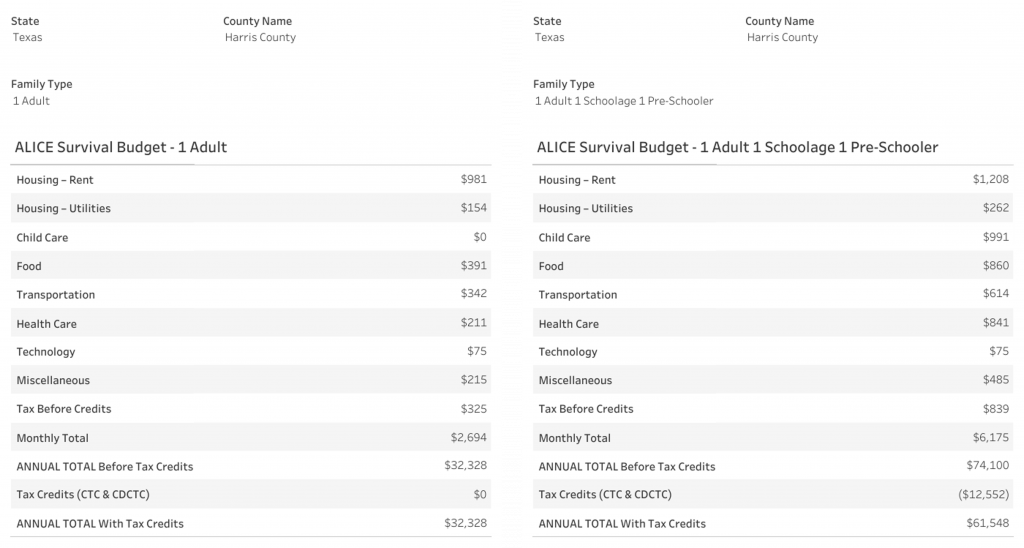
    The ALICE Survival Budget highlights how a single adult in Harris County, for example, needed an annual income of $32,328 to afford the basics in 2021, while a family of three (one adult with one preschooler and one school-aged child) needed $61,548. In contrast, the FPL for a single adult was $14,583 and for a family of three was $24,860 in 2023 – a 121% and 148% difference, respectively. The individuals and families who earn above FPL but still can’t afford everything are often not eligible for assistance programs, public benefits, and other supports.

    Picture source: an itemized budget, along with monthly and annual totals and the hourly wage needed to support the budget based in Harris County.
    Comparison of itemized budgets for one adult versus one adult with a school-aged child plus pre-schooler in Harris County.

    Households experiencing ALICE typically spend more than half of their income on housing and transportation, leaving less money for other essentials. The local cost of rent represents the greatest expense for a family of three in Harris County, averaging $1,208 per month. The same size family in Fort Bend would need $1,574 per month for housing and $1,334 in Montgomery County. The average monthly cost of transportation was $364 for the same size family across all three counties.

    You can use the ALICE Survival Budget calculator to explore the Survival Budget for different household combinations.

    Who is ALICE?

    The ALICE data also reveals disparities and challenges faced by different groups of households in our community. By race and ethnicity, 43% of Black and 45% of Hispanic households were experiencing ALICE across Fort Bend, Harris, and Montgomery counties in 2021, compared to 25% of white households.

    By age of head of household, those with a head of household under 25 years old or over 65 years old had the highest rates of financial hardship, with 40% and 42% experiencing ALICE respectively across the three counties.

    By household composition, single-parent families with children were more likely to experience ALICE than married-parent households or single/cohabiting households without children. Single-female-headed households with children experience ALICE at 35% and single-male headed households with children experience ALICE at 45% across Fort Bend, Harris and Montgomery counties.

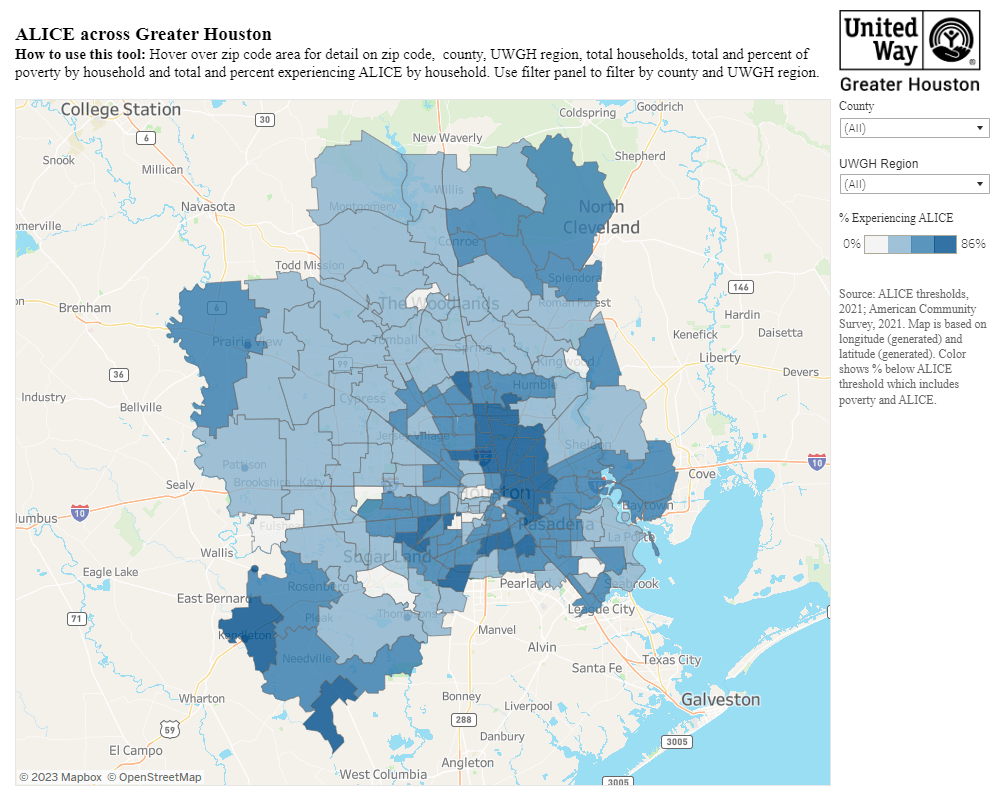
    Screenshot of ALICE 2021 map for Greater Houston

    We see the number of those experiencing ALICE growing across communities. You can dive into the ZIP Code level data for prevalence of those experiencing ALICE and living below the FPL. For example, when reviewing ZIP code level data, 77417 in Fort Bend County has 6,923 households experiencing ALICE, an increase of nearly 5% since 2018. In Montgomery County, zip code 77306 has 2,139 households experiencing ALICE, up 14% from 2018.

    Where we live matters, impacting your financial stability, health, life expectancy, exposure to violence, access to resources, and housing. Yet individuals and families experiencing ALICE — whether they are homeowners or renters —are frequently forced to make difficult choices or sacrifices in other areas of their lives.

    What’s important about being able to look at the ALICE data from this lens is that households of all ages, genders, races, and ethnicities, living in rural, urban, and suburban areas, are impacted by financial hardship.

    ALICE and COVID

    What’s important about being able to look at the ALICE data from this lens is that households of all ages, genders, races, and ethnicities, living in rural, urban, and suburban areas, are impacted by financial hardship. The ALICE data shows that financial hardship is not a temporary or isolated problem, but a persistent and widespread issue that affects households across our community. It also shows that the COVID-19 pandemic exacerbated the situation for many ALICE households. They faced employment shifts, health struggles, and disruption to day-to-day life activities.

    Throughout 2020 and 2021, there were various temporary pandemic supports that provided a much-needed cushion for these struggling households, such as a range of direct assistance programs, including pandemic-specific unemployment insurance, economic impact payments, expanded Child Tax Credit (CTC) and Child and Dependent Care Tax Credit (CDCTC), and emergency rental assistance. The temporary relief mitigated the pandemic’s negative financial impact on ALICE households, avoiding what could have been a deeper economic crisis overall.

    When combining the households that are living below the federal poverty level and experiencing ALICE, over a million households are forced to make difficult choices and risky tradeoffs every day across our area. This requires them to make tough choices, often forgoing basic necessities such as healthy food and health care which is why sufficient incomes matter for everyone.

    How to Use ALICE Data

    The ALICE data also highlights the opportunities and solutions that can help households achieve financial stability and well-being. United Way of Greater Houston is using the ALICE data to guide the Integrated Client Journey, which consists of a network of over 100 funded nonprofit partners that coordinate services to support those that identify as ALICE. The vision is that these organizations work together to help individuals and families to reach financial stability, ensuring that individuals and families in our community have the opportunity to thrive and to prosper.

    We invite other service providers and community stakeholders to explore and use this data to gain a deeper understanding of the realities many of our neighbors are facing and how we as a community can lift up those struggling to make ends meet. To learn more about ALICE data visit https://unitedwayhouston.org/what-we-do/employed-but-in-need/.

  • Is Houston really that affordable?

    Is Houston really that affordable?

    Over the years, the greater Houston region has gained a reputation for affordability. Historically, Greater Houston is the rare major metro in which the cost of living is low and overall opportunity is high, especially relative to its size as the fifth largest metropolitan area and the fourth largest city in the nation. 

    Our region’s affordability is one of the main reasons the Houston population (the nine-county Houston metropolitan area) grew at the fastest rate in the last decade (18.8% between 2010 and 2019) among the 20 most populous metros in the nation. That reputation for affordability may be threatened by the hot real estate market, soaring gas and energy prices, and 40-year high inflation rates, begging the question: is Houston affordable, still?

    Continue reading about Houston’s population growth

    Rising home and transportation costs and the widening affordability gap

    Prices and sales have soared in the Greater Houston housing market, like much of the country, to a level that many experts believe is untenable. According to research from Greater Houston Partnership, the median price of a single-family home in the nine-county Houston Metropolitan Area has increased nearly 45% over the past four years and 14.5% in just the first six months of this year alone. If folks can’t purchase homes, they need to rent, but that option has offered little relief as rent prices are up nearly 20% since 2020, according to the Partnership’s analysis of Apartment Data Services data.

    The median price of a single-family home has increased by nearly 45% over the past four years.

    Harvard’s Joint Center for Housing Studies estimates that some four million renters nationwide were effectively priced out of buying a home due to rising interest rates from April 2021 to April 2022.

    According to the 2022 State of Housing in Harris County and Houston report, the affordability gap for renters in Harris County in 2011 was $35,000. The affordability gap is the difference between what median-income households can afford and the median house price and an indication of how much housing has gone up relative to earnings. Ten years later, the affordability gap for renters has nearly quadrupled to $135,500, with 38% of that growth from 2020 to 2021 alone. According to the report, current homeowners in Harris County do not face an affordability gap — they were able to purchase a home at the median sales price with their median household income. However, homeownership may remain only a dream for would-be-first-time buyers due to increasing costs and the widening affordability gap.

    There is more to housing affordability than how much mortgage or rent you pay. Typically, families would move out to the suburbs for relatively less expensive housing, but, in a region like ours where people have historically commuted into the city, that usually means their transportation costs go up.

    The Location Affordability Index estimates the percentage of a household’s income spent on housing and transportation costs in a given location. According to the latest data from 2017, households in Harris County spent about 27% of their income on housing and an additional 21% on transportation, comprising nearly half of a family’s income. Comparatively, residents of Fort Bend and Montgomery counties spend more of their income on transportation than residents of Harris County.

    In 2017, households in Harris County spent about 27% of their income on housing and an additional 21% on transportation.

    This is due in part to the fact that we commute alone to work in our private vehicles at higher rates than other metro areas and spend more time in traffic. Despite the COVID-19 pandemic, Houstonians spent an average of 49 extra hours in traffic in 2020 — the third worst in the country. These delays cost each of us about $1,100 a year in fuel costs and lost time, according to the 2021 Urban Mobility report from Texas A&M Transportation Institute.

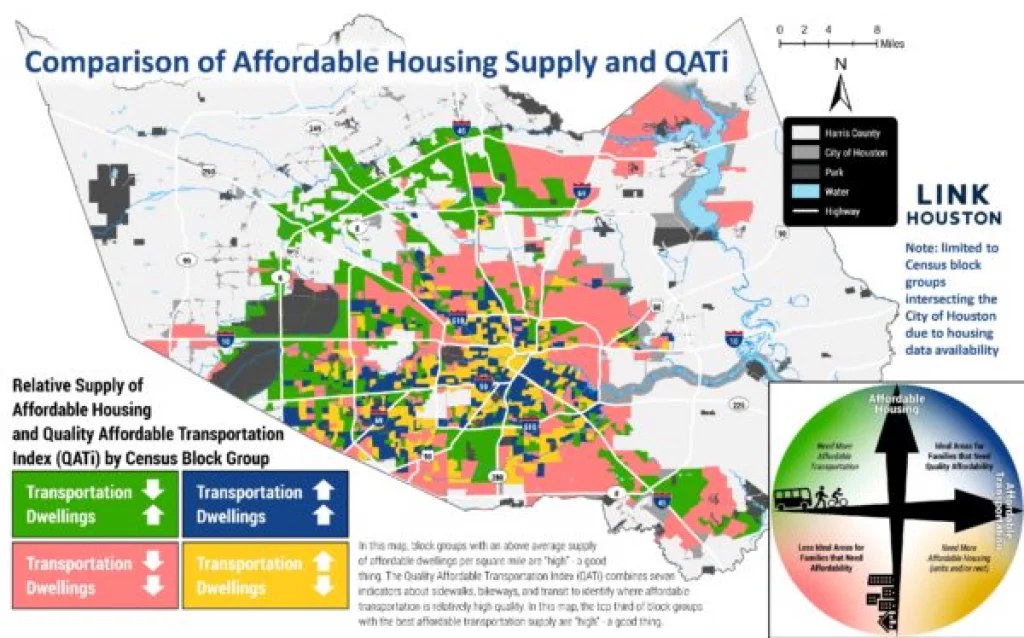
    Ideally, instead of treating them as two independent issues, affordable housing and access to transportation should be aligned. LINK Houston and Rice University’s Kinder Institute for Urban Research developed the Quality Affordable Transportation Index (QATi) to map areas of quality, affordable transportation and housing. LINK Houston’s Where Affordable Housing and Transportation Meet in Houston report found that 44% of rental units in Houston are affordable to moderate-income households (defined as a family of four spending no more than $1,907 per month on housing plus utilities), and only one-third of these rental units are near high-quality, affordable transportation.

    LINK Houston, Affordable Housing and Transportation Data
    Source: LINK Houston, Affordable Housing and Transportation Data

    Disparities in housing affordability

    Of course, the decision to buy a home depends on more than its purchase price. There are additional costs to consider like mortgage terms (including interest rates), insurance and taxes. Part of the reason homeownership remains out of reach for many marginalized communities is because of historic and current discriminatory policies and practices.

    Banks deny home loans from Houston-area Hispanic and Black applicants at about four times the rate of white applicants. In 2020, banks denied home loans to 25% of Black and 23% of Hispanic applicants compared with 8% of white applicants, according to the Kinder Institute’s 2022 State of Housing report.

    Further, among those who were approved for a home loan, Hispanic and Black applicants were given higher interest rates, higher loan-to-value ratios, longer loan terms and were far more likely to be heavily debt-burdened borrowers.

    In 2020, banks denied Houston-area home loans to 25% of Black and 23% of Hispanic applicants compared with 8% of white applicants.

    Despite declining homeownership rates and the challenges they face in the housing market, Hispanic homeowners were the only racial/ethnic group with a growing homeownership rate both in the U.S. and Houston between 2020 and 2021. Hispanic residents will soon become the largest share of homebuyers in the country.

    We observe disparities in the housing market not only in loan denials or predatory mortgages for lower-value properties, but also in foreclosures. According to the Kinder Institute’s 2022 State of Housing report, foreclosures in the three-county area were disproportionately higher in suburban communities of color. Within Harris County, each of the 10 census tracts with the highest foreclosure rates consisted mostly of communities that have been historically underrepresented. The report states that these particularly high foreclosure rates are likely correlated with the unfavorable mortgage terms banks typically offer these communities.

    Continue reading about housing issues such as evictions and homelessness in Houston

    Energy costs in Houston are rising, but remain lower than national averages

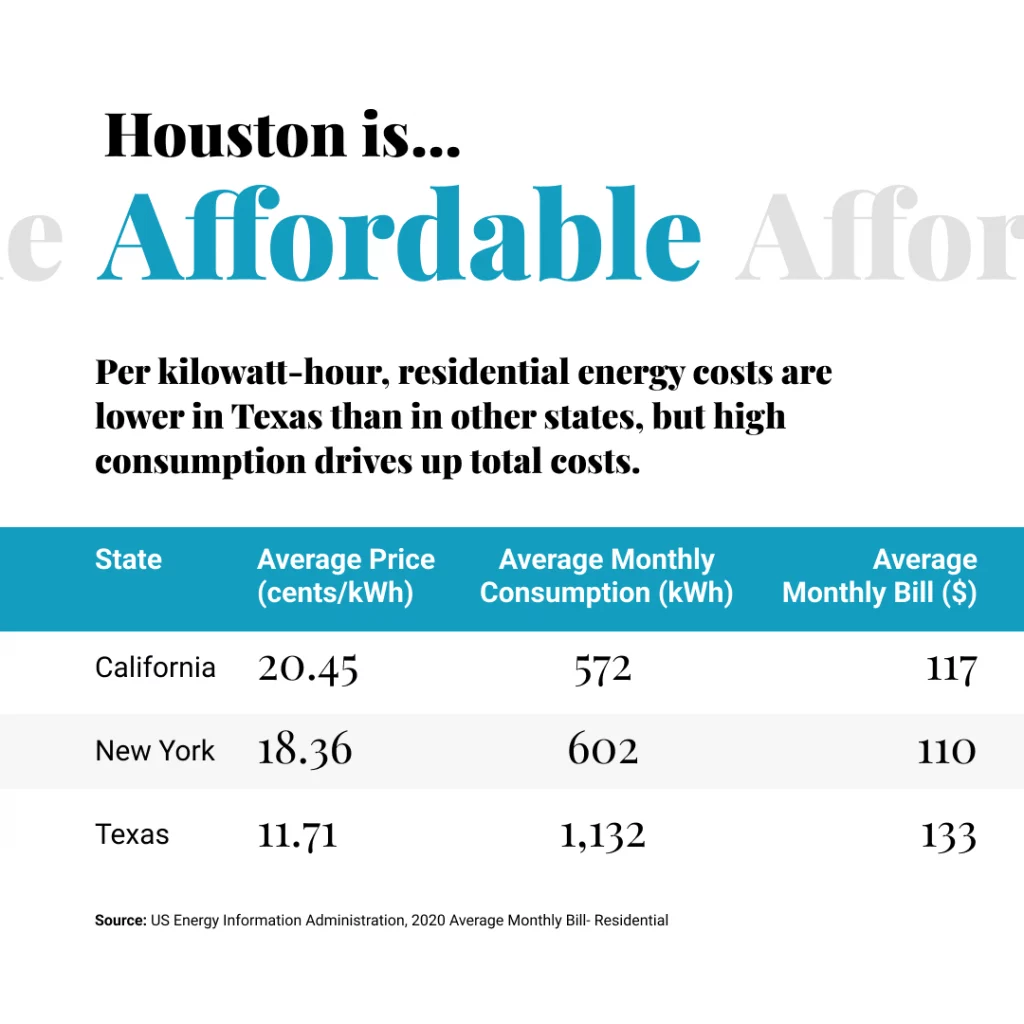
    In Houston, housing costs immediately come to mind when discussing our region’s affordability; the cost of energy likely follows. While Texans pay some of the lowest rates in the country per kilowatt hour for energy, consumption drives electric bills high. 

    Those of us who have experienced the sweltering Houston heat, and surprisingly cold Texas winters, know that most Texans keep their climate control pumping year-round. Average monthly consumption in Texas is consistently among the highest in the country — in 2020, energy bills in Texas were the sixth-highest in the nation, despite paying less per kilowatt hour than 31 other states, according to the U.S. Energy Information Administration.

    In keeping with the reasonable prices for energy in the region, gas prices in Houston are also relatively low — averaging about 7% lower than the national rate over the last decade. In 2021 the average price for retail gas in the country was $2.91 per gallon, compared to $2.66 in Texas, representing an 8% price break. Despite the recent surge in prices, gas in Texas is consistently cheaper than the national average. At its peak this year in June 2022 the average retail price for a gallon of gasoline in Texas was $4.58, 4% lower than the national average, according to the U.S. Energy Information Administration.

    Inflation’s impact on the Houston economy

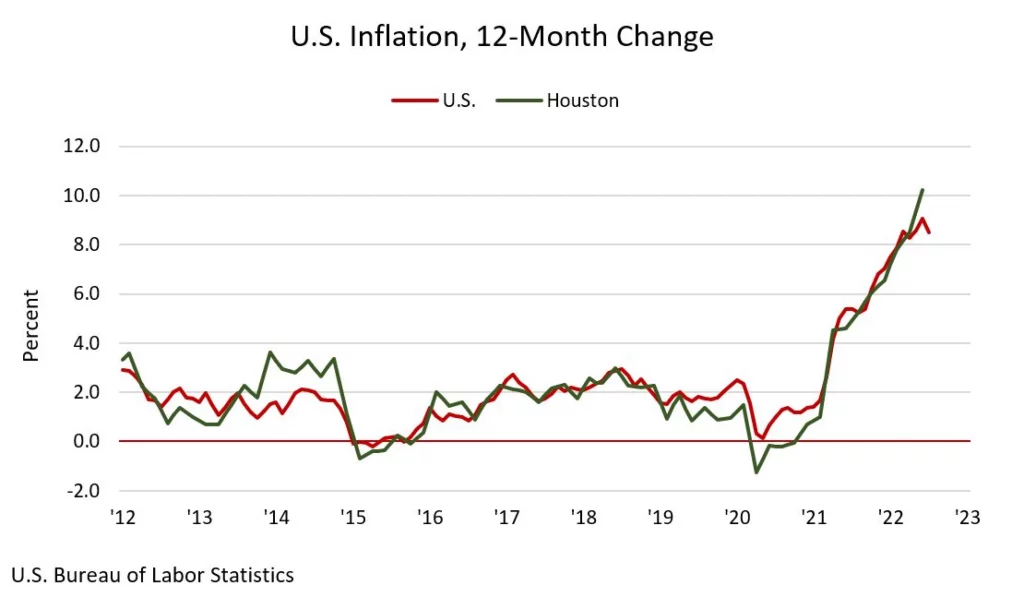
    Inflation is on the mind for many in the country right now, and for good reason. Inflation rates in the U.S. and in Houston are at their highest since December 1981

    Inflation rose to 9.1% nationwide, according to the Consumer Price Index for all Urban Consumers (CPI-U), in the twelve months ending June 2022. But the inflation rate for the Houston Metropolitan Area rose even more during that time, 10.2%. Houston’s higher rate suggests stronger demand and a hotter economy compared to the nation as a whole, according to Greater Houston Partnership analysis.

    Living costs in Houston are 8.3% below the national average, and 36.2% lower than the average of the 20 most populous U.S. metros.

    The most recent report from the U.S. Bureau of Labor Statistics showed only moderate increases in housing costs in the region, suggesting that the true increase in Houston’s housing costs has yet to be fully reflected in the Consumer Price Index, and the real rise in inflation could be higher than what has been reported.

    Retrieved from Greater Houston Partnership, Monthly Update: Inflation, June 2022

    So, is Houston a low cost of living city? Despite inflation increasing at a slightly faster rate than the national average, the cost of living in Houston is still the second-lowest among the 20 most populous metropolitan areas in the United States, according to the Council for Community and Economic Research’s Cost of Living Index from Q1 of 2022. Living costs in Houston are 8.3% below the national average, and 36.2% lower than the average of the 20 most populous U.S. metros.

    Houston’s affordability is being redefined

    As the entire country becomes less affordable, so does Greater Houston. However, even as inflation continues to rise, the region’s cost of living remains relatively low when compared to other major metros and the quality of life Houstonians enjoy, including the arts and cultural amenities of a world-class city. However, historic disparities and recent events have threatened this reputation, and the region will never truly be affordable for all until our region’s prosperity provides opportunity for all.

    Helpful Articles by Understanding Houston:

  • Houston is… Entrepreneurial

    Houston is… Entrepreneurial

    Exploring the factors influencing Houston’s famed entrepreneurial spirit 

    Houston’s business culture is unique — both distinctly global and local, it owes its evolution as much to every hardworking Houstonian as it does to the frontier mentality from which its industry grew. Entrepreneurship is an essential part of what it means to live in Houston, and whether you’re buying new business software or a cup of coffee, Houston small businesses and the entrepreneurs who run them likely play a role in your purchase. 

    Industry is in our history

    Houston owes its existence to brothers John Kirby and Augustus Chapman Allen, two entrepreneurs who saw opportunity in the unrest following the bloody Battle of San Jacinto. They bought their initial spit of 6,600 acres for just $10,000, successfully lobbied the Texas Congress for capital status, and put some ads in the paper claiming glory for Sam Houston and the Republic — all with about a dozen citizens sitting on a muddy bayou in land that wasn’t considered particularly desirable.

    First, they built a railway (that would go on to join the Union Pacific Railroad) and advertised the city as the place “where 17 railroads meet the sea,” despite the fifty miles in between Houston and the Gulf of Mexico. Once the railroad was underway, the city spent the next 50+ years bringing the sea to its borders, dredging Buffalo Bayou and Galveston Bay incrementally to accommodate larger and larger ships.1 They eventually turned that muddy stream into the second largest port in the United States, beginning the project before oil was ever even found in the state.

    Oil did, however, change everything. It made Houston the unofficial capital of the energy industry, combining the maverick spirit of its founders with the industry boom of many in the country chasing down the valuable resource, and contributing significantly to the growth of our region. 

    Houston’s origins tell a story not just of the quality of the human spirit, but of the inherent balance and imbalance of economic opportunity. To continue improving our great city through years of its exponential industrial and population growth, it is necessary to look unceasingly into how our entrepreneurial nature can better serve every single Houstonian.

    In Houston, small business is big

    Houston is certainly a huge, global city, but it just wouldn’t be the same without Mom and Pop.

    Houston is famous for its maverick founders, its tycoons, for the big business and even bigger briskets — but the reality is that business in Houston isn’t always so “big.” 

    Small businesses employed about 14% of our region’s workforce in 2019 — nearly 400,000 people. In addition, 81% of entrepreneurial firms in the Houston Metropolitan Area have fewer than 20 employees. According to estimates from the Greater Houston Partnership, the Metropolitan Area had 663,800 “non-employee businesses” in 2018; these are most often consultants or freelancers — the entrepreneurial spirit exemplified.

    What is the main business in Houston, Texas for small business owners? While real estate is Houston’s number one industry for small businesses, with 95% of firms employing fewer than 20 , industries like retail and administrative services are right on their heels, and smaller companies exist in all sectors (even energy!). These small businesses benefit Houston’s economy in important ways. In particular, creation of small businesses  among communities of color — sometimes a necessity to overcome employment barriers, challenges in building personal wealth, and discrimination — can help increase economic opportunity..

    Continued intentional support of Houston small businesses, especially among communities that disproportionately face challenges like lack of credit access, social capital and accumulation of generational wealth, is what the path toward a healthier and more vibrant local economy looks like.

    81% of Houston-area firms have fewer than 20 employees.

    Source: U.S. Census Bureau, 2020 Annual Business Survey, data year 2019 

    Diversity and disparities in Houston small business

    As well as its reputation for entrepreneurship, Houston is also a city known for its diverse population. Its cultural diversity today mirrors what demographers predict the U.S. population will look like in half a century. Houston’s reputation for entrepreneurship is inextricably linked to the city’s diversity. The growing populations in Houston from diverse backgrounds, namely immigrants and people of color, are not only the economic and cultural driving force for the evolution of our city, but also the future of our country.

    Houston ranks fourth in the nation for start-ups owned by Black, Indigenous, and other people of color (BIPOC), with 35% of start-ups in the Houston Metropolitan Area being BIPOC-owned. While 35% is high enough to outpace most major metros in the United States, it obviously falls short of true representation; the BIPOC population share of Houston Metro is far greater, at about 65%, according to 2020 Census data. Black and female residents remain particularly underrepresented in the small business community, with only 25% of small businesses in the Houston area being solely woman-owned, and only 3% being Black-owned, according to the 2020 Annual Business Survey.

    These trends underline the fact that simply being diverse is not enough, and that disparity will edge out prosperity if not given the proper attention and resources.

    Continue reading about income inequality and diversity in Houston

    Only 35% of new Houston businesses are BIPOC-owned

    By contrast, these residents represent 65% of our region’s population.

    Source: U.S. Census Bureau, 2020 Annual Business Survey, data year 2019 

    A region filled with allies for Houston entrepreneurs

    So, is Houston a good city for business? What kind of resources do Houston entrepreneurs have aside from an industrious culture? Despite common perceptions, the entrepreneurial spirit is not solely an individual cause. Houston’s penchant for entrepreneurship is aided in great part by our philanthropic, academic and nonprofit communities, which work to cultivate and support aspiring business owners from all walks of life. 

    These are just a few of the organizations whose work empowers entrepreneurs throughout Greater Houston. 

    Houston Fund for Social Justice and Economic Equity 

    This new initiative led by Houston Mayor Sylvester Turner and some of Houston’s top community leaders is working to fund and drive strategic progress for Black-owned Houston businesses and nonprofits.

    Impact Hub Houston

    With their Black Marketing Initiative, Impact Hub Houston is raising funds and offering training programs to elevate and support Houston’s Black entrepreneurs as they recover from the effects of the COVID-19 pandemic.

    The Prison Entrepreneurship Program

    The beauty of entrepreneurship is that its benefits are open to all — even those currently behind bars. The people at the Prison Entrepreneurship Program work directly with those currently incarcerated to foster and encourage their entrepreneurial spirits, so that they might find and create new opportunities for themselves and their communities once released. 

    The Wolff Center For Entrepreneurship

    The Wolff Center for Entrepreneurship at UH’s Bauer College of Business has been ranked the number one or two entrepreneurship program in the country, including a number one ranking in 2021 for the third consecutive year. Over the past decade, more than 1,400 businesses have been started by Wolff Center students, earning a collective $399 million in funding.

    Entrepreneurship matters to Houston

    Ensuring that Houston-area entrepreneurs have access to the tools and resources they need in order to thrive is vital to the continued success of our region. By understanding the challenges and barriers current and aspiring entrepreneurs face in Greater Houston, we can better equip our region with the tools it needs to foster an even healthier small business community that positively impacts us all.

    As important as they are to our region’s health and prosperity, Houston’s entrepreneurs are also a reflection of other truths about life in our city. Be sure to follow along on social media and in our newsletter to keep up with the “Houston Is …” series all year long.

    Helpful Articles by Understanding Houston:

    References:

    1Understanding Houston utilizes the U.S. Census term, “Hispanic,” “Latino” or “Hispanic/Latino” when referring to the overall population. For the purposes of this article, we will use these terms interchangeably depending on the nomenclature used in our cited sources.

  • The Great She-cession: How COVID-19 is impacting women in the workforce

    The Great She-cession: How COVID-19 is impacting women in the workforce

    America is facing an unprecedented exodus of women from the workforce. The hard-fought gains women have made over the past 40 years are at risk of being wiped out by the economic crisis caused by the COVID-19 pandemic. As of March 2021, more than 1.8 million women have left the workforce since the pandemic started. While this number is an improvement over the initial 4.2 million women who dropped out of the job market last April, so many women have left the labor force that the current participation rate has fallen to 56.1%, a level not seen since the late 1980s. 

    Compared to men, women initially left the workforce in disproportionately higher numbers and their return to the job market has been slower. The graph below shows that using February 2020 as a baseline for both sexes, women have lagged men in their ability to regain their pre-pandemic employment levels. This disproportionate collapse in women’s labor participation has led some to call this the first “she-session.”

    Like everything related to COVID-19, the effects of the pandemic on working women varied among different groups. On average, women of color experienced greater hardships than all other workers, including white women. Comparing the experiences of Black, Hispanic and white women, Hispanic women had the highest unemployment rate — 20.1% — in April 2020, at the peak of the crisis. However, since then, Black women have found their recovery to be slower than the other groups.

    20.1% unemployment
    At the peak of the pandemic in April 2020, Hispanic women had the highest unemployment rate in the nation.

    Working mothers of young children also have been hit especially hard. As daycares closed and school became virtual, mothers found themselves taking on an even greater share of domestic responsibilities. According to a McKinsey report, 23% of working women with kids under the age of 10 have considered leaving the workforce altogether.

    While there is some evidence that women are beginning to find their way back into the labor force, it is important to realize that, like many other disparities the COVID-19 pandemic has highlighted in our society, it didn’t create this problem. It simply magnified it. The truth is that growth in women’s labor force participation has stalled since the early 2000s. It began to decline after the Great Recession, mimicking trends in men’s participation rate. Interestingly, this phenomenon isn’t replicated in other advanced economies around the world. The proportion of women in the U.S. labor force has declined since 2000 — the only country among five major OECD countries with that trend.

    “23% of working women with kids under the age of 10 have considered leaving the workforce altogether.”

    Societal expectations

    Even before COVID-19, women performed an unequal share of the domestic responsibilities in opposite-sex-headed households, even as the amount of time men spend on housework has increased over the last 50 years. In 2018, 9.6 million females gave family and home responsibilities as their reason for not participating in the labor force, compared to just 1 million men. This is hardly surprising. When families start looking at the high costs of child care and the lower wages of women, it seems to make the most economic sense. But these individual “forgone” conclusions are predicated on structural failures.

    The gender pay gap

    Equal Pay Day for 2021 was March 24. This date symbolizes how much longer a woman would need to work to earn the same amount the average man did in 2020 alone. Meaning, because women earn less, on average, than men, they must work an additional 82 days to earn as much as an average man did in one year. For Black women, that symbolic day would be in August, and not until October for Hispanic women. We see these disparities at both the national and local levels. In 2017, women in Montgomery County made $20,000 less than men and women in Fort Bend County made $15,000 less. Harris County had a smaller but still significant gender pay gap of $7,500.

    According to a study by the National Women’s Law Center, a woman starting her career today stands to lose $406,280 over a 40-year period compared to her male counterpart. This earning gap spans all jobs, no matter what career a woman choses. The same study found the gender wage gap in 98% of occupations. As Megan Rapinoe, the U.S. Women’s Soccer star, said in her testimony on Capitol Hill: “One cannot simply outperform inequality.” It is a truly pervasive problem, but it is hardly a new one. In fact, in 25 years, the gender pay gap has only shrunk 8 cents. At this rate, we can hope to close the gap by 2059. While this isn’t a problem exclusive to the U.S., other countries have made much better progress toward ending it.

    Besides being paid less for the same work, women are also overrepresented in jobs with lower wages. While there are many underlying causes for this, one of the largest contributors is discrimination. According to a report from the Washington Center for Equitable Growth, occupations with more men tend to pay better regardless of skill or education level. These trends are especially more pronounced for women of color. The implication for this being that even working full time, these women face higher rates of poverty. The negative effects extend beyond women and hurt the next generation. According to a study from the Pew Research Center, single mothers are almost twice as likely as single fathers to be living below the poverty line.

    a woman starting her career today stands to lose $406,280 over a 40-year period compared to her male counterpart

    Structural obstacles to increasing women’s workforce participation

    COVID-19 has shown that, for all the advancements women have made in the workforce, the main impediment to gender equality is the structural barriers they face. COVID-19 further loosened the tenuous grip that kept many women in the workforce. 

    We have seen minimal gains in equal pay for equal work in the past quarter-century. The pay gap is a fundamental problem women faced before the pandemic, one they’ll continue to face throughout its duration, and even when it’s over. Research suggests that one of the most effective ways to close the pay gap is to help women achieve entry into the higher-paying, male-dominated fields, as women have an outsized representation in lower-paying jobs.

    Another roadblock for many women is lack of maternity leave. Research finds that mothers offered paid maternity leave were more likely to return to work after the birth of a child both in the short- and long-term. The study found a 20 percent reduction in the number of women who left their jobs in the first year after giving birth and up to a 50 percent reduction after five years. In addition to helping women stay in the workforce, evidence suggests that paid family leave provides myriad benefits to the child, which can have a positive influence on their future. 

    Oftentimes for women, the problem of finding affordable child care becomes almost insurmountable. In Texas, child care often costs more than college tuition, and parents don’t have 18 years to save for it. Even before the pandemic, child care in Texas was facing a tipping point. It is estimated that U.S. businesses lose roughly $4.4 billion a year because of lost productivity due gaps in child care. 

    Change, while not cheap, is necessary. Significant investments that support families will help all women, mothers, fathers, and children live up to their fullest potential and thrive by improving educational outcomes, time for family bonding, and allow both women and parents to “show up” fully in their professional lives.

    “In Texas, child care costs more than college tuition, and parents don’t have 18 years to save for it.”

    Women are integral to our collective prosperity

    Our ability to recover from the current economic crisis depends on women re-entering the workforce. Our ability to find new levels of economic growth depends on women being able to find economic success equal to men. A study often cited by Treasury Secretary Janet Yellen estimates that “increasing the female participation rate to that of men would raise our gross domestic product by five percent.” McKinsey estimates that gender parity would add 19% to GDP by 2025. If we don’t want the economic fallout of COVID-19 to become permanent, we must support women and encourage their return to the workforce. Our collective prosperity depends on it.

  • COVID-19 Recovery and the Ongoing Challenges Facing Houston Entrepreneurs

    COVID-19 Recovery and the Ongoing Challenges Facing Houston Entrepreneurs

    The ongoing COVID-19 pandemic has impacted Houston’s business community so drastically that no company is too big — or too small — to feel its effects. Even the healthiest businesses have found themselves in need of emergency assistance to stave off layoffs or permanent closure as a result of plummeting levels of consumer spending, stay-home orders, and fear of catching and spreading the virus to loved ones. And while programs like the Small Business Administration’s (SBA) Paycheck Protection Program (PPP) have provided valuable assistance to a number of employers, many of Houston’s small business entrepreneurs who most need these funds to survive have been unable to access them — particularly female entrepreneurs and entrepreneurs of color.

    The state of minority and female-owned small businesses in Houston 

    Houston is nationally recognized for its racial/ethnic diversity as people of color make up two-thirds of residents living in Houston’s three most populous counties. This reputation carries over to our small business community. According to a national analysis, Houston ranks first in the United States for minority entrepreneurs, based on criteria such as startup density, rate of new entrepreneurs, percentage of companies owned by minorities, and access to financial resources.


    Despite Houston ranking first in the U.S. for minority entrepreneurs, business owners of color are still underrepresented in the Houston area and face unique challenges.

    About 38% of Houston’s small businesses are minority-owned, higher than the rate for the state. In Fort Bend County, 53% of small businesses are minority-owned.  Woman-owned businesses are underrepresented in our regional economy —  just 29% of small businesses in Houston are women-owned.

    These businesses reflect the entrepreneurial spirit of Houstonians — forging their own economic path with talent and persistence — sometimes as a necessity to overcome employment barriers, challenges in building personal wealth, and discrimination.

    The importance of small businesses and Paycheck Protection Program loans 

    Both in Houston and across the nation, small businesses are vital to the financial and economic health of our communities. About 63% (68,500) of firms in the Houston Metro area are small businesses with fewer than 10 employees, according to the 2018 Annual Business Survey from the Census Bureau. Across the three-county region, 559,000 establishments with no paid employees (representing self-employed entrepreneurs) — generated $28 billion in receipts in 2017, according to the Census Bureau’s Nonemployer Statistics. 

    As a means of helping these businesses weather the economic storm accompanying the COVID-19 pandemic, the federal Paycheck Protection Program (PPP) loan began to deploy $349 billion to provide “small businesses” with up to $10 million in forgivable loans as long as certain requirements are met. The program allowed all businesses — including nonprofits, veterans organizations, tribal businesses, sole proprietorships, self-employed individuals and independent contractors — with 500 or fewer employees to apply.1

    Issues with the Paycheck Protection Program loans

    While the broad eligibility criteria allowed many small businesses to apply for relief, the exceedingly fast process and unclear guidance for borrowers and lenders had a narrowing effect, as businesses with significant capacity and legal/financial expertise were best positioned to apply. Furthermore, the 7(a) loan was quickly administered by banks that were existing SBA-certified lenders, a pool of lenders that has been criticized as having an insufficient track record of providing access to capital to underserved businesses owned by women and people of color.

    In less than 14 days, all PPP funds were exhausted due to high demand, with more than 1.6 million loans processed by about 5,000 lenders.2 It’s estimated that as of April 17, approximately 80% of small businesses that applied for a loan were still waiting for answers the day after the program ran out of funds.  

    Why minority- and woman-owned businesses in Houston are struggling

    Even before COVID-19, many Houston-area small businesses, microbusinesses, and sole proprietorships led by historically marginalized communities and women faced financial challenges at disproportionate levels relative to White small business owners in our region. On average, minority-owned businesses in Houston are denied loans at three times the rate of non-minority-owned firms. The COVID-19 pandemic has only exacerbated these challenges in Houston. Many small businesses owned by minorities historically have lacked access to established accounting infrastructure and banking relationships that would allow them to access substantive capital such as the federal PPP loan. 

    Some issues that prevent small businesses from accessing capital through PPP loans include: 

    • Low employee count: The financial incentives associated with PPP loans encouraged lenders to serve clients with larger loan sizes, meaning larger “small businesses” were more likely to have their requests approved than those with fewer employees. For context, 90% of businesses owned by a woman or minority in Metro Houston have fewer than 100 employees, according to the Annual Survey of Entrepreneurs. In response, some large banks have donated their fees totalling millions of dollars to nonprofit organizations. 
    • Smaller operations: Given that microbusinesses, sole proprietors, and contractors often have very low fixed costs (e.g., payroll, rent, utilities), the PPP loan rules and forgiveness conditions often do not truly apply to many small/micro minority- and/or woman-owned businesses as they are more likely than other groups to not have employees and significant overhead costs.

    Major local efforts in Houston to support small businesses have faced challenges, despite good intentions. For example, a $10 million loan fund in Harris County was depleted in less than 48 hours, with broad eligibility criteria and credit requirements that made it difficult for small/microbusinesses led by people of color to access these funds.

    Understanding Houston’s needs on the long road to recovery

    Small businesses are critical to our region’s economic success. When small/micro-business owners and self-employed entrepreneurs are unable to provide for themselves, their employees and their families, entire communities suffer. And when the safety nets in place are unable to accommodate the needs of the most vulnerable small business owners, the economic inequalities affecting our region will only intensify.

    As our region continues to work toward a long recovery process, thoughtful and direct action on behalf of minority- and woman-owned businesses will be needed to help these valuable institutions survive. Access to the right information is vital to making these important decisions. As we research and work toward a plan for our region, we invite you to explore the data, get involved and use Understanding Houston to learn more about what matters in our communities. 

    End Notes:

    1 Businesses in certain industries can have more than 500 employees if they meet applicable SBA employee-based size standards for those industries.
    2 “The SBA has processed more than 14 years’ worth of loans in less than 14 days,” said U.S. Treasury Secretary Steven T. Mnuchin and SBA Administrator Jovita Carranza in a joint statement.