Month: September 2020

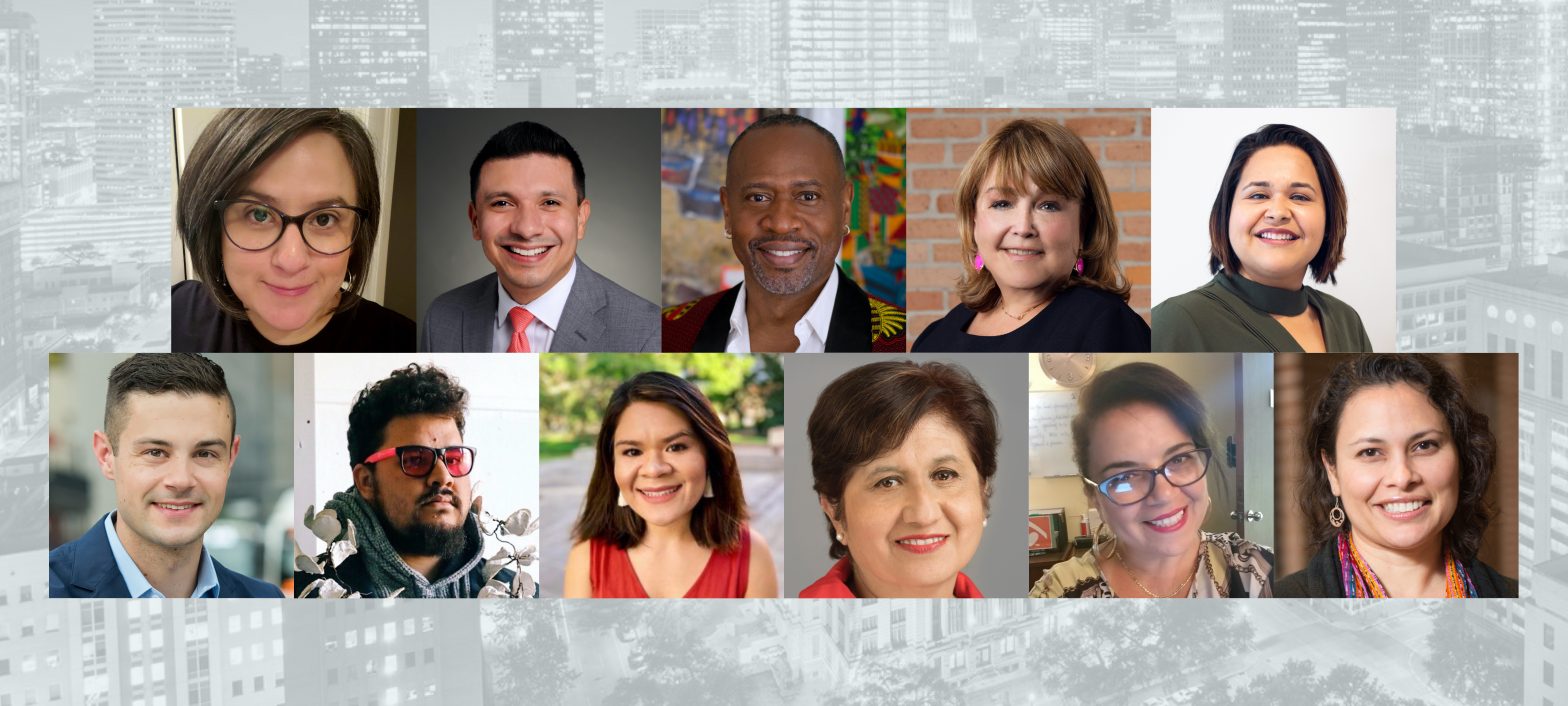
  • Celebrating Houston’s Hispanic Heritage: 11 Latino Community Leaders Making a Difference Today

    Celebrating Houston’s Hispanic Heritage: 11 Latino Community Leaders Making a Difference Today

    Meet Latino community leaders who are forging a brighter path for Houston

    Houston heritage is Hispanic heritage. The remarkable contributions of Houston’s Hispanic community can be felt in nearly every square inch of our sprawling region, forming a trajectory that aligns closely with our region’s future. 

    Within the next ten years, Hispanic/Latino* residents are projected to make up over half of the Greater Houston-area population, and as their presence increases, so too does their impact in our communities. Latino leaders are making vital contributions in nearly every aspect of Houston life — from speaking out for human rights and immigrant protections, to advocating for educational equity, to contributing to our arts and culture, to empowering communities of color through organizing and entrepreneurship.

    When it comes to making Houston a more vibrant, opportunity-rich region, these leaders are blazing new trails. An important note: We recognize that this list is far from exhaustive. If you know of a leader or organization that we should cover, please let us know

    Celesté Arredondo-Peterson

    Campaign Director at Texas Organizing Project – Houston
    Celesté Arredondo-Peterson, Campaign Director at Texas Organizing Project – Houston

    As our region continues to grow, access to quality housing remains an issue for new and established residents alike. More than one-third of Houston’s three-county area population does not live in adequate or affordable housing, and the problem is only getting worse — especially for Houston’s Black and Hispanic residents.

    Fortunately, people like Celesté Arredondo-Peterson and the Housing Justice team at Texas Organizing Project are working tirelessly to ensure that Black and Latino communities have access to the safe housing conditions that can help residents achieve their dreams and reach their fullest potential. 

    “Texas Organizing Project has been organizing with Black and Latino communities in Houston for 10 years. I like to think of community organizers as power paleontologists; it’s our job to unearth the power that exists in our communities…together we can demand the American dream we were sold.”

    For Celesté, these dreams and ambitions are more than just vague notions. She takes the time to hear residents in underserved communities and sees the potential that lies inside each and every one of them. “I spend a lot of time on people’s porches … their living rooms, talking to people about the things they care about. Their hopes and dreams for their families and what they want out of life,” says Celesté of her work in Houston’s Black and Latino neighborhoods. “The people I talk to have often been kicked in the teeth by a hurricane or the criminal legal system… (But) they remain hopeful that things can be different, that people can change and that their community will be there for them — because history has shown that to be true.”

    Moving forward, Celesté and TOP have their sights set toward Washington, D.C. as they continue the fight for better Houston-area housing. “In Houston, we are building a movement of tenants who can demand the kind of housing solutions that our families so desperately need. And on January 20, 2021 we will join a nationwide call to action for our nation’s leaders to do their job and take the necessary steps to ensure the working people of this country aren’t left behind during this economic disaster.”

    Andy Canales

    Executive Director of Greater Houston at Latinos for Education
    Andy Canales, Executive Director of Greater Houston at Latinos for Education 

    Hispanic/Latino students are the future of Houston schools. Today, more than half of Houston-area public school enrollees are Hispanic, and with nearly half of Houston-area children under the age of five being Hispanic, that trend isn’t likely to change any time soon. As such, it’s vital that Houston’s education leaders reflect their student bodies, and that Latinos are in positions of influence in the education sector. 

    As the Executive Director of Greater Houston for Latinos for Education, Andy Canales is dedicated to ensuring that Houston’s world-famous diversity translates into world-leading opportunities for students of all backgrounds. 

    “We, at Latinos for Education, deeply believe that representation matters and that our solutions in education can be even more effective if we incorporate the Latino voice in decision-making,” says Canales of his work in Houston. “We equip more Latino leaders to be at the forefront of education change by training and placing them on boards of education nonprofit organizations and helping those that work inside the education sector to increase their sphere of influence.”

    Since beginning their work in Houston in 2018, Latinos for Education has helped to develop 70 Latino leaders in the education sector, as they aim to establish a stronger infrastructure for Latino voices in Houston-area education programs. But Andy’s ambitions for his work aren’t limited to the Hispanic community. “One of our core values at Latinos for Education is ‘Bridge Across Cultures.’ We see value in knowledge, relationships, and ideas that may be different than our own. We seek to learn, grow, and become more inclusive with others in a multicultural world.”

    Raúl Orlando Edwards

    Founder/Director at FLAMART

    Raúl Orlando Edwards, Founder/Director at FLAMART

    Community access to the arts is about more than just entertainment. The arts inspire community pride, spur economic activity, and can even improve education outcomes. And while Houston may be home to several world-class arts and culture organizations, not everyone is able to participate equally. While 75% of surveyed Hispanic Houstonians say they view the arts as important, only 40% report being able to attend an artistic performance in the last year. Similarly, Hispanics represent a small percentage of artistic professionals across our region’s creative sector.

    It was in this gap between interest and engagement that Raúl Orlando Edwards founded FLAMART (Featuring Latin American Music and ART). FLAMART is dedicated to promoting Latin American voices in the arts through a variety of innovative programming, including dance, music, festivals and more. “I would like to see a city that honors the traditions and histories of its people,” says Edwards of his goals for FLAMART. “Our goal is to exemplify the cultures that make up Houston and find solutions to problems.” 

    “The reason my organization came to be was because we saw that there was an incredible void in the way Latin American arts was being represented in Houston; there was very little recognition of the African part of Latin America and to the indigenous regions there as well. One of the things we noticed was how those groups were represented and so we decided to do something where all of these cultures were represented with the dignity and respect they deserve.”

    Despite the gulf in representation, Raúl has found in Houston a rich tapestry of multicultural exchange, and is inspired by Latino trailblazers like Alice Valdéz and Luz Mouton. Moving forward, Edwards and his fellow artists at FLAMART are working to expand their annual Latin Week Houston event, and hope to continue sharing these experiences in-person as soon as they can.

    Marilu Garza

    Chief Development Officer at The Center for Pursuit
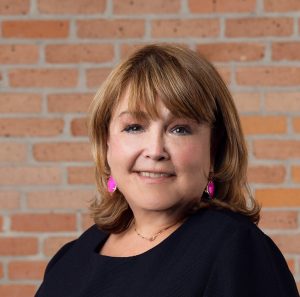
    Marilu Garza, Chief Development Officer at The Center for Pursuit

    We often speak of Houston as a welcoming and inclusive region. Living up to that reputation means respecting the rights and needs of people with disabilities. Just one sign that we have work to do in our education system alone is a 2019 report by the U.S. Department of Education, which found that the Texas Education Agency capped the statewide percentage of students who received special education services in order to control costs. Not only are there challenges, there are opportunities to support adults and children with disabilities on their journey of choice, growth, and independence.

    That is where Marilu Garza and The Center for Pursuit continue to provide support. “With a brand new campus being built in the East End, we will bring together other groups in this area as collaborators who can work together to give these clients a true shot of choice, independence and growth, and serve as a voice for those who have a voice but whose voice is not always heard.”

    “We want to help families continue to navigate through the difficult waters that lie ahead of them as they attempt to find services in the areas of health, education, employment, and living situations for their children,” says Marilu of her work with The Center for Pursuit.

    Marilu had a granddaughter born this year on March 23, and her vision for her and all children and adults in the Houston area is that they continue to live in a city with increasing opportunity for all. She believes that Houston is a place that can continue down this path toward growth and inclusivity.

    “I am always amazed by our resilience. We can be knocked down but rarely are we out. We respond by reaching out to help our neighbors. When COVID-19 became a reality, we made sure that our elderly were taken care of, that our homeless were safe, and that our front-line workers were honored for this service. I, like so many others, remain HOUSTON PROUD!”

    Estella Gonzalez

    Director of Education and Economic Opportunity at BakerRipley
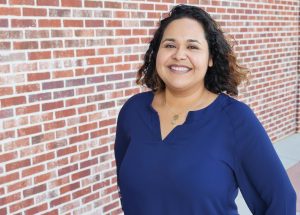
    Estella Gonzalez, Director of Education and Economic Opportunity at BakerRipley

    Houston may struggle with economic inequality, but the Houstonian spirit of giving and the hard work of everyday residents supports our region’s rise above our challenges. It’s this spirit of giving that inspires Estella Gonzalez and her partners at BakerRipley to work tirelessly for a more opportunity-rich Houston. 

    “BakerRipley inspires positive change by truly working side-by-side with community members… We believe that the most important assets in a community are the residents — they are capable and powerful enough to create meaningful change in their neighborhood, we simply give them a safe space to do it in, and support them along the way. Although the organization has been around for longer than a century, it hasn’t changed its mission of bringing resources, education, and connection to emerging neighborhoods.”

    Most recently, Estella spearheaded a social enterprise project in Houston’s Aldine community, helping to develop small businesses in the area through the establishment of a commercial kitchen, a business incubator, and a co-working space. Though the ongoing COVID-19 pandemic requires flexibility in planning for the future, Estella is “…focusing on making sure we continue to provide quality programs that our community needs and that my staff are taking care of themselves at the same time” and remains inspired by her fellow Houstonians.

    “The way Houstonians help each other is inspiring. Ask anyone about what it was like during Hurricane Harvey and you are sure to get stories about homes being destroyed and lives uprooted, but know what else you will hear about? Neighbors helping neighbors. It didn’t matter where you lived, there were Houstonians showing up in Fifth Ward and Kingwood to help clear out homes and just lend a helping hand.”

    James Llamas

    Principal at Traffic Engineers, Inc. and Board Member of LINK Houston
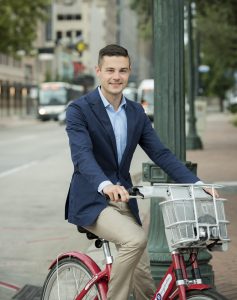
    James Llamas, Principal at Traffic Engineers, Inc. and Board Member of LINK Houston

    It’s no wonder that Houston has developed a reputation as a “car town.” Households in Greater Houston have higher rates of car ownership than the national rate, contributing to an annual congestion-associated cost of $1,490 per vehicle. While some have become complacent, James Llamas and his partners at LINK Houston and Traffic Engineers, Inc. are advocates for safer, equitable and more diverse transportation options for residents throughout the Greater Houston area. 

    As a member of Houston Bike Share and the Midtown Management District Urban Planning Committee, James is inspired by Houston’s spirit of continuous improvement, and is taking an active role in making Houston’s urban areas more walkable, more bike-friendly and less reliant on cars. “I’d contend that more people have the ability to ride a bike than to drive a car. However, not everyone has the skills, desire, or budget to own and maintain their own bike … We offer 1,200 bikes available at 112 stations and counting for people to make short trips around the city. We’re expanding to more neighborhoods all the time with help from partners like Council Member Karla Cisneros and Commissioner Rodney Ellis and have launched a GO Pass program to ensure bike share is affordable to all,” says James of his work with Houston Bike Share.

    In his work with LINK Houston, James is helping to stand up against the controversial I-45 expansion project (NHHIP), which opponents believe will disproportionately impact Houston’s communities of color. “Segregation, wealth disparities, and the persistence of poverty are the results of deliberate policy decisions over many decades. It will take a concerted and sustained effort to undo that legacy, and LINK is taking on this challenge in Houston.”

    Felipe Lopez

    Local Houston Artist
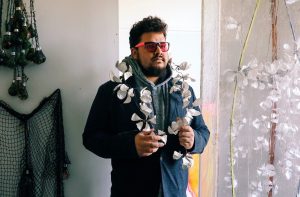
    Felipe Lopez, Local Houston Artist

    Over the past 25 years, the three-county area has seen an increase in the number of arts and cultural organizations. Along with that has come an increase in the diverse perspectives the arts community can utilize to shed light on issues such as health, education, environment, and more, which is exactly what local Houston artist Felipe Lopez has done.

    “My work has progressed within themes of environmentalism with each piece highlighting our relationship to nature, the precious commodity of water, and how we choose to help (or oftentimes neglect) the natural world around us. I hope to inspire change within the arts to look and find more conscious choices to hopefully not just visually inspire people but give them a chance to reflect on our conservation opportunities as well.”

    A few organizations that have inspired Felipe in his artistic endeavors include Fresh Arts, which “allows artists to step out of the studio and meet with colleagues who can give guided perspective and useful knowledge on topics that will reshape a creative’s thinking to propel their career forward in a more focused fashion.” Other inspirational organizations include Art League Houston, which “continues to expand their dedication and cultivation of local talent” and Houston Arts Alliance, where Felipe served on their Disaster Recovery Board and received an Individual Artist Grant in 2019.

    He is currently working with others to reimagine, in the face of this pandemic, “the way business in the art world is completed that favors the livelihood and wealth of ideas from creative individuals and their families.” Felipe will also feature his visual art and set design in a collaboration with Emmanuel Outspoken Bean and Meghan Hendley of Chapel in the Sky through the Houston Artist Commissioning Project he was awarded by the Society for the Performing Arts. Additionally, he has a beautiful array of progressive work in the Texas A&M Corpus Christi Oso Bay Biennial XXI Group Exhibition.

    Dr. Norma Olvera

    Executive Director at BOUNCE and The Latino Health Disparities Lab at UH

    Dr. Norma Olvera, Executive Director at BOUNCE and The Latino Health Disparities Lab at UH

    On average, the three-county Houston area has a higher percentage of food-insecure households than the state or the nation with food insecurity being defined by the U.S. Department of Agriculture (USDA) as a lack of consistent access to adequate food for a healthy life. The Houston area also shows a higher percentage of obesity among Black, Hispanic and low-income adults. The opportunity for all residents to have a healthy lifestyle is essential for a thriving community as gaps in health behaviors such as lack of physical activity, obesity, and food insecurity account for 40% or more of health-related deaths in the United States. Through her Behavior Opportunities United Nutrition Counseling and Exercise (BOUNCE) program, Dr. Norma Olvera is educating community members on ways they can improve their health through physical activity and healthy eating, no matter their environment.

    “Through my work, research, and other activities I’m very much an advocate for health equity and education equity. What that means is that every person has the same opportunity to be healthy and be educated.”

    Dr. Olvera’s BOUNCE program empowers families to make healthy choices through a comprehensive program that promotes a healthy mind and body. “I believe in working to make the families agents of change. I work with schools and parents and teachers as well to some degree but I believe the best way to start a positive change is from the roots by starting with the individuals and families.”

    Through her work, Dr. Olvera, is inspired by Pamela Quiroz, Director of the Center for Mexican American Studies at UH, who “…always has the courage to stand up for what is right for the Hispanic community” and Daisy Morales, Vice President of Community Affairs at Community Health Choice, for “…her ability to have hard conversations when it comes to insurance and health access for the Hispanic community but being able to approach it with finesse.”

    “These two women really go above and beyond and are really committed to improving the community.”

    Angelica Razo

    Texas State Director at Mi Familia Vota
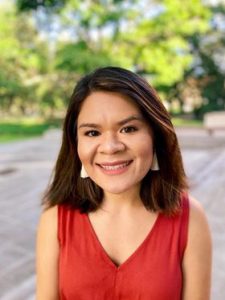
    Angelica Razo, Texas State Director at Mi Familia Vota

    As Hispanic residents form an increasingly large portion of Greater Houston’s population, political participation and representation are and will continue to be of vital importance in ensuring that all residents are given fair opportunities in our communities. Unfortunately, Hispanic candidates remain underrepresented in local offices and elections, and Hispanic residents are registered to vote at a lower rate than other Houston-area ethnic groups.  

    As the Texas State Director at Mi Familia Vota, Angelica Razo is committed to tackling these shortcomings at the root so that Latino Houstonians of all backgrounds and income levels can use the tools of civic engagement to better the world for those around them. 

    “Our organization believes that democracy should be accessible to everyone, and in order to achieve positive change in Houston, community members really need to understand the issues impacting them and then advocate by voting and speaking to their elected officials in order to have ownership to improve their quality of life.”

    Though much work remains to be done to create equitable Latino representation in our political process, Angelica knows that if any region can overcome such barriers, it’s ours. “There is a saying in Spanish, no te rajes (“Do not give up”). It’s a mantra that I see Houstonians live up to and it shows through their hard work ethic, perseverance, dedication, and kindness to their neighbors.”

    Even with the 2020 election coming soon, Angelica and Mi Familia Vota are already looking ahead to 2021 for opportunities to advocate for better environmental justice, immigration, education and healthcare policies.

    Daniana Trigoso-Kukulski

    Executive Director at Fe y Justicia Worker Center
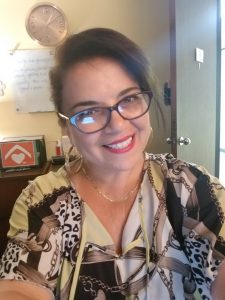
    Daniana Trigoso-Kukulski, Executive Director at Fe y Justicia Worker Center

    Prior to the pandemic, Houston experienced faster job growth and more industrial diversity compared to the nation and state, largely thanks to the contributions made by immigrants who strengthen our labor force and generate demand for goods and services within our local economy.

    Not all Houstonians have prospered — even during boom times — with 40% of working families economically insecure. Some of these individuals are immigrants without a high school education and almost half (49%) of jobs accessible to workers without bachelor’s degrees are considered lower-wage.

    Daniana Trigoso-Kukulski, at the Fe y Justicia Worker Center, remarks that, “The construction and service industries are particularly dependent on immigrant labor today, but other sectors such as domestic workers who have been on the front line in this tragic worldwide pandemic have been forgotten or erased out of the political and economic changes that have happened.”

    Daniana has been working hard with the immigrant community to empower them with information on their rights as workers. “We have assisted with legal and advocacy help, but also provided a safe space where those who are discriminated against and rejected by the working community can receive education and empowerment to address their status.”

    When it comes to Houston, Daniana greatly admires, “…the passion and driving spirit that the immigrant community brings to the economy, in areas that are so crucial to the national wealth such as medicine, construction, oil, and other important industries.”

    But true to the spirit of the Fe y Justicia Worker Center, Daniana knows there’s still more that can be done to improve Houston by “…helping authorities, organizations, and the general community understand what immigrants with drive, luck, talent, and creativity bring to… economic life…”

    Ruth Lopez Turley

    Founder/Director at Houston Education Research Consortium – A Program of The Kinder Institute for Urban Research
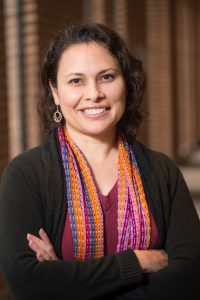
    Ruth Lopez Turley, Founder/Director at Houston Education Research Consortium – A Program of The Kinder Institute for Urban Research

    With Hispanic, Black, and economically-disadvantaged students in the Houston area being less likely to meet or exceed grade-level expectations on third-grade STAAR Reading Exams and eighth-grade STAAR Math Exams, it is likely we need to reexamine whether or not our public education system is distributing resources in an equitable manner.

    As founder and director of the Houston Education Research Consortium (HERC), a program of The Kinder Institute for Urban Research, Ruth Lopez Turley and her team produce research to improve education equity by race, ethnicity, economic status, and English language learner status through a research practice partnership between Rice University and 11 Houston-area school districts. Ruth envisions a Houston where these differences in backgrounds continue to add a positive impact to the culture and diversity of the Houston community and are no longer barriers to educational opportunities.

    The conception of HERC was based on Ruth’s previous interest in and conversations with the UChicago Consortium on School Research. “I was really inspired by the way they were doing education research and their partnership with the Chicago Public Schools and saw that not a lot of academic researchers were doing research in that way in partnership with schools.”

    “I’m interested in producing research that can be directly accessed and used by district leaders. Research is often considered a luxury item as it is expensive to do well, but I want HERC to provide the resource of our research capacity to our community and don’t want it to be just about learning in an academic sense. We are explicitly trying to have an impact on the educational opportunities that students in the Houston area have and are really trying to make sure the research we are producing is informing those efforts.”

    Ruth sees Understanding Houston as a great step in the right direction to start pulling information together in one place and increasing collaboration and comments that, “There is still a lot to pull off but I think the Foundation’s efforts to help us be better coordinated is a great start.”

    Going forward, Ruth would like to think even deeper about what can and should be done in order to make progress towards education equity by addressing the underlying structural barriers within the system.

    *Racial and ethnic labels are by their very nature imperfect, and in many ways evolving. For simplicity here, we use Hispanic and Latino interchangeably in this blog, with most data on Understanding Houston utilizing the U.S. Census term “Hispanic” or Hispanic/Latino.
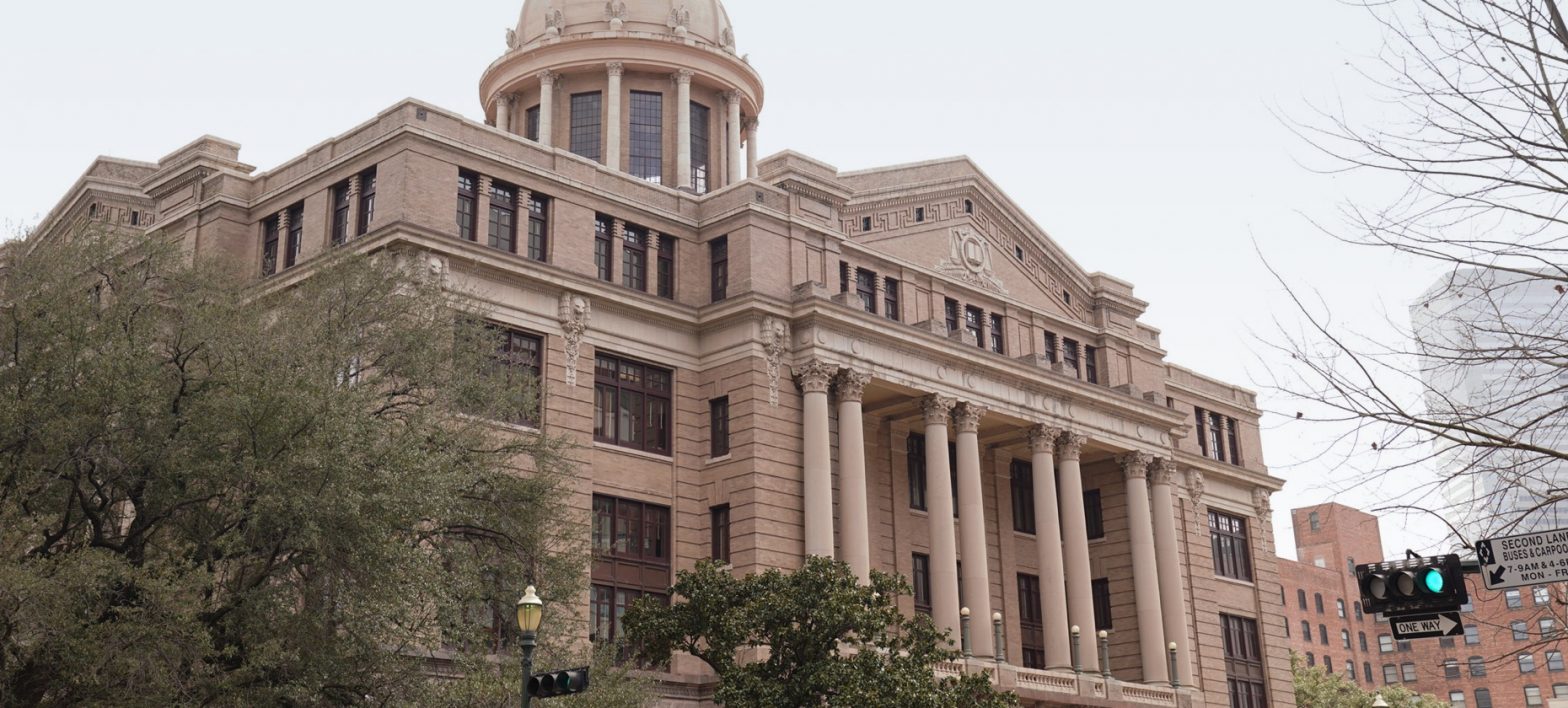
  • Five key insights from our webinar on Criminal Justice

    Five key insights from our webinar on Criminal Justice

    While progress is being made in the criminal justice system, much work remains to be done in removing racial disparities and the life-long consequences of incarceration.

    In partnership with Arnold Ventures, the Greater Houston Community Foundation held a Criminal Justice Reform program on September 24 to educate and engage donors on various aspects of the criminal justice system nationally and locally. The program featured Dr. Howard Henderson, Founding Director, Center for Justice Research at Texas Southern University; Julie James, Director of Criminal Justice, Arnold Ventures; Sebastian Johnson, Advocacy Chief of Staff, Arnold Ventures; and Sybil Sybille, Pure Justice Fellow. We invite you to watch the full conversation here.

    The informative conversation revealed five key insights about criminal justice and how we can improve the system for all.

    1. The criminal justice system is expansive, has grown significantly in recent history, and affects everyone.

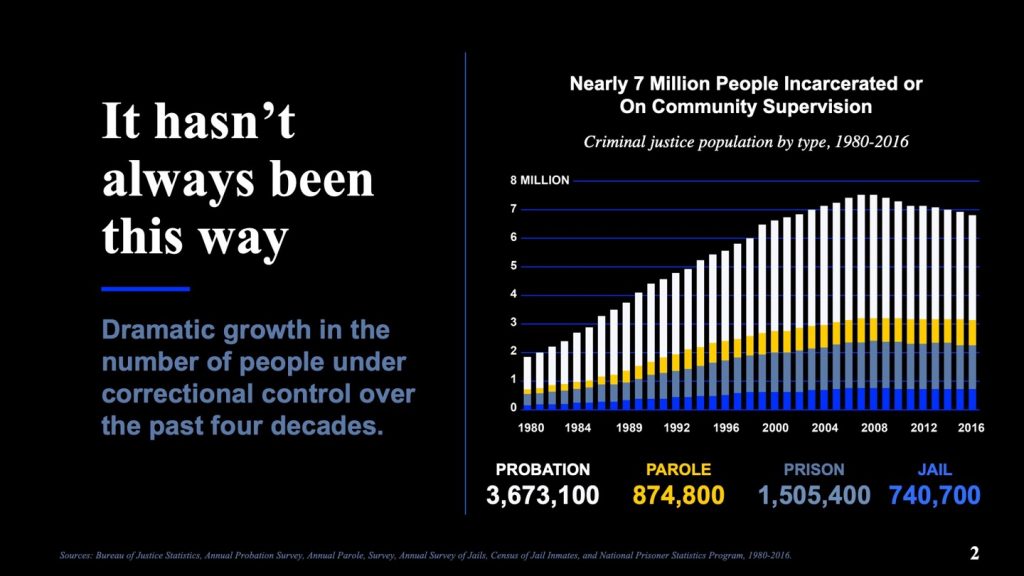
    One out of 37 American adults is currently under control by the criminal justice system (i.e., imprisoned, parole, probation), or nearly seven million people, according to Bureau of Justice Statistics data analyzed by Arnold Ventures. About two-thirds of those are under community supervision (otherwise known as probation or parole) which are “hidden” drivers of mass incarceration.

    “It hasn’t always been this way,” Julie James from Arnold Ventures states. The number of people incarcerated or under community supervision nearly tripled from 1980 to the peak in 2008. “This is historically and internationally unprecedented. The United States has just 4% of the world’s population, yet about 25% of the world’s prisoners are in the U.S.,” James reports. Of course, incarceration is not felt in a vacuum — entire communities and families are disrupted when someone goes to jail, such as the more than 5 million children who have had a parent incarcerated.

    “This [growth in people incarcerated or on community supervision] is historically and internationally unprecedented. The United States has just 4% of the world’s population, yet about 25% of the world’s prisoners are in the U.S.,” Julie James, Arnold Ventures

    Locally, Harris County has the largest number of individuals on probation in the state; and Texas has the largest number in the country, according to Dr. Howard Henderson from the Center for Justice Research at Texas Southern University. “About 70,000 return to Texas from prisons, and one in five returns to the Houston area,” he explains. Harris County Community Supervision and Corrections Department supervises nearly 70,000 individuals throughout the year, the third largest probation department in the United States.

    2. Black Americans, particularly males, are disproportionately impacted by the criminal justice system – and at every level.

    While the criminal justice system affects everyone, some are more likely to feel these impacts than others, more frequently, and to a hasher degree. People of color, particularly Black Americans, are disproportionately impacted at each stage in the criminal justice system: arrest, bail, sentencing, release, and beyond.

    A common myth is that Black and Brown people are arrested at higher rates because they are more likely to commit crimes. Research has established this just isn’t true, Sebastian Johnson with Arnold Ventures notes. What is happening, is that Black people are more likely to be associated with criminality, their communities are over-policed, and there is bias in the system that disadvantages Black people at every stage, including more severe punishments.

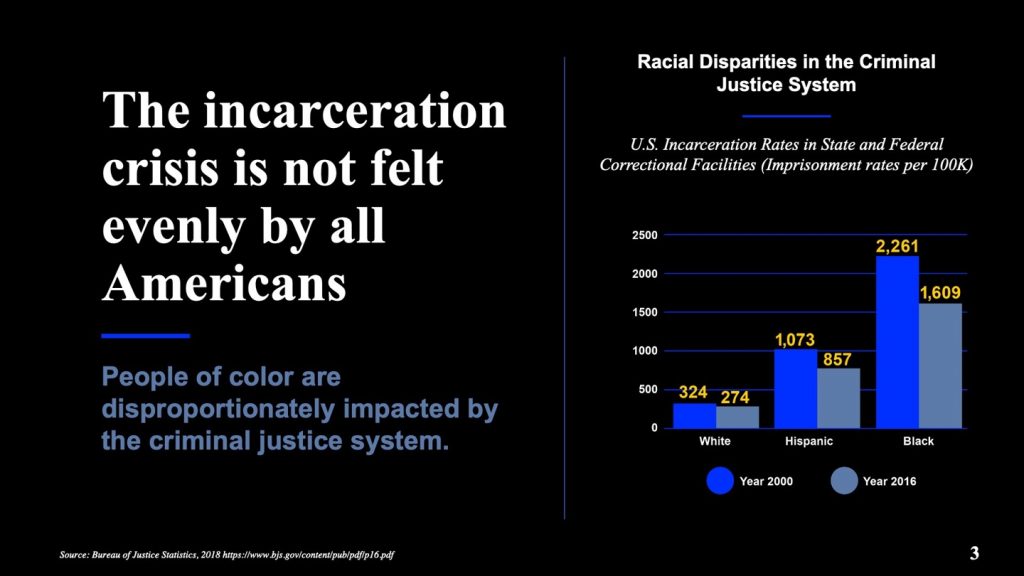
    Nationally, incarceration rates have declined for Whites, Latinos, and Black Americans since 2000, however, Black adults are still incarcerated at nearly six times the rate Whites are incarcerated.

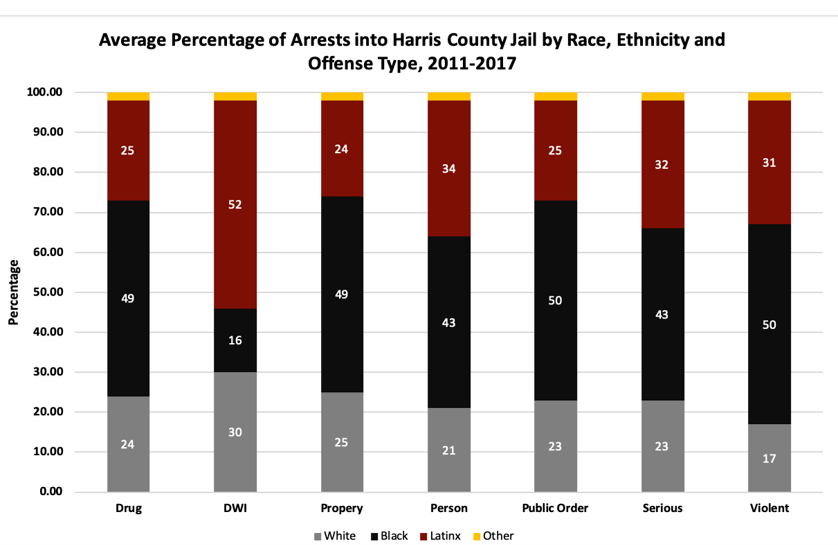
    In Harris County, Blacks are overrepresented in arrests for each type of offense except Driving While Intoxicated (DWI). Despite making up 18.5% of the population, Black residents comprise between 43% and 50% of those arrested on drug, property, person, public order, serious, and violent charges, according to Dr. Henderson’s analysis.

    Source: Harris County Sheriff’s Office

    Consider the following:

    • Black people are four times as likely to be arrested in Harris County than Whites.
    • Blacks and Latinos are more likely to have a firearm discharged at them by a Houston Police officer than at their White counterparts.
    • Black residents represent 50% of all bookings into the Harris County Jail.
    • Half the people currently being held at Harris County Jail are Black.
    • Nearly 80% of the pretrial populations in Harris County Jail are Black or Latino.
    • Nationally, one in 13 adults is convicted of a felony compared to one out of three Black men.

    3. Those within the criminal justice system incur major personal, professional, developmental, and financial costs that don’t end after time served.

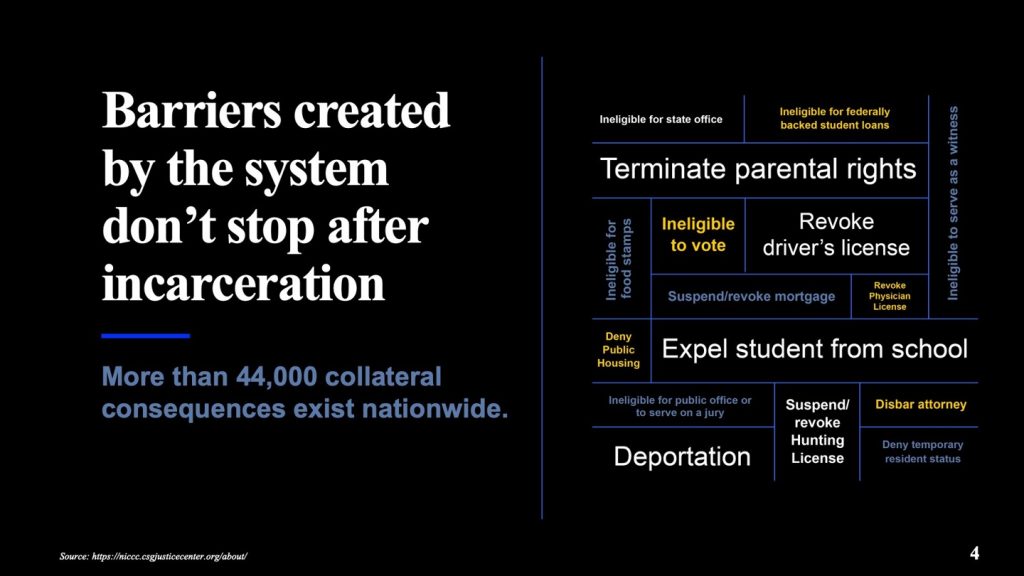
    Costs for the accused, imprisoned, and released are substantial, broad-ranging, and prolonged. They include direct financial costs, opportunity costs, and “collateral consequences” which includes barriers created by the system that don’t stop after incarceration.

    Even limited contact with the criminal justice system can result in fines and fees, which most people can’t afford. Three out of every four people in the Harris County Jail have not been convicted of any crime (held in pretrial). They are there because they could not afford to get out while they wait for trial. Unpaid debt in turn prevents people from getting a driver’s license, voting, getting an occupational license, and more. One study found that on average, families paid about $13,600 in court-related costs.

    The costs do not stop after one has served one’s sentence and been released. The formerly incarcerated face numerous and widespread systemic barriers that exacerbate challenges to re-entry, including the denial of the right to vote even after time served, denial of housing and employment, and ineligibility for federally-backed student loans, to name a few.

    Again, these impacts are borne more by Blacks than other groups. For example, Johnson cited a study which found that white people with a criminal record are still more likely to get a job than a Black person without a criminal record.

    Sybil Sybille, a Veteran and community activist focused on trauma-informed approaches in the criminal justice system, was also formerly incarcerated. She describes her experience this way: “I got out of jail in 1998 and off of parole in 2002, when I could finally vote again. I could not vote for four years even while paying into the system that imprisoned me.”

    In describing her attempts to get housing and employment after her release, she has paid numerous application fees for apartments only to get rejected upon learning she was formerly incarcerated. Sybille doesn’t have many other housing options due to her record and faces challenges securing employment when she is required to check the box on an application that asks if she has ever been convicted of a crime.

    Sybille is currently a Pure Justice Fellow and graduated from the inaugural Smart Justice Speakers Bureau class created by Anthony Graves in collaboration with the ACLU, URRC and Texas Southern University. She is also a member of the Community Working Group of the independent monitor for the ODonnell v. Harris County Consent Decree regarding misdemeanor bail practices. She continues, “It does not matter the accomplishments I’ve made since then…it [the impact of incarceration] does not go away. I’m still being punished. I’m still living a sentence.”

    “It does not matter the accomplishments I’ve made since then…it [the impact of incarceration] does not go away. I’m still being punished. I’m still living a sentence.” – Sybil Sybille

    4. It doesn’t have to be this way.

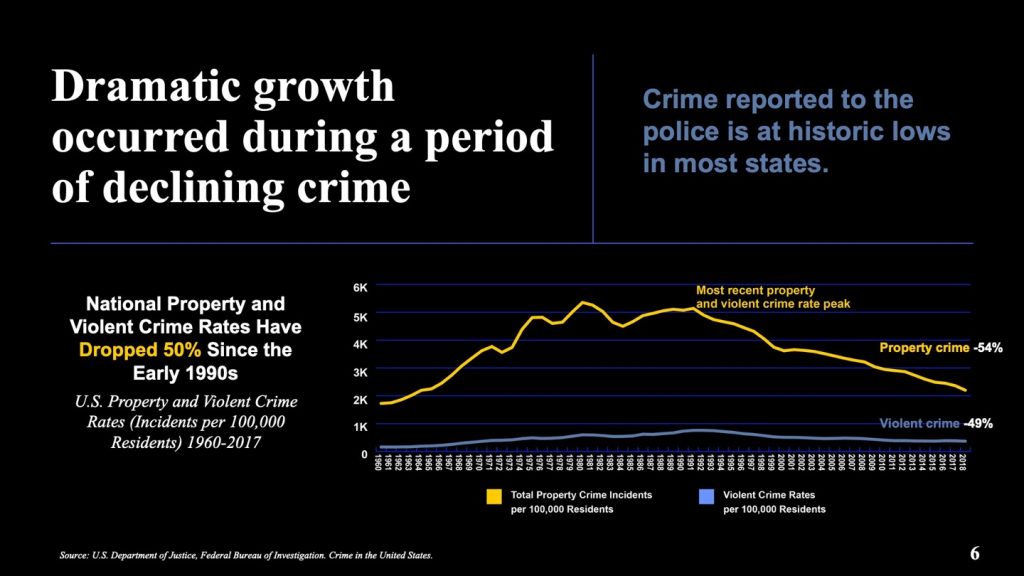
    There are multiple forces at work that keep this unjust system going, but the data suggest that the growth in our criminal justice system cannot be attributed to an increase in crime — national property and violent crime rates have declined by half since the peak in the early 1990s. In fact, imprisonment can advance crime “by destabilizing families and people, and restricting economic opportunity when people get out,” James explains.

    According to data collected from the Bureau of Justice Statistics, the crime rate fell 21% between 2007 and 2016 in 36 states where imprisonment rates also decreased, compared to a 12% decline in crime rate in 12 states that increased imprisonment rates during the same time period.

    Panelists spoke to many reasons we’ve seen explosive growth in the criminal justice system, including bias; a “tough-on-crime” narrative, policies and practices; over-policing, particularly in Black neighborhoods; and the cyclical nature of criminal justice — even serving between one and three days in jail or prison increases one’s likelihood of being arrested for another crime. The lack of resources and support the formerly incarcerated receive compounds systemic obstacles, reducing chances for success.

    But, it doesn’t have to be this way. “Countries that have restructured criminal justice to focus on rehabilitation have enjoyed lower recidivism rates,” Arnold Venture’s Johnson cites. The Center for Justice Research has found that the more resources and access ex-offenders have, the less likely they are to re-offend, which prompted them to develop a dashboard of resources and support services for the formerly incarcerated.

    Sybille uses her lived experiences to advocate for bail reform and trauma-informed training for judicial personnel, and has worked to change policies and laws to advocate for those under the criminal justice system. She believes that we must prioritize rehabilitation and trauma-informed care over incarceration, noting that programs that don’t address mental health challenges will never be a permanent solution. Johnson adds that so-called “diversion programs” should be evaluated so that they aren’t additional pathways into jail and are community-led.

    5. We can make a difference.

    Arnold Ventures estimates that if we continue at the current rate, it will take 72 years to cut the prison population in half. We can do better. “We can have much lower rates of incarceration and keep our communities safe,” Johnson from Arnold Ventures states.

    There is broad bipartisan support for criminal justice reforms, Johnson continues. Here are some things you can do to educate yourself on this issue and advocate for positive change.

    • Funders can support policies and programs that prioritize rehabilitation over incarceration, particularly trauma-informed care. See a list of organizations below.
    • Be part of the conversation, particularly those who are most affected by the system. Dr. Henderson states “what we know about criminal justice is not coming from people who are most impacted by the system,” citing that 81% of faculty in doctoral criminal justice programs are White.
    • Employers can “ban the box” from their employment applications, signaling to those formerly incarcerated that they will be considered holistically as a candidate instead of dismissed outright for one aspect of their history.
    • Get involved. Attend local city council and commissioners court meetings. Sybille emphasized, “Show up. Don’t just sit on the sidelines. Be an active participant. Use your voice along with your money to make something known.”

    Educate yourself. Use resources like ballotready.org and The Appeal: Political Report to learn where elected officials stand on criminal justice issues. You can find recommended reading and a list of organizations working on criminal justice reforms below.

    Resources Recommended by the Panelists

    The Challenge of Criminal Justice by The Square One Project

    Incremental Change Is A Moral Failure by Mychal Denzel Smith, The Atlantic

    We need to talk about an injustice, Ted Talk by Bryan Stevenson

    The Center for Justice Research at Texas Southern University

    Arnold Ventures | Criminal Justice

    Understanding Houston | Criminal Justice

    Additional Resources

    Local Organizations:

    Regional Organizations:

  • Meet Alice Valdez: Musician, educator, advocate, and MECA founder

    Meet Alice Valdez: Musician, educator, advocate, and MECA founder

    Alice Valdez: Musician—Educator—Advocate

    Access to and participation in the arts is a vital part of any community; and in a region as diverse as Houston, the arts play a crucial role in helping us see and understand cultures other than our own. And while Houston may be home to several world-class arts and culture organizations, not everyone in our region is able to participate equally — particularly Black, Latinx and economically disadvantaged residents. Despite 75% of Hispanic/Latino Houstonians saying they believe the arts are important, only 40% reported being able to attend an artistic event within the year of the survey. Fortunately, Alice Valdez and her team at MECA Houston are working to bridge that gap. 

    Alice’s advocacy work started in the 1960s with her initial brush with social justice reform, after her first public encounter with institutional racism. Her high school was selected to join the Texas Orchestra—part of the Texas Music Educators Association (TMEA)—and invited to perform at the annual TMEA conference in Houston. A Black classmate of Alice’s was barred from sharing the same hotel and from eating at the same restaurants as the other students of the Texas Orchestra. Her orchestra teacher gave his students two options: attend the conference without the Black student or protest the TMEA and advocate for the student’s inclusion. Alice and her classmates chose to support their fellow musician and they succeeded in their efforts, allowing all students to attend the conference together. The incident left a lasting impact on Alice and taught her how the arts can bring people together, no matter their social circumstances. Alice went on to graduate with a Bachelor of Music Education degree from the University of Texas at El Paso and earned her certification to teach instrumental music at all grade levels in Texas.

    When Alice moved to Houston in the early 1970s, many inner-city Houston schools did not offer music education; this was a stark contrast to her experience growing up in El Paso, where most schools had band or orchestra programs. After becoming familiar with arts education programs in Houston, Alice quickly realized that inner-city schools of color would only receive funding for arts education if they were part of magnet programs or arts-oriented schools like the High School for the Performing and Visual Arts (HSPVA). Recognizing this gap in art education services inspired and influenced Alice to get involved with community philanthropy at St. Joseph Catholic Church in the Old Sixth Ward.

    To build upon the spirit of the community, Alice founded and organized, along with the Morin, Salinas, and Zermeno families, St. Joseph Fun ‘n Food Fest. Following on the success of the festival, Alice founded an after school arts program, St. Joseph Multi-Ethnic Cultural Arts. She described the incorporation process as “on-the-job training” and marked her first steps into nonprofit management. In 1991, the organization became Multicultural Education and Counseling through the Arts (MECA). The nonprofit remained at St. Joseph for nearly fifteen years, completing several public art projects, like the Resurrected Christ mural inside the parish, until settling in the historic Dow School building in 1993.

    MECA fosters the growth and development of underserved youths and adults through arts and cultural programming, academic assistance, community building, and support services. The organization assists over 4,000 students and their families each year through their social support services, multicultural artistic performances and events, and arts education. The goal of MECA is to cultivate self-esteem, discipline, and cultural pride in their students. One of the unique offerings of MECA is that it is at the intersection of social services and arts education. With Alice’s guidance, MECA has provided participants and families with extensive counseling for alcoholism, drug addiction, and abuse as well as social service referrals. Alice recognized the need for such services early in her teaching career, as she faced many hardships balancing her family life and professional aspirations. MECA’s innovative approach to combine social services and arts education under one nonprofit is not typical for arts organizations, but Alice’s advocacy efforts have impacted thousands of Houstonians over the course of her remarkable career.

    Under Alice’s leadership, MECA has received numerous awards and recognitions, including a Point of Light designation by President George H. W. Bush. Alice is also lauded for her contributions to the visual arts and community parks—namely, initiating the planning and directing the construction of the Old Sixth Ward Art Park in inner-city Houston, and has gone on to direct many major public sculpture and mural projects throughout the Houston area. Alice sees her nonprofit endeavors as a way of giving to her community.

  • Houston’s Pulse: COVID-19’s Impact on Education

    Houston’s Pulse: COVID-19’s Impact on Education

    This time of year is typically filled with back-to-school excitement. Students dust off backpacks, pencils and binders from closets. Families flock to retailers to spend hours wandering around the “Back-to-School” sections, all to make sure students are prepared for their first day and beyond. 

    However, this year feels a little strange. “Back-to-school” has had a completely different meaning, as most school districts across the country start remotely for at least the first few weeks. Texas Education Agency (TEA) officials have granted districts authority to devise their own reopen plans. Houston ISD plans on teaching remotely for at least the first six weeks. Spring ISD is allowing parents to choose whether their child will be in the “safety-first in-person” section or the “empowered learning at-home” section. However, district officials have determined that it is not safe for anyone to come into school until September 11. Humble ISD started in-person classes for 35,000 students on August 24 — one of the first districts in the region to do so.

    In this time of uncertainty, parents and educators around the country are left wondering: will students actually be able to learn remotely this fall? Will virtual school be an effective way for kids to learn, or will they fall behind?

    Thanks to 12 weeks of survey data collected by the U.S. Census Bureau during the initial period of online learning following COVID-19-related school closures, we can analyze how learning disruptions impacted households and track how education changed during the beginning of the pandemic. While we can’t predict the future, we can use data about previous remote learning efforts to identify and understand the challenges that may lie ahead.

    The more we understand these educational changes and their implications, the more we can do to ensure all students in our region continue to learn during the pandemic. 

    Learning “looks” different during a pandemic

    The Trump Administration declared COVID-19 a national emergency in mid-March. Soon thereafter, schools closed for a couple of weeks and then moved to online learning when much of the country shut down. The first week of pulse surveys — as schools were in the middle of their spring semester — indicated 67% of classes were moved to distance learning and 31% of classes were cancelled altogether. While fewer students took summer classes, they continued to experience substantial changes to schedules as the virus continued to spread, and schools remained closed.

    According to Pulse Survey data, 64% of classes taking place in the Houston Metropolitan Statistical Area (MSA)1 during the week of July 9 were moved to a distance learning format. An additional 35% were completely cancelled, higher than the cancellation rate the week of April 23 (31%). These data align with trends in other major metros and the United States as a whole, representing major adjustments students and teachers must make across the nation.

    Education is now a household activity, though only part-time

    In a typical pre-COVID-19 school day, neither child nor parent spent much time at home working on intentional education activities beyond homework. In our new reality, this has changed drastically.

    The graph below compares the amount of time children and parents in Houston spent on education at home during the week of July 9 to other similar regions like Dallas-Ft. Worth Metro (fourth-largest metro in the nation), Greater Los Angeles (second largest school district in the country), Texas, and the U.S.

    Houston-area parents reported spending around four hours teaching their children at home in the past seven days. Similarly, children spent around one hour learning with a teacher and almost four hours learning on their own. This totals nine hours of learning during the week of the survey — less than an hour and a half per weekday. 

    While this is substantially less time than we’d expect for a regular school day, it’s on trend with rates for Texas and the U.S. overall. Notably, parents and students surveyed in Greater Los Angeles spent almost double the amount of time learning than those in Houston.

    These data reflect a snapshot from early July when the majority of students were on summer break, but students in Houston spent an inadequate amount of time on school even when it was officially in session. During the week of April 23 (when learning hours peaked), students studied for 17 hours — approximately three and a half hours per weekday — far below the usual eight hours students spend at school.

    The steady decline in hours dedicated to learning, especially during the academic year, potentially reflects increasingly negative feelings parents and children have toward online classes. A national poll found 42% of parents are concerned that COVID-19 will negatively impact their child’s education. Sitting in the same spot at home staring at a computer screen alone most likely quickly lost its appeal to students and parents. Online schooling leaves kids missing socializing with friends, individualized help from teachers, and designated time to move around or play. As the pandemic wears on, parents and students may be losing patience with the numerous challenges associated with at-home education.

    “42% of parents are concerned that COVID-19 will harm their child’s education.”

    Teachers share this wary sentiment toward online education. A national survey found that 75% of teachers reported their students were less engaged in remote class than in-person class, and an NPR/Ipsos poll found 84% of teachers assert that online learning will create opportunity gaps among students. With such a rapid pivot to a brand-new form of instruction, teachers did not have the opportunity to learn and effectively use virtual teaching platforms. Teachers are feeling overwhelmed, most commonly requesting “strategies to keep students engaged and motivated to learn remotely.” Simultaneously, they also want to ensure safety for their students and themselves.

    Households face significant challenges adapting to online learning

    Pulse Survey data suggest the extent to which education has become a household activity might vary by household income. According to Week 11 (July 9) survey data, Houston households with annual incomes below $50,000 reported spending the most time on educational activities. This pattern was observed in each of the previous 10 weeks as well. 

    While this appears promising, preliminary research indicates that the move to online learning will disproportionately hurt students from low-income homes. The digital divide between low- and high-income households (and schools) is a major contributor to disparities in learning loss. Schools and homes without adequate technological resources face major obstacles to successful online learning.

    Online classes necessitate children have access to a computer (or digital device beyond a smartphone) and internet access at home. This is not guaranteed for all students, of course. Approximately 6% of households in the three-county region don’t own a laptop, tablet, or smartphone, and another 11% have only a smartphone and no other type of computing device — totaling 346,400 households — according to 2018 U.S. Census Bureau estimates.

    Recent Pulse Survey data reinforce these lagging statistics. Households in Greater Houston report less access to computers/laptops than those in Dallas and Los Angeles metros as well as state and national levels. Houstonian are least likely to “always” have a device available and most likely to “never” have a device available for educational purposes compared to these major metros. Given the urban nature of our region, Houstonians’ access to the internet tends to be slightly higher than the rate for the state. Still, 12% of households (245,800) in the three-county region have no internet subscription at all, and additional 13% (274,400) have internet access through a cellular data plan only. 

    “346,400 households in the three-county area have no computing device other than a smartphone.”

    The expansive digital divide in Texas is well-known, and many school districts and nonprofits have worked to bridge the gap. Dallas addressed its students’ lack of access to devices and internet with Operation Connectivity which shares the cost with the state. This operation proved so successful that Governor Abbott launched it throughout Texas with the help of the Texas Education Agency in the beginning of May. However, Houston lags behind, with about a quarter of households reporting receiving a device from the school or district.

    The percentage of students who “never” have access to a device for educational purposes in Houston rose from less than two percent in Week 1 (April 23) to more than seven percent in Week 11 (July 9), suggesting students have less access to devices during the summer, potentially widening learning loss. Meanwhile, in Dallas and Los Angeles metros, the proportion of students without access to a device fell during the same time period.

    Three lessons that support a more successful Fall semester online

    Failing our region’s students is not an option for any of us. That’s why we’ve collected lessons gleaned from the data, established research, and practitioners that will support a successful fall semester for our youth.

    1. Focus on the most vulnerable.

    As we enter a new school year amidst a pandemic, pre-existing challenges are only likely to be exacerbated, particularly for students from low-income Black, or Latino households, with disabilities, or with limited English language skills. An analysis from consulting firm McKinsey found the average student could fall seven months behind at least. Compounding challenges, these students come from the groups who have faced the worst public health outcomes of the virus — it is likely they may have lost someone to the virus. We must support policies and programs that prioritize the most vulnerable students in our region.

    1. Expand access to technology and the internet.

    The region has come together to ensure students have access to the technology they need during this time of remote learning. HISD has established Digital Learning Centers where students without reliable tech access can go, but those who are concerned about the virus may steer clear. Consistent access to reliable, modern technology is critical to learning in general but more acutely now as we are still in the throes of a pandemic. We applaud the substantial efforts districts have made to support all students. 

    1. Support teachers and school staff.

    Even before the pandemic, schools faced significant challenges. One reason schools and districts are struggling to adapt to virtual instruction is they themselves lack adequate resources. Texas spent an average of $9,375 per pupil in the 2017-2018 school year, 23% less than the national average of $12,200. 

    “Texas spent 23% less per pupil than the national average in the 2017-18 school year.”

    Teachers are essential front-line workers, and we must support them as they embark on the substantial and significant mission of educating students in an unprecedented time of simultaneous public health, racial equity, economic, and political crises.

    1 The Houston Metropolitan Statistical Area (MSA) is a geography boundary designated by the Federal Office of Management and Budget that includes the following nine counties: Austin, Brazoria, Chambers, Fort Bend, Galveston, Harris, Liberty, Montgomery, and Waller.

  • The State of Water Quality in Houston: Four Stats Every Resident Should Know

    The State of Water Quality in Houston: Four Stats Every Resident Should Know

    In no uncertain terms, easy and fair access to clean water is an absolute necessity for a prosperous Houston and its residents. And while many dedicated local officials and nonprofit organizations work to maintain the safety and drinkability of Houston’s water supply, some troubling trends require our region’s attention and action in order to keep our water supply healthy for all. 

    Working to protect our region’s water resources will require the awareness, input and action from people across the region — all of which starts with exploring the data. 

    1) Houston’s water supply is decreasing relative to our population growth

    As the greater Houston population grows, so too does our water usage. Though our region’s supply is currently strong, careful use and conservation will be essential to maintaining and extending our resources for future generations. 

    In Fort Bend and Harris Counties, water withdrawals increased between 2010 and 2015.

    In the three-county region’s two most populous counties — Fort Bend and Harris — water supply (also known as “withdrawals,” which refers to water taken from the ground or surface for use in homes, businesses, industries and food production) increased between 2010 and 2015 (most recent data available). Unsurprisingly, Harris County extracted the most water in 2015, withdrawing 287 milligals per day, up 2.5% from 2010. Similarly, withdrawals in Fort Bend County increased by 2.1% over the same time period, while Montgomery County withdrew less water in 2015 than in 2010. 

    The amount of publicly-supplied water per capita decreased between 2010 and 2015.

    Withdrawals supplement water collected from rain which is also used for similar purposes, so while this measure is not a comprehensive indicator of a community’s total water supply, it is an important one, particularly within the context of population. The available water supply relative to the overall population (per capita) decreased in all three counties between 2010 and 2015. The decline in availability was most severe in Harris County, where supply dropped by nearly 15% over the 5-year period. A recent report from Texas Living Waters Project found that water conservation in Houston has worsened recently, primarily as a result of water loss in its distribution system (such as from leaking pipes). More broadly, Texas2036 reports that if Texas were hit with a drought today, the state would be unable to meet one-fourth of its water needs — calling on policymakers to reduce Texas’ water shortage by 40% by 2036. 

    Read more about droughts and climate change in Houston

    2) Levels of drinking water contamination in Houston are (mostly) low

    While we need to continue to monitor our water use, the good news is that our drinking water presents low levels of contamination and is generally safe to drink. 

    Water contamination is typically tracked by measuring levels of coliform bacteria, which indicate the presence of human or animal waste. One commonly recognized coliform bacteria is E. Coli, which is often harmless but can cause serious illness depending on the strain. Water contamination is also determined by the presence of non-coliform bacteria, harmful environmental organisms and inorganic chemicals.

    A 2018 study conducted on Harris County’s water quality — the largest county in the state — found that 150 out of nearly 63,000 water samples contained a presence of coliform bacteria (0.24%). However, the presence of inorganic contaminants was noticeably higher. In the same study, 7.6% of 24,300 non-coliform samples exceeded limits for compounds possibly connected to industrial waste in the region.

    3) Most Houston-area waterways are unsafe for human exposure

    While drinking Houston tap water may be mostly safe, our natural bodies of water are another story. While large bodies of water aren’t usually the first thing people envision when they hear the name Houston, we didn’t get the nickname “The Bayou City” by accident. As home to four major bayous and more than 2,500 miles of waterways, the health of local bodies of water is an important indicator of our region’s larger environmental condition.

    Nearly 900 miles of the region’s water streams, or 60%, are contaminated and unsafe for human consumption/exposure. 

    Harris County has twice as many miles of impaired water streams as unimpaired streams.

    In Harris County, 71%, or 515 miles, of water streams are impaired, as are 52% of Montgomery County’s. While Fort Bend County has more miles of unimpaired streams than impaired streams, 43% of waterways are still unsafe. These ground or surface water streams are largely made unsafe by bacterial contamination, likely created by malfunctioning wastewater treatment plants, overflowing sewers and failing septic systems. Severe storms that cause flooding in Houston can also exacerbate Houston water contamination, particularly in areas prone to flooding.

    4) Less trash is being thrown into our waterways

    What causes water pollution in Houston? While industrial pollution and waste management practices account for much of Greater Houston’s water contamination (found in both waterways and groundwater), trash and litter from individual residents also play a role in the condition of our waterways. Fortunately, recent data suggest that littering and trash dumping in waterways is on the decline in the Houston area.

    Each year, residents across the state join hands to remove waste and debris from our waterways during the annual Trash Bash. In recent years, Trash Bash volunteers have been finding and collecting far less trash than they used to. 

    After peaking in 2001, the amount of trash collected from Houston-area waterways has drastically declined.

    In 2019, Trash Bash volunteers collected 56.5 tons of trash from Houston-area waterways, compared to 107.5 tons collected ten years prior, and 212.5 tons collected in 2001. While the Trash Bash is not a scientific study, the volume of trash collected does paint a picture of the amount of litter contaminating our waterways — and less trash collected can reasonably be interpreted as good news for the greater Houston environment.

    Protecting Houston’s water supply is a job for everyone

    When it comes to water quality in Houston, each of us can take meaningful steps to conserve and protect our region’s water for all residents throughout our region.

    From reducing wasteful consumption to participating in local cleanup efforts and reaching out to your local officials with concerns and suggestions, there are many ways we can make a difference in our community.

    Want to get involved? Check out these nonprofit organizations that do amazing work to protect our region’s water supply and see when and where you can help out:

    To keep up with the latest data on Houston’s water quality, environmental health and more, be sure to follow Understanding Houston on social media, subscribe to our newsletter and hear more from community voices

    Helpful Articles by Understanding Houston: