Author: Understanding Houston

  • Houston is Changing

    Houston is Changing

    “This is the city where the American future is going to be worked out,” Stephen L. Klineberg, Ph.D., said of Houston in 2010. Klineberg, the founding director of Rice University’s Kinder Institute for Urban Research, has been tracking the ways in which Houston has been changing since the 1980s through the Kinder Houston Area Survey. Understanding Houston, like the Kinder Institute, believes that data helps tell our region’s story and provides a barometer with which we can measure how we change over time. Our region is of such consequence not only because of our size and demographics, but also because of strengths like our industrial diversity and the opportunities we have to address our region’s unique vulnerabilities.

    Houston’s population growth, population change

    Greater Houston’s population has changed significantly over the last few decades, a trend that will inform the other ways in which our region will continue to evolve and grow.

    Houston’s three-county region has added over one million residents since 2010, with each county seeing significant population increases. Population growth comes from two sources: natural increase and net migration. Natural increase refers to the number of births minus the number of deaths, and it is relatively predictable. Net migration, both domestic and international, is more affected by external factors, such as cost of living, the regional economy and public policy.

    The U.S. Census Bureau distinguishes between domestic and international migration when calculating net migration. According to Census Bureau data, Harris County, the most populous of Houston’s three-county region, experienced significant negative domestic migration between 2010 and 2020. Approximately 80,000 more people left Harris County to live elsewhere in the U.S. than moved into Harris County from somewhere else in the country over the ten-year period.

    Despite the negative domestic migration, Harris County (and the region overall) continues to grow at a rapid rate. This is due to both the natural increase and high levels of international migration — Harris County gained 289,400 residents from international migration over the ten-year period. The population in Houston hasn’t just grown, however, it has fundamentally changed. 

    More than two-thirds of Houston’s three-county region is now made up of people of color, marking a complete demographic transformation from the region’s racial/ethnic composition just 40 years ago. The largest contribution to this immense shift has been the growth of people who identify as Asian American or Hispanic, who now comprise 47% of the population of Houston’s three-county area, up from 16% in 1980.

    Increasing industrial diversity

    Houston has a reputation for being an energy town. This reputation, while not entirely unearned, is limited in its assessment of the Houston economy. Houston ranks third among U.S. metropolitan areas in number of Fortune 500 headquarters, and received half a billion dollars in venture capital funds for the tech sector in 2019 alone

    The jobs in Houston’s three-county region have also changed. Between 2000 and 2020, the number of people employed in management of companies and enterprises increased five-fold to 43,000 in 2020 from 8,000 only 20 years ago. And jobs in agriculture, forestry, fishing and hunting in our region have fallen 40% to 28,000 in 2020 from 45,600 in 2000, according to the Quarterly Census for Employment and Wages. Perhaps most concerning, manufacturing jobs in the region have also fallen 7% in that same time period. Further, job growth in Texas and the three-county region has outpaced the national rate in all major industries but healthcare and social assistance, though that industry now employs 13% of our region’s workforce compared to 9% in 2000.

    Healthcare and social assistance jobs, however, are more likely to qualify as ‘“opportunity employment.” Opportunity employment refers to the jobs accessible to workers without bachelor’s degrees that pay above the national median wage and reflect the local cost of living. In the Houston metro area, 24% of employment was classified as opportunity employment in 2017, while 27% of jobs required a bachelor’s degree, and 49% of employment was considered lower-wage

    Climate change and environmental progress

    It would be impossible to discuss the region’s evolution over the last few decades without mentioning our relationship with the environment, natural disasters and shifting climate patterns in Houston. The region continues to feel the effects of more frequent and severe storms, which have shaped the region in many ways — some more obvious than others. 

    Although many in the region have grown accustomed to the oppressive Houston heat, Houston is demonstrably hotter than it was a decade ago, according to the National Oceanic and Atmospheric Administration. The 30-year average temperature in our region increased between 0.6 and 1.0 degrees Fahrenheit between 2010 and 2020 — unwelcome news to residents who live in a region that can be dangerously hot. Montgomery County had over 500 days at temperatures above 95 degrees Fahrenheit in the last decade, compared with fewer than 300 days the previous decade. That is almost two-thirds of a year of extra extreme heat over a single decade. 

    The numerous and recent natural disasters our region has experienced have also changed us. (And the National Weather Service.) FEMA has declared a disaster in our region eight times since 2015, and more are likely to come our way given predictions that warmer temperatures will continue to cause stronger hurricanes. But Houstonians by and large know that now; in 2019 53% of Houstonians participating in the Kinder Houston Area Survey reported that the shifting climate patterns is a serious threat, up from 39% in 2010.

    At the same time, we have made major strides in improving our region’s air and water quality. For example, between 2000 and 2020, levels of harmful particulate matter fell 23% in the Houston Metropolitan Area. Texas also produces a larger share (23%, nearly double the national rate) of its energy from renewable resources than the rest of the nation. Living up to its reputation as a city ready to embrace change, the City of Houston announced its Climate Action Plan, aiming to further reduce greenhouse gas emissions and achieve carbon neutrality by 2050.

    Changing perspectives and behaviors

    We’ve seen how the region’s demographics, industry and environment have evolved over the last few decades, but how have Houstonians’ behaviors, opinions and attitudes changed? 

    Resident priorities have changed in the past 10 years in many meaningful ways. Voting in Houston has experienced a surge in popularity, with voter registration rates at an all-time high, in keeping with the country’s increased participation throughout the pandemic and in the 2020 election. Voter turnout increased by almost 10 percentage points in Fort Bend County between the 2016 and 2020 presidential elections and 7.8 points in both Harris and Montgomery counties. Houston voters still lag behind the rest of the country in voter turnout, but the region is making progress.

    The region has also gone through some important ideological changes related to sustainability and urban innovation. Metro’s light-rail service and bus routes have been expanded, and Houston BCycle, a local non-profit bike-share program, has seen rider numbers spike. Houston Parks Board has introduced their Bayou Greenways Plan in an effort to create and connect a navigable greenspace through the system of bayous running through the city.

    Some of the most profound shifts in our region are also some of the least visible. Gradual changes in ideology have also taken place. For example, support for same sex marriage in the Houston area has more than doubled in the last few decades, growing to 64% in 2019 from 31% in 1993, according to the 2020 Kinder Houston Area Survey. 

    The effects of a diverse population may have inspired another change; 71% of U.S.-born non-Hispanic white adults in Harris County are in favor of granting undocumented immigrants a path to legal citizenship if they speak English and have no criminal record, up from 56% in 2010. 

    Despite our challenges, the proportion of Houston-area residents who say the region is a “good” or “excellent” place to live has increased to 76% in 2020 from 59% in 1983, according to data from the Kinder Houston Area Survey.

    Houston’s resilience won’t change

    Change can be unsettling, but it can also represent growth and improvement. As much as our region has already changed, we know more is still to come — some changes we may reasonably predict while others may completely surprise us. And in the face of all this change, we look to one constant aspect of our region: resiliency. Whatever may come our way, we know that armed with the right information and resources, community leaders and residents alike can help Houston thrive through whatever may come next.

    Helpful Articles by Understanding Houston:
  • Examining Houston’s Reputation as a Car City

    Examining Houston’s Reputation as a Car City

    A data-driven look at personal vehicle use in Greater Houston

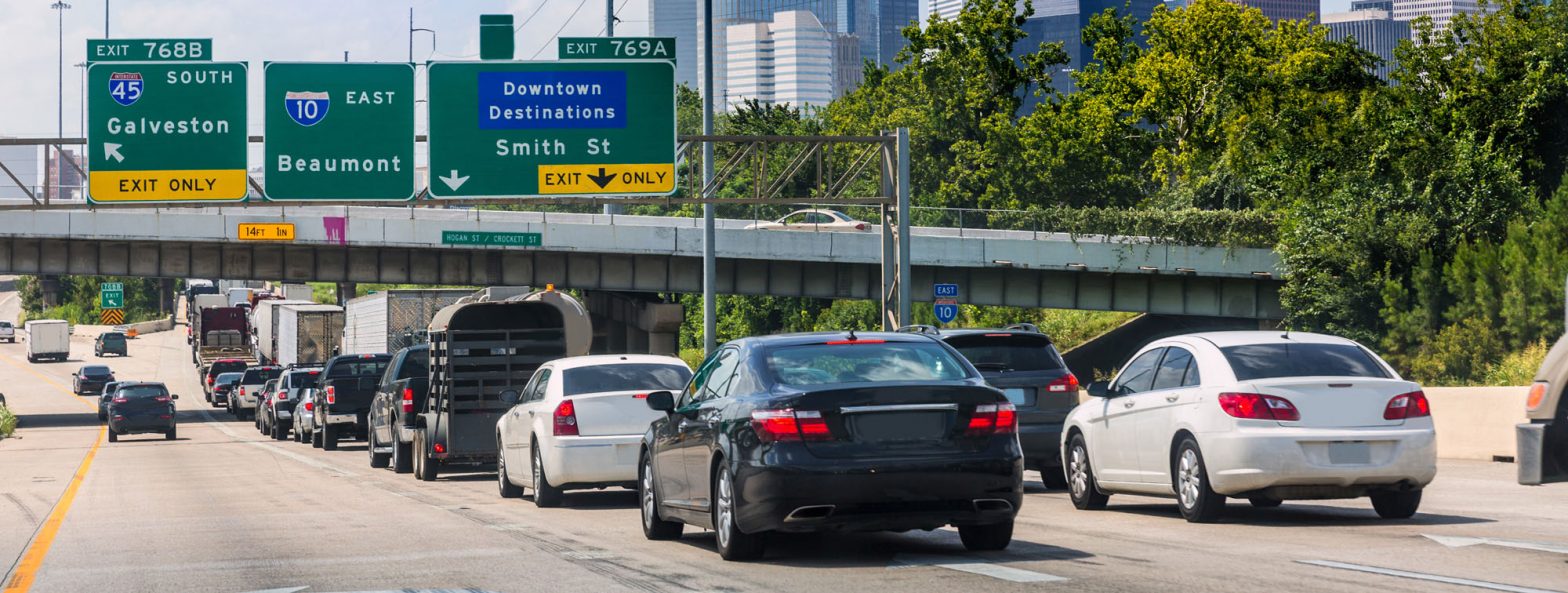
    You’ve probably heard it from visiting relatives who just can’t seem to wrap their heads around how big the city is, asking “is this still Houston?” on the twenty-minute drive to your favorite dinner spot. Houston’s size contributes to its character, but it also makes owning and driving a car a fact of life for most residents.

    Do you need a car in Houston? It depends on who you ask and where you live. Historically speaking, Houston is similar to most U.S cities developed post World War II. As people’s ability to make and save money grew, so too did demand for things like spacious homes and personal vehicles, the latter made affordable by the innovations of the Ford assembly line. 

    But why is Houston so car-dependent today? The sheer amount of ground to cover is certainly a contributing factor to Houston’s car-centrism, but more philosophical barriers, like Texans’ fierce attitude toward independence, contribute as well. Cars offer freedom and flexibility, all while contributing to personal style and status.

    That said, Houston’s reputation as a car city, while grounded both culturally and statistically, is not immutable. In fact, 58.8% of Houstonians believe that a much-improved mass transit system is vital to the success of the city, according to the 2020 Kinder Houston Area Survey, despite the fact that 80% of Houstonians drive to work alone in a personal vehicle (2019 American Community Survey). However, research has shown that people often choose to commute by car, even when other travel modes like public transportation, walking or biking might save them time and money, making any major shifts in how people choose to get around a foreseeable challenge. 

    The cost of Houston’s car dependency

    Average commute times in Houston

    How bad is Houston traffic? It may not surprise you to hear that average commute times in Houston’s three county region are higher than the national average, or that they’re generally getting worse. Houston ranks #3 of 15 large metros for worst commuter congestion, and #4 for worst commercial truck congestion. Motorists spent an average of 49 hours stuck in Houston traffic in 2020, averaging out to $1,097 in fuel and lost time.

    According to census data, Houstonians spend an hour a day getting to and from work, which is higher than both the state and national average, according to Census data. This is all despite 80% of the population in Houston choosing the supposed convenience of driving alone in a personal vehicle. More cars on the road means more traffic. It also means more accidents, which also means more traffic. While the pandemic may have given commuters and the environment a short reprieve from congestion and pollution, both accident and roadway fatality reports show that the sojourn is over; from January to September of 2021 Texas roadways saw a 15% jump in crash frequency.

    As normalcy ebbs its way back into our lives and our roadways, so do the safety concerns, environmental concerns, and tedium that come with all those people just trying to get somewhere.

    Pollution

    Ozone pollution in Houston has abated over the last twenty years, with fewer days in which ozone poses a measurable threat to our residents. Days still exist in which just walking around in urban areas would pose significant risks to your health, often in the dead heat of summer. Despite a national decline, ozone pollution is still very much a threat in Houston, due in part to the number of cars on the road. About 60% of Houston’s ozone pollution is estimated to result from vehicle exhaust alone.

    Particle pollution (or PM) are small solid and liquid particles, like soot, released into the air by a variety of industrial processes, that reduce visibility and cause haze. Of particular concern are PM2.5 particles less than 2.5 micrometers in diameter that are easily inhaled. In 2019 the EPA determined that short or long-term exposure to PM2.5 can lead to cardiovascular disease, respiratory disease, and even early death. PM2.5 levels in Metropolitan Houston (10.1 µg/m3) are about as far below national limits (12 µg/m3) as they are above the national average (8 µg/m3). 

    National standards for acceptable levels of both ozone and particle pollution have seen consistent reductions over the years as we develop a better understanding of the danger posed by these environmental hazards. Because of this, Houston is now within acceptable limits on both ozone and PM, but has lagged behind the national pace of reduction in both categories. The air quality in Houston is still of great concern, as the American Lung Association State of the Air Report rates the air in Harris and Montgomery counties an “F,” and the PM2.5 numbers could fall on the wrong side of the new national limit upon the EPA’s imminent reexamination.

    So if we’re doing better, and Houston falls within most national guidelines, why is this important? Because pollution doesn’t affect everyone in the same way — some neighborhoods face higher threats than others, and Black and Hispanic residents most acutely suffer the effects of pollution though they produce less of it.

    Continue reading about Houston’s climate at UnderstandingHouston.org

    Houston’s car-centric infrastructure

    Given the consequences of high solo-commuting rates, why don’t more residents elect to ride Houston’s public transportation? Is Houston walkable? Bikeable?

    Simply put, most of the region is just not very walkable. According to the National Walkability Index provided by the EPA, most neighborhoods in all three counties have below-average walkability. This car-centric infrastructure is due in part to the sprawling geography of Houston, but also has a lot to do with the cultural prioritization of cars over pedestrians. Houstonians want walkable urban spaces, but the cultural and infrastructural barriers are high and made of poured concrete.

    Cyclists face similar issues in that the city is built to serve motorists. Biking carries the same (if not more) health and environmental benefits as walking. Houston can be a delightful place to bike after all; the city has committed to the creation of 1,800 miles of bike lanes by 2027 through its Bike Plan. Although 345 of those miles currently exist, only 25 miles are protected (just over 7%), a fact that underscores why many might be reluctant to pick up the hobby.

    However, cycling is not always a hobby. Many bike commuters choose to cycle not out of respect for its social or cardiovascular benefits, but out of necessity; your average bicycle costs a lot less than a car. And due to Houston’s car-centric streets, bicyclists often endanger themselves getting around, with Harris County drivers striking cyclists 557 times in 2021, killing 23 riders. 

    What about Houston’s public transportation? Why is it that Houstonians choose public transit at half of the national rate?

    Although national rates for commuters choosing public transportation have gone up since 2010, rates in Houston, and Texas at large, have actually gone down. Part of the problem is the availability of stops in general. Only 5% of households in Fort Bend and Montgomery counties are located within a quarter-mile of a public transit stop, while Harris County sits at 38%.

    Low-income populations use public transit far more often than others, a finding consistent with national trends. In 2017, more than twice as many Harris County residents in poverty used public transportation as those who live above the poverty line.

    These individuals would benefit from more bus and train stops as first steps, in addition to basic amenities (such as benches or roofs), extended service hours, and expanded routes to fully access the vibrant culture, prosperity and opportunity Greater Houston has to offer.

    The road ahead

    Steps have been taken to make our region less car-reliant and safer for those who do choose to ride bicycles or public transportation when traversing the region. Where there once were no protected bike lanes in the city of Houston, there are now 345 miles of high-comfort bike lanes, with plans for 1,800 more miles currently in progress. Additionally, programs like Houston BCycle are making it easier for residents of all means and backgrounds to choose bikes over cars when traveling within urban areas.

    Houston-area cyclists aren’t the only ones enjoying improvements to our transportation infrastructure; thanks to people like Janis Scott and the team at LINK Houston, safe and comfortable public transit options are reaching more parts of our region than ever before.

    When armed with the right information, we believe our region can continue to take the steps necessary for a less congested, more free-moving Houston that’s safe and accessible for all.

    Helpful Articles by Understanding Houston:

  • Houston is… Entrepreneurial

    Houston is… Entrepreneurial

    Exploring the factors influencing Houston’s famed entrepreneurial spirit 

    Houston’s business culture is unique — both distinctly global and local, it owes its evolution as much to every hardworking Houstonian as it does to the frontier mentality from which its industry grew. Entrepreneurship is an essential part of what it means to live in Houston, and whether you’re buying new business software or a cup of coffee, Houston small businesses and the entrepreneurs who run them likely play a role in your purchase. 

    Industry is in our history

    Houston owes its existence to brothers John Kirby and Augustus Chapman Allen, two entrepreneurs who saw opportunity in the unrest following the bloody Battle of San Jacinto. They bought their initial spit of 6,600 acres for just $10,000, successfully lobbied the Texas Congress for capital status, and put some ads in the paper claiming glory for Sam Houston and the Republic — all with about a dozen citizens sitting on a muddy bayou in land that wasn’t considered particularly desirable.

    First, they built a railway (that would go on to join the Union Pacific Railroad) and advertised the city as the place “where 17 railroads meet the sea,” despite the fifty miles in between Houston and the Gulf of Mexico. Once the railroad was underway, the city spent the next 50+ years bringing the sea to its borders, dredging Buffalo Bayou and Galveston Bay incrementally to accommodate larger and larger ships.1 They eventually turned that muddy stream into the second largest port in the United States, beginning the project before oil was ever even found in the state.

    Oil did, however, change everything. It made Houston the unofficial capital of the energy industry, combining the maverick spirit of its founders with the industry boom of many in the country chasing down the valuable resource, and contributing significantly to the growth of our region. 

    Houston’s origins tell a story not just of the quality of the human spirit, but of the inherent balance and imbalance of economic opportunity. To continue improving our great city through years of its exponential industrial and population growth, it is necessary to look unceasingly into how our entrepreneurial nature can better serve every single Houstonian.

    In Houston, small business is big

    Houston is certainly a huge, global city, but it just wouldn’t be the same without Mom and Pop.

    Houston is famous for its maverick founders, its tycoons, for the big business and even bigger briskets — but the reality is that business in Houston isn’t always so “big.” 

    Small businesses employed about 14% of our region’s workforce in 2019 — nearly 400,000 people. In addition, 81% of entrepreneurial firms in the Houston Metropolitan Area have fewer than 20 employees. According to estimates from the Greater Houston Partnership, the Metropolitan Area had 663,800 “non-employee businesses” in 2018; these are most often consultants or freelancers — the entrepreneurial spirit exemplified.

    What is the main business in Houston, Texas for small business owners? While real estate is Houston’s number one industry for small businesses, with 95% of firms employing fewer than 20 , industries like retail and administrative services are right on their heels, and smaller companies exist in all sectors (even energy!). These small businesses benefit Houston’s economy in important ways. In particular, creation of small businesses  among communities of color — sometimes a necessity to overcome employment barriers, challenges in building personal wealth, and discrimination — can help increase economic opportunity..

    Continued intentional support of Houston small businesses, especially among communities that disproportionately face challenges like lack of credit access, social capital and accumulation of generational wealth, is what the path toward a healthier and more vibrant local economy looks like.

    81% of Houston-area firms have fewer than 20 employees.

    Source: U.S. Census Bureau, 2020 Annual Business Survey, data year 2019 

    Diversity and disparities in Houston small business

    As well as its reputation for entrepreneurship, Houston is also a city known for its diverse population. Its cultural diversity today mirrors what demographers predict the U.S. population will look like in half a century. Houston’s reputation for entrepreneurship is inextricably linked to the city’s diversity. The growing populations in Houston from diverse backgrounds, namely immigrants and people of color, are not only the economic and cultural driving force for the evolution of our city, but also the future of our country.

    Houston ranks fourth in the nation for start-ups owned by Black, Indigenous, and other people of color (BIPOC), with 35% of start-ups in the Houston Metropolitan Area being BIPOC-owned. While 35% is high enough to outpace most major metros in the United States, it obviously falls short of true representation; the BIPOC population share of Houston Metro is far greater, at about 65%, according to 2020 Census data. Black and female residents remain particularly underrepresented in the small business community, with only 25% of small businesses in the Houston area being solely woman-owned, and only 3% being Black-owned, according to the 2020 Annual Business Survey.

    These trends underline the fact that simply being diverse is not enough, and that disparity will edge out prosperity if not given the proper attention and resources.

    Continue reading about income inequality and diversity in Houston

    Only 35% of new Houston businesses are BIPOC-owned

    By contrast, these residents represent 65% of our region’s population.

    Source: U.S. Census Bureau, 2020 Annual Business Survey, data year 2019 

    A region filled with allies for Houston entrepreneurs

    So, is Houston a good city for business? What kind of resources do Houston entrepreneurs have aside from an industrious culture? Despite common perceptions, the entrepreneurial spirit is not solely an individual cause. Houston’s penchant for entrepreneurship is aided in great part by our philanthropic, academic and nonprofit communities, which work to cultivate and support aspiring business owners from all walks of life. 

    These are just a few of the organizations whose work empowers entrepreneurs throughout Greater Houston. 

    Houston Fund for Social Justice and Economic Equity 

    This new initiative led by Houston Mayor Sylvester Turner and some of Houston’s top community leaders is working to fund and drive strategic progress for Black-owned Houston businesses and nonprofits.

    Impact Hub Houston

    With their Black Marketing Initiative, Impact Hub Houston is raising funds and offering training programs to elevate and support Houston’s Black entrepreneurs as they recover from the effects of the COVID-19 pandemic.

    The Prison Entrepreneurship Program

    The beauty of entrepreneurship is that its benefits are open to all — even those currently behind bars. The people at the Prison Entrepreneurship Program work directly with those currently incarcerated to foster and encourage their entrepreneurial spirits, so that they might find and create new opportunities for themselves and their communities once released. 

    The Wolff Center For Entrepreneurship

    The Wolff Center for Entrepreneurship at UH’s Bauer College of Business has been ranked the number one or two entrepreneurship program in the country, including a number one ranking in 2021 for the third consecutive year. Over the past decade, more than 1,400 businesses have been started by Wolff Center students, earning a collective $399 million in funding.

    Entrepreneurship matters to Houston

    Ensuring that Houston-area entrepreneurs have access to the tools and resources they need in order to thrive is vital to the continued success of our region. By understanding the challenges and barriers current and aspiring entrepreneurs face in Greater Houston, we can better equip our region with the tools it needs to foster an even healthier small business community that positively impacts us all.

    As important as they are to our region’s health and prosperity, Houston’s entrepreneurs are also a reflection of other truths about life in our city. Be sure to follow along on social media and in our newsletter to keep up with the “Houston Is …” series all year long.

    Helpful Articles by Understanding Houston:
    References:

    1Understanding Houston utilizes the U.S. Census term, “Hispanic,” “Latino” or “Hispanic/Latino” when referring to the overall population. For the purposes of this article, we will use these terms interchangeably depending on the nomenclature used in our cited sources.

  • 2021 in Greater Houston: The year in review

    2021 in Greater Houston: The year in review

    A data-driven look at what 2021 meant for Houston’s three-county area

    No year in recent memory has simultaneously had so much and so little to live up to as 2021. Coming on the heels of a tumultuous 2020 mired in an ongoing pandemic and a contentious political landscape, the arrival of 2021 represented hope and the chance to return to normalcy — or at least something like it. And while 2021 certainly gave us more to celebrate than its predecessor, it also came with its share of challenges and surprises.

    From big freeze blackouts to vaccine rollouts, an Astros World Series to an Astroworld tragedy, the greater Houston area was at the center of some of 2021’s most talked about events. And with so much clogging our newsfeeds on any given day of 2021, it wasn’t always easy to keep up with the finer details, especially with one event often overtaking another before the dust could even settle.

    That’s why we’re closing out the year by taking a look at the numbers and unpacking the things that defined life in Greater Houston during 2021.

    Winter Storm Uri

    Greater Houston may be no stranger to natural disasters, but freezing weather has not historically been our region’s burden to bear. Then came Winter Storm Uri. Uri blew into Texas barely a month and a half into the new year, bringing with it temperatures as low as 13℉ in Houston and leaving about 1.4 million Houstonians waking up to freezing cold temperatures and no electricity.

    Hours turned to days as people desperately waited for their power to come back on. The surprise of an extended power outage left many without food, water and other essential supplies needed to endure such conditions –– including highly vulnerable communities, who are less likely to have the emergency supplies or funds on-hand to endure unexpected emergencies.

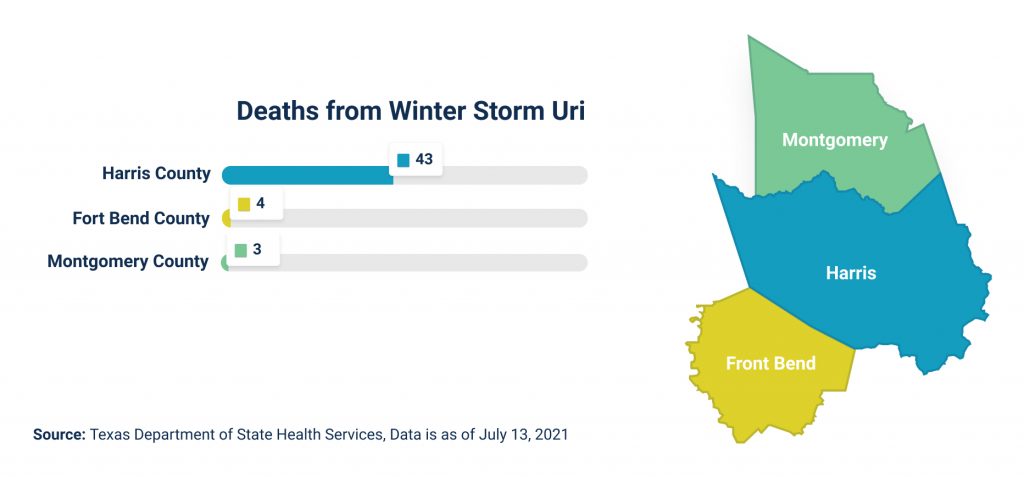
    Here’s how Winter Storm Uri impacted Greater Houston/Texas, by the numbers

    The COVID-19 pandemic and vaccine rollout 

    Despite what many had hoped, the COVID-19 pandemic continued to shape Houston life in 2021, impacting our region, its residents and its healthcare systems. However, thanks in significant part to the effectiveness of available COVID-19 vaccines, residents and businesses have found new ways to carry on in the face of the ongoing pandemic. 

    As one of the largest and most diverse major metropolitan areas in the country, the greater Houston region played a significant role in setting the tone for vaccine rollouts across the nation. Despite some early challenges regarding inequity in access, vaccines have had a mostly successful rollout throughout our region, albeit at inconsistent rates.

    Even after all Texas adults became eligible to receive the COVID-19 vaccine on March 29, 2021, hesitancy and accessibility remained barriers for many. According to survey data from the U.S. Census Bureau, Houston-area residents have expressed a variety of reasons for not getting vaccinated.

    Of those surveyed, 51% of those not yet vaccinated cited concern about side effects as the driving factor behind their hesitancy. While the vaccine has proven to be safe over the past 12 months, trust issues remain a concern. A third of those surveyed said they did not trust the COVID-19 vaccine, and possibly more concerning, more than a quarter of respondents cited distrust of the government as a driving force in their decision not to get vaccinated. As the vaccine is arguably our most critical tool in our battle against the deadly impact of COVID-19, consistent communication about the safety and effectiveness of the vaccine remains vital.

    Amidst a protracted vaccine rollout that was even more challenging overseas, two COVID-19 variants — Delta and Omicron — have emerged, presenting new challenges for public health officials and medical professionals. While the impact Omicron could have in our region remains to be seen, Delta represented significant challenges at its peak, overwhelming area hospitals and medical facilities – with COVID-19 patients occupying 21.3% of area hospital beds the week of August 22, 2021, a significant increase from just 5.9% the month before, and just 2.3% the month before that. 

    85% of COVID-19 deaths in Texas were among the unvaccinated. 

    The Summer surge also contributed to a sobering death toll. As of December 8, 2020, 3,890 people had died of COVID-19 throughout the three-county region. A year later, that number tripled to 11,721. According to a study conducted by the Texas Department of Health and Human Services, 85% of people ages 12+ who died of complications from COVID-19 between January 15 and October 1, 2021 were not vaccinated. 

    Houston’s population keeps growing and changing

    The results of the 2020 census were released this year and confirmed what many residents could already feel: Our region — and our state — has grown significantly over the past decade. In fact, population growth in Greater Houston accounted for a quarter of the total population growth in the state of Texas. 

    Between 2010 and 2020, the three-county area population grew by 1,040,787 people, a 20% increase. While Harris County added the most residents total, Fort Bend County experienced the highest growth rate at 40.6% over the last decade.

    Non-white people made up 95% of all of Texas’ growth in the past 10 years –– and Hispanics alone accounted for half of that growth. 

    This population growth was significant enough to warrant the creation of a new congressional district in the Houston area.

    Further reading: Take a deeper look at what the 2020 Census tells us about Greater Houston

    Houston’s housing market in 2021

    Growing populations and pandemic-impacted markets have had a significant impact on both the availability and affordability of housing in Greater Houston. Though the greater Houston region has historically had a reputation for affordability, that trend has been gradually reversing for years, reaching a boiling point alongside similar markets nationwide.

    The median sale price for a single-family home in the Houston area grew by 16% — from $270,000 in November 2020 to $314,000 in November 2021, according to Greater Houston Partnership analysis of data from Houston Association of Realtors. And total sales in November 2021 were up 5.6% from the same time last year. 

    Home sales increased only for homes valued $250,000 and higher.

    Source: Greater Houston Partnership analysis of data from Houston Association of Realtors, November 2020 – November 2021

    Even as home prices increased, the demand and competition for buying them remained strong. In November 2020, a given piece of property remained on the market for 46 days on average. A year later, that number was down to 35. 

    Life in Houston, by the numbers

    Amidst a year defined by uncertainty, vaccines and a cautious return to normalcy allowed for some memorable moments to return to our region — many great, one tragic. 

    The Astros in the World Series

    A highlight for many Houstonians was no doubt the return of the Houston Astros to the MLB World Series for the third time in five years. Though the Astros ultimately lost the six-game series, the greater Houston region won in a number of other ways. We’ll let the baseball fanatics focus on the game stats, meanwhile, we’d like to draw your attention to the economic impact the Astros’ championship season had on our communities. 

    • Estimated economic impact: $26 million (Source: Houston First Corporation)
    • Downtown hotel occupancy rates: 90%+, up from just 11% a year before (Source: Houston First Corporation)
    • Fans in seats: 128,526 (Source: Baseball Almanac)

    The Astroworld Tragedy

    When Grammy Award-winning Houston-native Travis Scott announced the return of his popular Astroworld music festival, fans and music-lovers were thrilled at the chance to gather and enjoy live music again after a mostly concert-free 2020. Unfortunately, that joy was short-lived.

    While investigations are ongoing amid an ever-growing slew of lawsuits against Scott, promoter Live Nation and others, what we do know paints a tragic picture of loss that our region will mourn and reflect on for years to come.  

    • Official attendance: 50,000
    • Deaths: 10 
    • Injuries: 300+
    • Hospitalizations: 25

    Source: Houston Chronicle

    Looking ahead to the new year

    2021 was filled with ups and downs for our region, and If the last two years serve as any indication, there’s only so much anyone can safely predict about 2022. But whatever trends impact our region in the coming year, Understanding Houston is here to add data-driven insights and context to the issues that matter in our communities. 

    We invite you to join us for the year ahead — follow us on social media, subscribe to or share our newsletter and find out how you can get involved for the year ahead.

  • Celebrating Understanding Houston’s Second Anniversary

    Celebrating Understanding Houston’s Second Anniversary

    Reflecting on two years of community connections and informed action. 

    When we began work on Understanding Houston a few years ago, we set out to create a relevant, accessible platform that would connect community leaders and changemakers with the information they need to take targeted, informed action where our region needs it most. This November, Understanding Houston is celebrating its two-year anniversary of our launch in 2019. Since then, Understanding Houston — an initiative of the Greater Houston Community Foundation — has grown significantly, and we would like to thank everyone who has supported our mission to build a more vibrant Houston with opportunity for all.

    Here are just a few of the things that made year two such a success.

    The addition of our ninth topic: Disaster

    Between hurricanes, floods and even freezes, residents in Houston’s three-county region are no stranger to weather-related disasters. Layer on the COVID-19 pandemic and its many devastating impacts, and the need for a source to find data on regional disasters was greater than ever. 

    At the beginning of 2021, Understanding Houston added a Disaster topic page along with four subtopic pages to share key findings and provide insights into how disasters affect residents differently.  Our hope is that this information helps residents understand the varied risks of disasters, who is the most vulnerable to disaster impacts and in what ways, and shows how uneven disaster response can widen pre-existing inequities. In order for our region to bounce back after a disaster, everyone in our community — especially the most vulnerable — must receive the help they need to not only recover but also be made stronger to weather the next disaster.

    The Disaster topic page allows us to take an in-depth look into these areas of disaster and identify opportunities and obstacles to help our residents prepare for and withstand the various impacts of disasters. But we have also started catalyzing collaborative action in the area of disaster recovery and resiliency in more proactive and intentional ways. Following the release of Understanding Hoston’s new disaster data, the Greater Houston Community Foundation and United Way of Greater Houston announced their Disaster Resilience partnership to streamline disaster funding, combine resources, and provide a streamlined response for the entire region whether recovering from a pandemic or a winter storm.  

    Understanding Houston helped with reliable data to provide a basis for discussion on problems facing Greater Houston. Using this information with others allows us to determine root causes and first steps to developing an action plan to address a basic issue.

    Shelia Thorne, GardenKids of Kemah

    Understanding Houston’s community continues to grow

    Understanding Houston’s community has grown substantially in the last year. More people use and engage with the site, subscribe to our newsletter, follow us on social media, and have joined us at a data briefing, data workshop, or a visioning session as we seek to continually evolve and improve.

    New audiences through data briefings 

    Despite the need for social distancing, Understanding Houston was able to continue to engage the community in our data through programming. In the summer, we held three Data Dives + Workshops in partnership with United Way of Greater Houston (UWGH) where nearly 300 members of Houston’s nonprofit community attended. In addition to reviewing the new data around disasters, we sought feedback from local nonprofit organizations on what they want to see as we build disaster-ready philanthropic partnerships to improve our collective disaster preparedness and response. We asked how the data would be useful and how it could be more helpful to regional leaders who activate during disasters. Read our findings here.

    More recently, this fall we held an intensive Visioning Lab in which we engaged 50 users in a conversation about what they liked best about the Understanding Houston website and how they would improve it. We will hold another Visioning Lab in January and publish our findings the following month. Stay tuned as we share where we are headed next.

    New users and increased awareness

    The Understanding Houston website allows visitors to access impartial data through high-level topic pages, deeper subtopic pages, informative articles, downloadable reports and interactive charts. Our website also allows visitors to vote on the type of content that we should focus on moving forward so that we can reflect our residents’ interests and concerns.  

    Here’s how the community has been utilizing Understanding Houston website in year two: 

    • 40,038 site users: More than 40,000 people have come to Understanding Houston through search engines, social media, or direct referrals in the past year.
    • 99,008 page views: These users have explored more than 99,000 collective pages of Understanding Houston content. 
    • 1,937 report downloads: Nearly 2,000 reports have been downloaded by users for later use and reference.
    • 786 chart exports: Close to 800 charts have been exported by users to include in presentations, share on social media or feature on their website.
    • 336 topic votes: Users have voted for the topics that matter most to them 336 times in the past year.

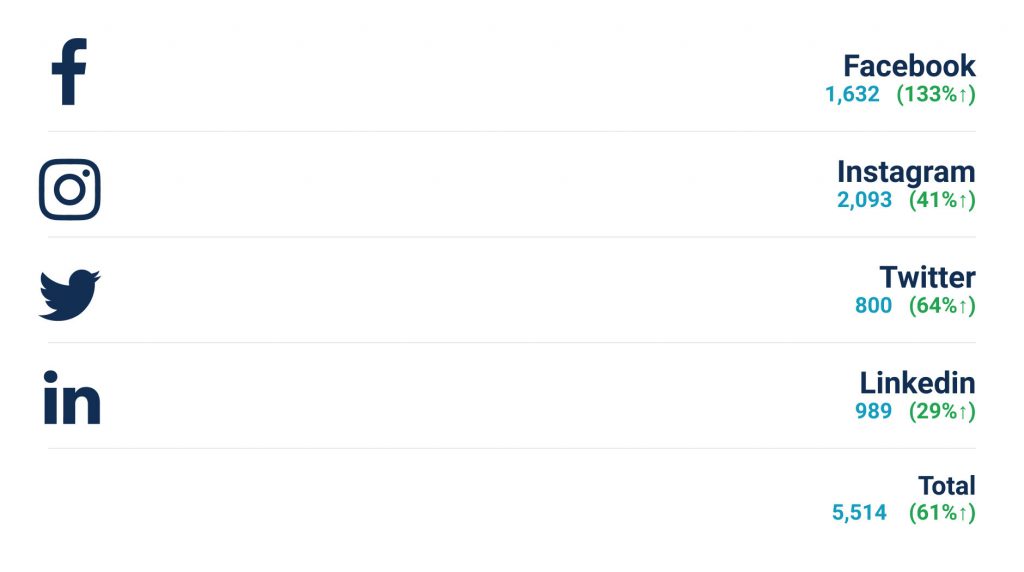
    Understanding Houston utilizes multiple platforms to reach different audiences, including social media and a monthly newsletter. Across all social media platforms, Understanding Houston gained more than 2,000 followers in our second year. This means that more individuals are engaging with Understanding Houston’s data and becoming more informed and aware of issues and current events that are taking place in our region. 

    Here’s how we have continued to grow and engage our Houston audience in our second year.

    • 2,106 total newsletter subscribers (23.8% ↑ from last year)
    • 5,514 total social media followers (61% ↑ from last year)

    Understanding Houston has provided information about the importance of diversity, equity and inclusion in discussions around the region’s population. This bolstered our organization’s response by hiring a DEI consultant to assist in a two-year initiative to improve processes where needed and better serve our clients. We are finding more funders’ attention to this subject important in grant making.

    – Jenetha Jones, Child Advocates of Fort Bend

    Amplifying community voices 

    At its core, Understanding Houston aims to inspire and inform and action. Not only by providing robust data over time on key quality of life indicators but also by illuminating and contextualizing that data into insights through research articles and amplifying Community Voices with regional leader profiles and personal stories. In the past year, we have collaborated with a number of community leaders and organizations including the Houston Education Research Consortium (HERC), Arts Connect Houston, Urban Harvest, FuelEd, and many more!

    These collaborations resulted in 21 total in-depth articles, including six pieces authored by leaders and changemakers from Houston’s nonprofit community. Through data and testimonies, these pieces helped us paint a more detailed picture of issues affecting our communities. 

    How Understanding Houston is making an impact: Survey responses

    In October 2021, Understanding Houston sent out a Feedback & Impact Survey –– an opportunity for those in Houston’s three county region to share how Understanding Houston can improve its website’s tools and programming in the upcoming update. 

    The survey was conducted from August 26 to October 25 and garnered 170 responses. When asked to rate Understanding Houston’s usefulness for learning about the quality of life in our region, 96% of respondents rated our website as very or mostly useful, indicating respondents are very satisfied, and more than four out of five respondents took some action based on learning something new through the website or data briefing, and 99% said they were extremely likely to refer a friend or colleague to the site

    Through the responses, it became clear that most participants value a user-friendly website with relevant data and clear content –– most agreed that the Understanding Houston website caters to these preferences. As we move into year three with plans for a site-wide refresh, these responses will help us make our website a more inviting and useful tool for all who need it. 

    As a concerned Houstonian, the resources available through this initiative have a direct impact on where and how I can direct my resources to have the most impact in my own city.

    – GHCF Donor

    How we’re planning for the future of Understanding Houston

    Evolution is core to the Understanding Houston initiative. So even though the first two years of Understanding Houston have been successful, our work is not done yet. Using the responses from the Feedback & Impact Survey, we are working to improve our user experience and better our website’s resources by implementing a sitewide data update. 

    As we update hundreds of indicators on our website, we hope these updates better reflect and serve our community’s needs so that Understanding Houston can be as useful as possible. The first phase of updates will be launching soon, and we cannot wait for you to see what we have in store!

    Thank you, Houston!

    We would not be able to celebrate our second anniversary without thanking everyone who made this success possible! We owe many thanks to those who have helped to make Understanding Houston the compelling resource it is today. To all the donors, partners, guest bloggers, researchers, analysts, developers, designers, writers and followers who keep us moving forward, we are endlessly grateful.

    We would like to express our gratitude to our founding partners and supporters, our advisory committee, our strategic research partners at Rice University’s Kinder Institute for Urban Research, and our communications and content partners at Baal + Spots and Deutser for their continued support of Understanding Houston and efforts to grow our community.

    Thanks to you, our second year was successful, and we plan to continue that success in years to come. If you’d like to wish us a Happy Second Anniversary on our social media accounts, give us a follow on Instagram, Twitter, Facebook and LinkedIn!

    As we look toward our third year in 2022 and beyond, no one knows what Mother Nature, COVID-19, or even life, has planned for our region, but you can count on Understanding Houston to help you find the facts, deliver insights, and amplify community voices.

  • Houston’s three-county region accounts for a quarter of Texas’ population growth

    Houston’s three-county region accounts for a quarter of Texas’ population growth

    2020 Census data shows how the Houston region has evolved over the last decade

    The U.S. Census Bureau has released data from the 2020 Census; however, collecting this data did not come without its challenges. In March 2020, right as households began receiving invitations to participate in the 2020 Census, the COVID-19 pandemic forced the U.S. Census Bureau to cease all in-person operations. Not only did social distancing make it challenging to go door-to-door to follow-up with folks who hadn’t completed the census, but the virus (along with uncertainty around the existence of citizenship-status questions) also hindered Houston’s response rates to the 2020 Census

    In an article with Understanding Houston, Frances Valdez, the Executive Director of Houston in Action, wrote, “The census affects how billions of our tax dollars will come back into our communities through federal budgeting allocations over the next decade.” The lower the response rate, the smaller the budgets for services and programs like public education, public transit, housing, and more. Decennial census data allows us to look at the present to understand what the Houston region may need in the future. This data informs redistricting efforts, alerts county officials to which groups are growing or declining, and helps policymakers’ plans to strengthen our region for the road ahead. 

    Houston’s three-county region adds one million residents in past decade

    The past decade has been a time of growth for both the state of Texas and the Greater Houston region. The population of Texas grew to 29.1 million in 2020 by adding nearly 4 million residents since 2010. Three Houston-area counties — Fort Bend, Harris, Montgomery — accounted for one-fourth of Texas’ population growth.

    As for the population in Houston, each one of our three largest counties has also experienced population growth. The population of Harris County — the most populous county in the state — increased to 6.2 million (15.6%) between 2010 and 2020. Fort Bend County is home to 822,800 people and grew 40.6% in the last decade — the fastest growth rate in our three-county region. Montgomery County’s population grew 36.1% since 2010 to 620,400 in 2020.

    Population growth consists of two main components: natural increase and net migration. Natural increase refers to the number of births minus deaths in a population, and tends to remain relatively steady over time. Whereas, net migration — the total of the number of individuals who moved into an area minus those who moved out — can have more frequent fluctuations. 

    Domestic and international migration drives Houston’s population growth

    The U.S. Census Bureau distinguishes between domestic and international migration in its migration estimates — domestic migration is any movement within the nation while international migration refers to movement across international borders.

    For example, between 2010 and 2020, about 81,900 more residents left Harris County to live somewhere else in the U.S. than moved into Harris County from another U.S. county. (This is the second consecutive decade in which Harris County had negative net domestic migration. Between 2000 and 2010, 72,100 more residents left Harris County to live somewhere else in the country.) 

    If Harris County is losing people domestically, why is Houston growing so fast? Because Harris County net-gained 289,400 residents to its population between 2010 and 2020 from more people from overseas moving into the area than leaving it for another country. Much of Fort Bend and Montgomery counties’ population growth comes from domestic migration — historically, people from Harris County moving to a neighboring one.

    Projections for Houston’s population hit the mark

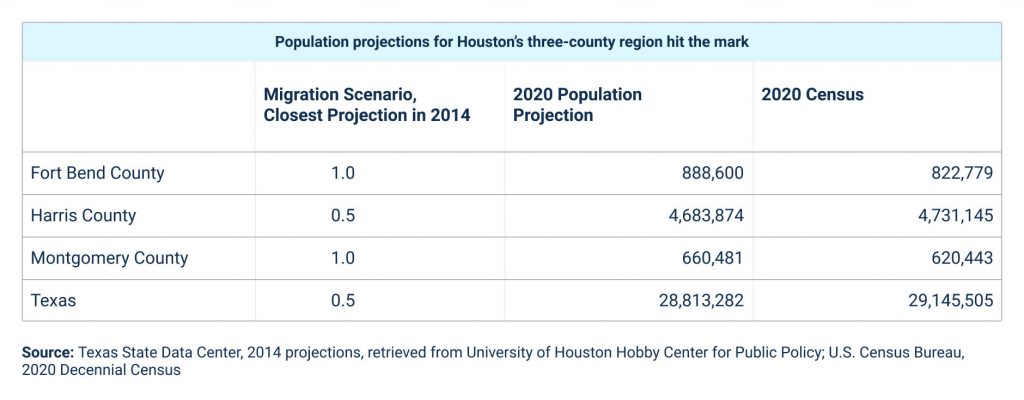
    In 2014, the Texas Demographic Center (previously known as State Data Center) made population projections for three different migration scenarios: one, assuming zero net migration (the number of people who move in equals the number of people moving out), another assuming a net migration rate equal to one-half of the rate seen between 2000 and 2010 (0.5 Scenario), and a final scenario assuming the net migration rate will be equal to the rate seen between 2000 and 2010 (1.0 Scenario). 

    The 2020 population of Texas is not very different from the projections the Texas Demographic Center made in 2014. Under the 0.5 scenario, they projected that the population of Texas would reach 28.8 million by 2020. Under the 1.0 Scenario, they projected Fort Bend’s population would reach 888,600; under the 0.5 Scenario, they projected Harris County’s population would reach 4,683,874; and Montgomery’s 2020 population is closest to the 1.0 Scenario estimate. 

    What is the expected population growth in Houston? According to their most recent Houston population growth projections made in 2018, the Texas Demographic Center estimates that by 2030, Fort Bend’s population will nearly double to 1.2 million, Harris County’s will exceed 5.9 million, and Montgomery County’s will reach 831,450.

    More than two-thirds of Houston’s three-county region is non-white

    The past 40 years has been one of transformative change for the three-county Houston region. Not only has our region grown to one of the most populous in the nation, but also the racial/ethnic composition of our already diverse population has further diversified. Between 1980 and 2020, each of the four largest racial/ethnic groups increased, however the growth rate of Hispanics and Asian Americans outpaced that of non-Hispanic whites and Black Houstonians, creating a shift in Houston’s demographics from being majority-white to majority-non-white. While this mirrors a similar trend happening across the nation and the state of Texas, no other major metropolitan area has witnessed this change more acutely and quickly as Houston, according to Stephen Klineberg, principal investigator of the Houston Area Survey and sociologist at Rice University. Interact with the chart below to see how racial/ethnic composition has changed in our region and Texas by selecting different geographies in the drop-down menu.

    In 2020, there were nearly 2.4 million Hispanics/Latinos in Houston’s three-county region (nearly 39% of the region), with 2 million in Harris County alone. In 1980, just 40 years ago, Hispanics comprised 15% of the population of Houston’s three-county region. The weight of these figures typically does not faze most Houstonians who have witnessed this significant shift, but to most Americans, these changes are unique. For example, among the 100 most populous counties in the nation, only 12 have a higher percentage of Hispanics than Harris County. More recently, Houston’s Hispanic/Latino community has grown considerably in the last decade. Between 2010 and 2020, the Hispanic population in Houston’s three-county region grew by 26% alone. The number of Latinos grew by 43% in Fort Bend County, 22% in Harris County, and 73% in Montgomery County during the same time period.

    More broadly, in Texas, the Hispanic/Latino population grew by nearly 2 million people between 2010 and 2020, increasing its share of the state population from 37.6% to 39.3%. In fact, non-white people made up 95% of all of Texas’ growth in the past 10 years –– and Hispanics alone accounted for half of that growth.

    According to recent Census data, the three-county region’s Asian-American population grew by 53% — from 358,000 in 2010 to 548,000 in 2020 — the fastest growth rate in our region. In 2020, Asian Americans comprised 8.9% of the population of Houston’s three-county region compared to 7.0% in 2010 and only 1.8% in 1980. Between 2010 and 2020, the number of Asian Americans grew 84% in Fort Bend County, 38% in Harris County, and 129% in Montgomery County — though Asian Americans comprise less than 4% of Montgomery’s total population.

    Fort Bend County has the highest proportion of Asian-American residents in Texas (22%). In Sugar Land, nearly 39% of the population identifies as Asian American. Asian Indians comprise 41% of the Asian-American population in Fort Bend, while Vietnamese Americans account for the largest share in the rest of our region. Read more about the fastest-growing ethnic group in our region here.

    Of course, it is difficult to talk about Houston’s population growth without considering how certain groups are typically displaced from their communities due to changing economic and demographic conditions. For example, the Houston Chronicle reports that historically Black Third Ward has changed significantly in the last decade. In 2020, Black people comprised 45% of the neighborhood — a decline from 71% in 2010. Acres Homes in North Houston saw its Black population fall 12% and its Latino population grow by 65%. Second Ward saw its Latino population decline by 25% while its white population increased 50%. Learn more about the history of these communities in the Chronicle’s report.

    Continue reading about the diversity of Houston

    Trends today inform Houston’s future

    Census data allows us to recognize the trends of the past and plan for the population of the future. The data also represents an opportunity for us to strengthen our region in the places where change and evolution will be necessary. These shifts in the Houston population have implications for our community context, economic opportunity in our region, our education system, and much more, including the process of adding a congressional district to our region and redistricting, which is currently underway. 

    As Houston’s three-county region continues to grow, we will continue to analyze and report on the data that affects our communities. Given the pandemic, the Census Bureau is expected to release its first-that-we-know of “experimental” data set that will allow us to delve deeper into the latest trends on a broader range of quality of life issues. Stay tuned for data updates coming in November and early 2022! We invite you to get to know the data, keep up with our mission on social media and discover how you can get involved to help Understanding Houston continue exploring what matters to the Houston area.

    Helpful Articles by Understanding Houston:
  • Hispanic Heritage Month: Celebrating the Hispanic Population in Houston

    Hispanic Heritage Month: Celebrating the Hispanic Population in Houston

    As the largest ethnic group in the region, Houston’s Hispanic community has left an indelible impression in our communities — both past and present. From indigenous roots spanning the Americas and those with African ancestry, to early Spanish-speaking settlers and present-day community pillars, Houstonians who identify as Hispanic/Latino have shaped our region in fundamental and invaluable ways.

    In honor of Hispanic Heritage Month, we’ll explore the multifaceted Hispanic population in Houston through data, history and what current leaders are doing to keep the community’s legacy thriving throughout our region.

    To me, Houston is the most dynamic city for Latinos in Texas. Not only have they been present since the city’s founding, but the community is constantly being strengthened by new arrivals who bring fresh energy, skills and perspectives. Hispanics in Houston introduce vibrant foods, music and cultural scenes. They integrate quickly into the economy and interact daily with other racial and ethnic groups. While many inequalities and challenges persist, this is a place where Latinos come to set roots, to grow, and to thrive.

    – Dr. Cecilia Ballí, an anthropologist and Visiting Scholar at the University of Houston’s Center for Mexican American Studies

    The Latino/Hispanic population in Houston

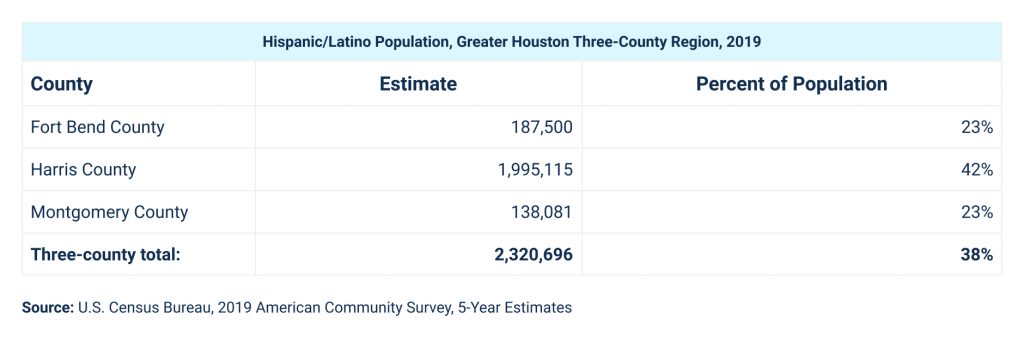
    What percent of Houston is Hispanic? Greater Houston is home to one of the nation’s largest Hispanic populations, numbering more than 2.3 million people throughout the region — meaning Houston’s Hispanic population percentage is currently about 38%.

    Hispanics are most likely to live in Harris County, where they comprise 42% of the population. In 1980, only 41 years ago, Hispanics made up only 15% of the county’s population. And this group is projected to continue growing — both within Greater Houston and throughout the state. According to the Texas Demographic Center, the Hispanic/Latino1 population in Texas is projected to reach 12.3 million by 2022 — becoming the largest ethnic group in the state. By 2030, the population is expected to reach 14.5 million. Let’s take a look at how the Hispanic/Latino community has shaped —and will continue to shape — the Houston we know and love

    Houston’s Latino population is diverse

    Because the general terms “Hispanic” or ”Latino” are used to describe a group of people who originate from a wide variety of Spanish-speaking or Latin American countries, and who understand their identity in different ways, the diversity within that broad group can often go unnoticed. Houston’s Hispanic/Latino population is not a monolith and can trace its heritage to many different countries and indigenous tribes. 

    Moreover, many people whose ancestors identified as Hispanic/Latino, may not describe themselves that way. According to the Pew Research Center, Hispanic self-identification varies across immigrant generations. Among people who report Hispanic ancestry, almost all the foreign born identify as Hispanic, whereas only half of those who are fourth generation Hispanic/Latino Americans or higher do.

    While a majority of the Hispanic population in Houston originates from Mexico, we find incredible diversity among all residents of Hispanic/Latino origin as well as among those with Mexican and Indigenous ancestry. As such, Mexican Texans, also known as “Tejanos,” have a long history in the state and in our region. 

    Dr. Jesus Jesse Esparza, an Assistant Professor of History at Texas Southern University, showcases the past and present of Houston’s Mexican American community in his piece La Colonia Mexicana: A History of Mexican Americans in Houston

    The end of the Texas Revolution in the mid-1830s marked a significant turning point in Mexican-American settlement in Houston and the booming economy and culture we celebrate today. Historically Hispanic neighborhoods in Houston, including Segundo Barrio in the Second Ward and Magnolia Park Neighborhood in the East End, were areas of early settlement and quickly became hotspots for the community to grow.

    Magnolia Park in particular –– named after the beautiful magnolia trees that line the neighborhood –– became the city’s largest Mexican-American community and was given the nickname “Little Mexico.” Mexican-American residents of the Magnolia Barrio, as it was called, worked on dredging the Houston Ship Channel in the early 1910’s. The important role Mexican Americans played in deepening the Channel allowed larger cargo ships to enter the port, which is why the Port of Houston is consistently the largest in the nation (measured by domestic and foreign waterborne tonnage) and contributes an estimated $339 billion in economic value to the state of Texas.

    Houston’s Mexican-American population established a variety of social, cultural, religious, and political organizations that advocated for the community and paved the way for its residents to thrive. From the Second Ward came Our Lady of Guadalupe Church, the first Mexican-American church in Houston and the first religious institution to offer services in Spanish. This church also ran one of the earliest schools for Mexican-American children in the region and provided food and shelter to those in the community.

    From even before Houston’s founding to today, Mexican Americans have been and continue to be the largest Hispanic group in our region, and cultural staples such as civil rights organizations, theatre companies, and art exhibits that were established around the 1980s still exist and thrive in present-day Houston.

    “Houston is so blessed with the richness of our Hispanic Heritage and our multifaceted cultures. This vast Texas city of opportunity coupled with warm Texas hospitality, kindness and charm make Houston, in my opinion, the greatest city in the world. Our fusion of flavor, color, music, and art are the spice that makes Houston so desirable and unique.
    In one family gathering, which because of our heritage are quite often, we easily represented Cuban, Mexican, Panamanian, Nicaraguan, Argentinean, Costa Rican, Dutch and Spanish cultures—and this is just the beginning. Our people, history, warmth and love are the greatest assets to our city and to our future.”

    – Mayte Sera Weitzman, 2021 President and Board Chair, Institute of Hispanic Culture of Houston

    Houston’s Latino community has supported our economy for decades

    The passage of the Immigration and Nationality Act of 1965 established a new immigration policy based on reuniting immigrant families and attracting skilled labor to the United States. This policy change enabled thousands of people from Latin American, Asian, and African countries to move into the Houston region, causing a population boom that has propelled our economy into one of the largest in the nation today. As sociologist Stephen Klineberg has written, “No city has benefited more from immigration than Houston, Texas.” This population boom also paved the way for our metropolitan area to be one of the most ethnically diverse places in the nation and one of only four with a Latino plurality.2 

    “As a life-long resident of the greater Houston area, I have seen a tremendous amount of impact from our Latino population. But it hasn’t always been easy for Latinos. Everything I do today, including in my community work around housing and education, is in remembrance of the role models my parents were. They were extremely humble but extremely loving. They worked hard to instill a strong work ethic and to provide for our family and my education. They loved life despite the hardships. My parents are my inspiration, but so many successful Houston Latinos continue to lead the way as well and should absolutely be celebrated. I’m proud of my heritage and culture and aspire to relay that to the younger generation.”

    Laura Jaramillo, Greater Houston Community Foundation Board Member

    While immigration is central to the story of Houston, some make the mistake of believing that most people of Hispanic origin are recent immigrants or newcomers. In fact, as of 2019, the majority of Hispanic/Latino residents in our region were born in the U.S. (61%). And, about half of Hispanic residents that were born outside the U.S. have been in the country since before the year 2000. Only about 20-26% entered the U.S. in 2010 or after.

    Hispanic/Latino workers are integral to Houston’s workforce and economic growth. In addition to participating in the labor force at higher rates than the overall region3, Hispanic workers continue to fill critical workforce gaps in labor-short industries such as agriculture, construction, and healthcare in Houston, according to bipartisan research from New American Economy

    Latinos comprise 35% of the Houston metro-area labor force, but hold 62% of jobs in construction, extraction and maintenance, 47% in service, and 45% in production and transportation, according to research from the University of Houston’s Center for Mexican American Studies (CMAS). These jobs tend to pay less than the regional average and were among the sectors hit the hardest during the pandemic. It is not surprising then that Hispanic households have experienced the highest rates of job and income loss since COVID-19 forced shutdowns.

    Continue reading about Houston unemployment and income inequality

    Educating the region’s future workforce

    Educational attainment rates for Latinos as a whole tend to lag that of other groups, despite recent improvements. The share of Latino adults in the region with at least a high school diploma has increased from 44% in 2000 to 63% in 2017. More recent data shows that nearly two-thirds of Latino adults have at least a high school diploma or equivalent in 2019.

    There are differences in the levels of education between Latinos who are foreign born versus native born, and even among the foreign born as well. For example, 12% of Hispanic immigrants in the three-county region have a bachelor’s degree or higher compared to 20% of Hispanic adults born in the U.S. 4 Research from CMAS found that recent Latino immigrants are more likely to be better educated than those who arrived before them. For example, 27% of immigrants who have arrived in the last five years have a bachelor’s degree or higher. For those who have been here for at least 11 years, that drops to less than 10%.

    Access to quality education is critical to maintaining a skilled workforce in our knowledge-based economy. However, nationally and locally, Hispanic students are five times more likely to attend a high-poverty school than white students, resulting in very unequal educational experiences. Given the fact that more than 575,000 Hispanic students are enrolled in the three-county region’s public schools (52%), our collective future success depends on the investments we make today. 

    The civic and cultural contributions of Houston’s Hispanic/Latino population

    Full citizenship is something one possesses as well as what one does. And, they are not mutually exclusive. While certainly not the only way, one of the most fundamental ways to exercise one’s citizenship is to vote. Hispanic voters are increasingly making up a larger share of the Texas electorate. Nearly 17 million adults in Texas were registered to vote in 2020, and census data estimates about 30% of those are Hispanic/Latino. About 60% of Hispanic citizens in the Houston Metro Area were registered to vote in the 2020 Presidential election.

    “Voting is learned through example, in the family and the community, and as larger numbers of Hispanics feel empowered to go to the polls, our share of the electorate will grow to properly represent our demographic size.”

    – Dr. Cecilia Ballí, an anthropologist and Visiting Scholar at the University of Houston’s Center for Mexican American Studies  

    Hispanic Houstonians have a strong history in civic leadership, whether leading the third-most-populous county in the nation, working toward educational parity, fighting for social and political justice, to promoting cultural food, music, and arts, their contributions enrich our community. Read about eleven Hispanic community leaders who are making a difference by visiting our Hispanic Heritage Month 2020 blog.

    One notable Hispanic leader in the Greater Houston area is Harris County Judge Lina Hidalgo, a native Colombian who moved to Houston at the age of 15. Judge Hidalgo is the first woman and the first Latina to be elected County Judge and the second to be elected to the Commissioners Court. For some time in 2019 and part of 2020, the Harris County Judge (Lina Hidalgo), Houston Police Chief (Art Acevedo), and Harris County Sheriff (Ed Gonzalez) were all Latino. 

    “In 1955, League of United Latin American Citizens (LULAC) Council 60-members purchased a building on an odd-shaped parcel of land that became their “clubhouse” and the de facto national headquarters for LULAC until 1996. This clubhouse served as a launchpad for creating  transformational social programs for Houston’s Hispanic community in education, workforce development and housing.”

    – Jesus Davila, Founder at Landing Advisors

    Latinos have also played an instrumental part in building Houston’s strong reputation for incredible food and culture. Legendary Houston small business Ninfa’s was started as a small taco stand by Maria Ninfa Rodríguez Laurenzo, a Mexican-American woman, in 1973. “Mama Ninfa” is widely credited with popularizing fajitas among Houstonians. Chefs and restaurateurs, David and Michael Cordúa elevated the profile of Latin American cuisine in Houston through famous establishments like Américas and Churrascos. Irma Galvan and Hugo Ortega, helped put Houston on the culinary map with Irma’s and Hugo’s, Caracol and Xochi. On the art scene, Colombian-American, Andrés Orozco-Estrada, became Houston’s first Latino music director for the Houston Symphony in 2014, and Venezuelan Karina Gonzalez is Houston’s first Latina Principal Ballerina.

    In addition to notable leaders, incredible organizations in the region work to preserve the culture, history and language of Hispanic communities, particularly the collaborative effort to establish a major Latino cultural center in our region.

    The Institute of Hispanic Culture of Houston is a local nonprofit organization that serves the Hispanic community through educational, cultural, and networking activities in collaboration with other Houston organizations and universities to keep the vibrant culture alive. Located in the East End, Talento Bilingüe de Houston is a bilingual, non-profit cultural center that strives to enhance Houston’s Latino arts experience through collaboration, education. and preservation. Not only do they provide workshops and exhibits to enrich the Hispanic/Latino population, but they aim to spread their passions with the rest of the Greater Houston area.

    One of the largest cultural organizations in Houston, the Multicultural Education and Counseling through the Arts, or MECA, still exists today thanks to the vision, passion, and dedication to community and youth of Alice Valdez. Read more about her decades of impact. 

    Casa Ramirez Folkart Gallery is not just a gallery. This vibrant shop on 19th Street showcases Mexican and Latin folk and art works, sells books on cooking, culture, and language for children, and is a community pillar for teaching cultural traditions. 

    Finally, the Museum of Fine Arts, Houston showcases the Latin American Art collection that hosts a vast collection of modern and contemporary art with more than 550 works from Mexico, Central and South America, the Caribbean, and works by Latino artists in the United States.

    Celebrating a rich past, present, and future 

    In no uncertain terms, the greater Houston region would not be where it is today without the presence, perspectives and contributions of members from our Hispanic/Latino community. As a vital part of our region’s history and future, Latinos in Houston continue to enrich and better our region in countless ways that we celebrate today. 

    Check out special events from Hispanic Houston, Institute of Hispanic Culture of Houston, and attend a free special Fiesta Sinfónica concert at Jones Hall on October 2. Read about the nominees of Mayor Sylvester Turner’s 2021 Hispanic Heritage Awards and hear more from notable leaders themselves. Happy Hispanic Heritage Month!

    Continue reading about social and community context in Houston’s three-county region

    Helpful Articles by Understanding Houston:

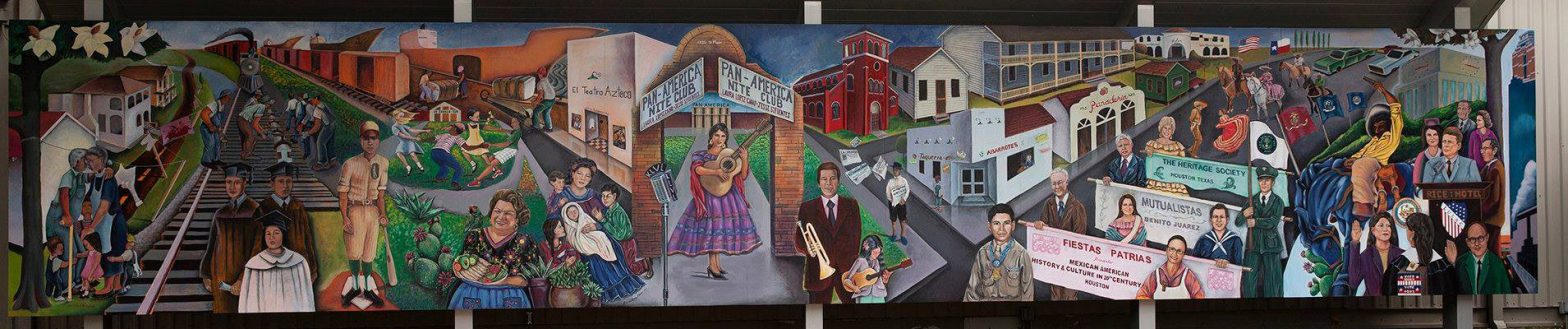
    Photo credit: The Heritage Society

    References:

    1Understanding Houston utilizes the U.S. Census term, “Hispanic,” “Latino” or “Hispanic/Latino” when referring to the overall population. For the purposes of this article, we will use these terms interchangeably depending on the nomenclature used in our cited sources.

    2Understanding Houston analysis of the 20 most populous Metropolitan Statistical Areas (MSA) from the U.S. Census Bureau, 2019 American Community Survey data. Other MSAs with a Latino plurality include (in descending order): Riverside MSA, Miami MSA, and Los Angeles MSA. Houston-The Woodlands-Sugar Land, TX (MSA) is a region that includes the following counties: Austin, Brazoria, Chambers, Fort Bend, Galveston, Harris, Liberty, Montgomery, and Waller.

    3Analysis of data from the U.S. Census Bureau, 2019 American Community Survey.

    4Understanding Houston analysis of data from the U.S. Census Bureau, 2019 American Community Survey, 5-year estimates, Public Use Microdata Sample (PUMS) for the population 25 years and older.

  • COVID-19’s ongoing effect on students in Greater Houston

    COVID-19’s ongoing effect on students in Greater Houston

    A data-driven look into how the pandemic has affected students in Greater Houston 

    Since March 2020, the world has been coping with the devastating impacts of the COVID-19 pandemic. For many students, the classroom suddenly became the kitchen table. Their teachers were now little squares on a screen. The learning experience that most students were accustomed to had been flipped upside down. 

    As the 2021-22 school year approaches and students return to the classroom amidst the fourth wave of COVID-19 infections, the pandemic and its effects are still ongoing. We’re analyzing available data on how COVID-19 has affected Houston-area students to shine a light on the challenges students may continue to face in yet another pandemic-affected school year.

    The struggle to adapt to online learning 

    The COVID-19 pandemic has drastically changed the way students experience their education. As Houston-area school districts and campuses transitioned to 100% online learning at the start of the pandemic, the need for stable internet and consistent access to technological devices like laptops and tablets became a necessity. 

    However, according to research from the Houston Education Research Consortium and RICE University, 20% of families reported that their child(ren) did not have a personal device such as a computer, laptop or tablet to do their schoolwork. The research also suggests that income played a significant role in setting students up for success in the form of access to the required resources to make online learning possible.  

    Almost half of the participating households earning less than $20,000 per year reported not having a device or internet for their child(ren) to complete schoolwork, compared to only 4% of families earning over $100,000 per year. 

    1 in 5 families

    in the Houston area lacked internet access or a digital device for their child(ren) to use to do their schoolwork during the early months of the pandemic.

    Source: Gulf Coast Coronavirus (COVID-19) Community Impact Survey

    Daniel Potter, Associate Director of the Houston Education Research Consortium, notes how research suggests that the pandemic has pushed a larger proportion of Black and Hispanic students online, which can negatively impact learning. According to his organization’s findings, 70% of Black students and 60% of Hispanic students in the Greater Houston area opted into virtual learning in the 2020-21 school year compared to white students (40%). These are the same students who are more likely to attend high-poverty schools that have fewer resources –– including necessary technology –– to engage all students successfully. 

    Parents show anxiety regarding students’ readiness for school

    In the Gulf Coast Coronavirus (COVID-19) Community Impact Survey, a majority of surveyed families reported feeling worried that students would not be ready for the 2020-21 school year. Those without access to WiFi worried more –– 67% of families without access to WiFi/Internet and a device for schoolwork expressed concern that their child would not be ready for the upcoming school year, compared to 49% of families with access to WiFi and devices for schoolwork. 

    Families that reported having access to WiFi and devices for schoolwork were not as worried about their children being prepared for the school year because they had the necessary resources. In an attempt to close this digital divide, Houston school districts distributed print copies of educational materials to families with limited access to technology to prevent students from falling behind. Additionally, WiFi hotspots purchased by the districts made online learning more accessible to all.

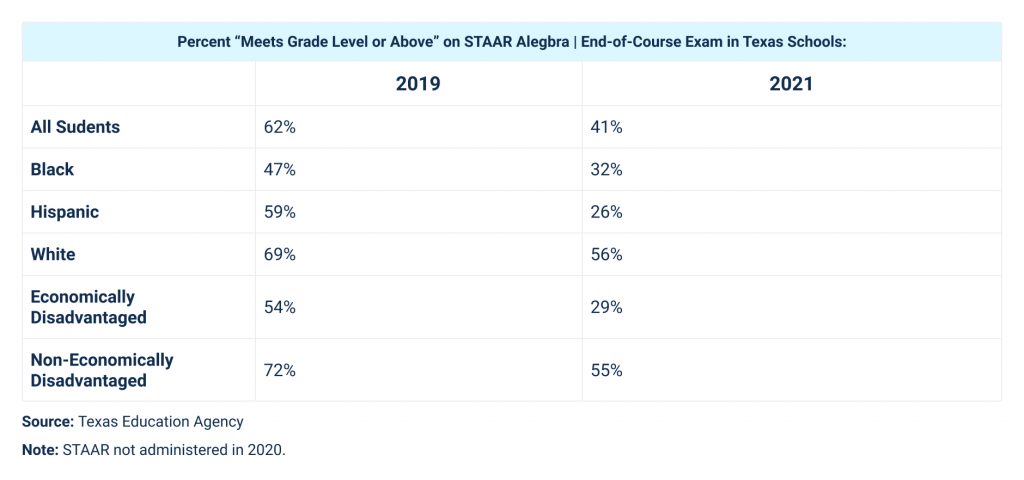
    The impacts on student performance

    From the cancellation of state standardized testing to the mandatory shift to remote instruction in March 2020, COVID-19 had a huge disruption on students. As schools transitioned into a “hybrid” learning model of virtual and in-person instruction in 2020-21, most campuses and students adapted to the new normal. However, as we begin the second full academic year in the era of COVID-19, the impacts on student learning and performance are beginning to emerge, though there is still much we do not know. 

    According to the Kinder Institute for Urban Research at Rice University, in the 2020-21 school year, several districts reported a significant increase in the percentage of students failing at least one course. Their findings also show that failure rates were typically highest for students attending school in the online/virtual setting.

    One measurable assessment, the eighth-grade math proficiency exam, is important in assessing student readiness for high school. The results from the Algebra I End-of-Course (EOC) State of Texas Assessments of Academic Readiness (STAAR) given to students in Spring 2021 show a significant decline in performance compared to 2019. Performance was on an upward trend prior to this decline.

    In Spring 2021, 41% of students who took the Algebra I EOC exam met the state standard, compared to 62% in 2019. The proportion of students who met the standard fell 33 percentage points for Hispanic students, 25 points for low-income students, and 21 points for all students combined.

    The effects on higher education plans

    While the total impact COVID-19 has had on student attrition and graduation rates in the Houston area is still unclear, preliminary research suggests that the pandemic has contributed to students changing their post-secondary education plans. Data from the National Student Clearinghouse Research Center supports this survey data. The number of students enrolling in undergraduate higher education in Spring 2021 fell by 727,000 students nationally, or 4.9%, from Spring 2020. For comparison, undergraduate enrollment fell 0.5% between Spring 2019 and Spring 2020. More than 65% of the total undergraduate enrollment decline occurred among community colleges, institutions that are more likely to serve low-income students and students of color. Texas is not immune either.

    According to the U.S. Census Bureau, 43% of Houston adults have canceled their higher education plans with 33% of students reporting they will be taking fewer classes in the fall of 2021. 

    Three out of four students who have decided to halt their post-secondary educational plans cite financial constraints as the main reason. Houston already has one of the lower rates of people with postsecondary degrees among peer metros; if this trend continues, it could have widespread implications on the quality of our workforce.

    Student mental health affects academic success

    It is impossible to discuss COVID-19 without acknowledging its effects on student mental health. From being cut off from one’s peer group and missing out on important milestones like prom, graduation, college visits, etc., to grieving the death of parents and other loved ones, including breadwinners, adolescents are struggling with much more than school. 

    Hispanics have the highest COVID-19 infection and death rates in the region and the highest rates of employment and income loss. A survey conducted by Latinos for Education found that Latino parents are most concerned with the mental health of their children. Another recent study estimated that nine family members are affected by one person who dies of the coronavirus. Given that Hispanics also make up the majority of students in Houston-area schools, thousands of Hispanic students have experienced the worst impacts of the pandemic, all while still trying to learn.

    Research indicates there is a direct link between mental health and academic achievement. It will be impossible to move on from the educational impacts of the pandemic without acknowledging and repairing student mental health, with an emphasis on supporting Hispanic students who have experienced the worst effects.

    Looking ahead to 2021-22 with the lessons we’ve learned

    COVID-19 has impacted everyone, but not everyone has been affected equally. Research suggests the pandemic has widened pre-existing disparities in academic performance and the pursuit of higher education. However, educators, school administrators and students have learned much since March 2020. We now know which tactics may work better than others, and we have a clearer picture of how students have been affected — and what they need moving forward.

    Educating students while trying to keep their teachers, faculty and staff safe during the pandemic is a challenging task that comes with consequences. As we navigate through another COVID school year, we hope to see improvement in overall student performance alongside practices that prioritize the health and well-being of our children and their educators. 

  • Four Facts Every Resident Should know about Houston’s environment

    Four Facts Every Resident Should know about Houston’s environment


    Greater Houston has many reputations, many good, some more challenging. We’re the Space City, Clutch City and home to the medical capital of the world. We’re also known to be the Bayou City, the Energy Capital of the World and a car city, to name a few. On their own each reputation speaks to a different facet of our region. But when viewed collectively, they have broader, more troubling implications for our region’s health. 

    Over the past several decades, population growth and urban development have contributed to historic economic expansion throughout Greater Houston’s three-county area. This expansion has led to new job opportunities, expanded access to vital resources and created new community spaces for recreation. It has also had considerable consequences for our natural environment, including impacts on our region’s natural resources as well as water and air quality in Houston. And, for residents of Houston, climate change is already a reality that carries additional implications for our region as we continue to face extreme weather in the future.

    The preservation of Greater Houston’s natural environment is crucial to the ongoing health of our region and its residents. Though there are many factors influencing Houston’s environment, these broader trends are an important first step in understanding where our region stands and, ultimately, working to protect it moving forward. 

    1) Greater Houston emits about 68 million metric tons of industrial greenhouse gas emissions

    According to a 2019 report by the EPA, energy production and consumption account for 61.2% of greenhouse gas emissions in the U.S., and as the “energy capital of the world,” Houston plays a significant role in creating and managing harmful greenhouse gases.

    Greenhouse gases (e.g., carbon dioxide, methane and nitrous oxide) trap heat in the earth’s atmosphere, contributing to global warming and climate change both in our region and around the world. Greenhouse gas emissions are on the rise in the region, even with the COVID-19 pandemic temporarily reducing Houston traffic and energy use. 

    Between 2011 and 2017, total greenhouse gas emissions generated by industrial facilities in the three-county region fell 3%, according to the Environmental Protection Agency (EPA). Non-biogenic carbon dioxide (C0) emissions (derived from fossil fuels) fell by 3% and biogenic C02 fell 40% while methane and nitrous oxide emissions increased by 6% and 2%, respectively. Since 2017, total greenhouse gas emissions have ticked back up 2%. While non-biogenic C02 has remained flat between 2017 and 2019, methane emissions have increased 22% in the last two years and biogenic C02 fell 44%, according to the EPA.   

    Read more about Houston’s air quality and the City of Houston Climate Action Plan

    2) Our region is increasingly reliant on cars

    Greenhouse gas emissions generated by industrial facilities are only part of the equation. Automobiles contribute to 28.9% of human-generated greenhouse gas emissions in the country, and Greater Houston is a very car-reliant region. Between 2010 and 2017, the percentage of Houston-area households that own at least one car grew one percentage point to 94.7%. This is higher than the national rate of 91.4%, which grew by only 0.5 percentage points over the same time period. Further, Houston-area residents are purchasing more vehicles at a faster pace than the nation overall, and they’re spending more time in them.

    Between 2010 and 2017, the percentage of households with three or more vehicles in the three-county area grew by 38% — more than double the 15% national growth rate. All these cars on the road contribute to higher than average commute times, with 13.3% of three-county residents reporting 60-90+ minute daily commutes.. 

    This disparity isn’t simply a matter of Houstonians preferring to drive or not caring about Houston’s environment — for most residents, public transit and/or walking simply aren’t practical options. 

    In both Fort Bend County and Montgomery County — where residents face above average commute times — fewer than 5% of households live within ¼ mile of a public transit stop. While Harris County fares better thanks in part to continued efforts by METRO, most households in the area are still out of walking distance from a public transit stop. As a result, only 2.3% of Houston-area workers commute on public transit — less than half the national rate.

    As most residents know, in general, walkability is not one of the Houston area’s strong suits. 

    On average, Montgomery County has fewer than 0.6 linear miles of connected sidewalk per square mile of land. While Fort Bend County and Harris County are more walkable with 4.4 miles and 7.6 miles of connected sidewalk per square mile of land, respectively, it’s clear that making Greater Houston more walkable needs to remain a priority of our region’s ongoing growth strategy. 

    3) Wetlands and farmland shrink as developed land increases

    It’s no secret that Greater Houston is growing, and with that growth comes a shift in how we use our region’s natural resources. In recent years, our region’s land cover has shifted heavily in favor of developed land, which makes up more than 1,800 square miles of our region. 

    Between 2001 and 2018, the percentage of developed land grew by 18–19% in all three counties, accompanied by some other striking changes throughout the region. In Fort Bend County, farmland decreased from 59% of total land cover in 2001 to 15% by 2018. In Harris County, forest and wetland continued to lose already low shares of land cover — as they did throughout the region — dropping to 10% and and 4%, respectively.  Also noteworthy is the increase in pasture/grassland throughout the three-county region. Viewed alongside the region-wide decrease in farmland coverage, this transition may portend even more increases in developed land in the future, as new grassland often preempts additional development on a previously wooded area. 

    Further Reading: Take a closer look at the state of our region’s water supply →

    Of particular concern is the decline in wetland coverage seen throughout the region. The low-and-declining levels of wetland coverage throughout the three-county area in the absence of resilience measures to compensate come with increased risk of flooding in Houston, from heavy rainfall in urban areas — a growing concern for our region today and in the future.

    4) The effects of continued climate change pose distinct challenges for Greater Houston

    Extreme precipitation is a problem with which many Houston residents are all too familiar. In the last five years, Houstonians endured four extreme precipitation events that were declared federal disasters, the most costly of which, Hurricane Harvey, dropped more than 60 inches of rain and caused more than $100 billion in damages. If climate change continues at its projected pace, Greater Houston will need to prepare for even more extreme precipitation events. 

    Over the next 50-60 years, the number of extreme precipitation days is expected to increase from 11.3 in 2020 to 11.6 by 2080. While this increase may seem slight, it’s important to consider the damages our region sustains from these extreme precipitation events, especially when 58% of residents in the region currently live in a census tract with increased vulnerability to the effects of natural disasters in Houston — many of them low-income and/or Black or Hispanic.

    As familiar as Houstonians are with extreme rain, we are even more familiar with the intense Houston heat. If climate change trends continue at their current pace, we may need to brace ourselves for even more higher temperatures than we already endure. 

    Between 2020 and 2050, the number of extreme heat days with temperatures over 95 degrees in the three-county area is projected to grow by as much as 47% to 51% over the next 30 years, with Fort Bend County seeing the most frequent extreme heat days in the region, a deeply problematic projection that has worrisome implications for resident health and energy use throughout the region. 

    Understanding Houston’s environment is the first step toward meaningful action

    We may not be able to control the weather or the implications of Houston’s population growth, but that doesn’t mean we are powerless in the fight against climate change or in making our region more sustainable and resilient for all who call it home. By taking the time to understand the data, we are one step closer to taking the targeted action that truly matters in our communities, which helps ensure a brighter future for all.

    As a community-driven nonprofit, our mission to connect community leaders (like those at Houston environmental organizations) with the data they need to make informed decisions relies on the action and generosity of people like you. Consider exploring how you can get involved with Understanding Houston, and stay tuned to our social media for new data, insights and program updates.

    Helpful Articles by Understanding Houston:
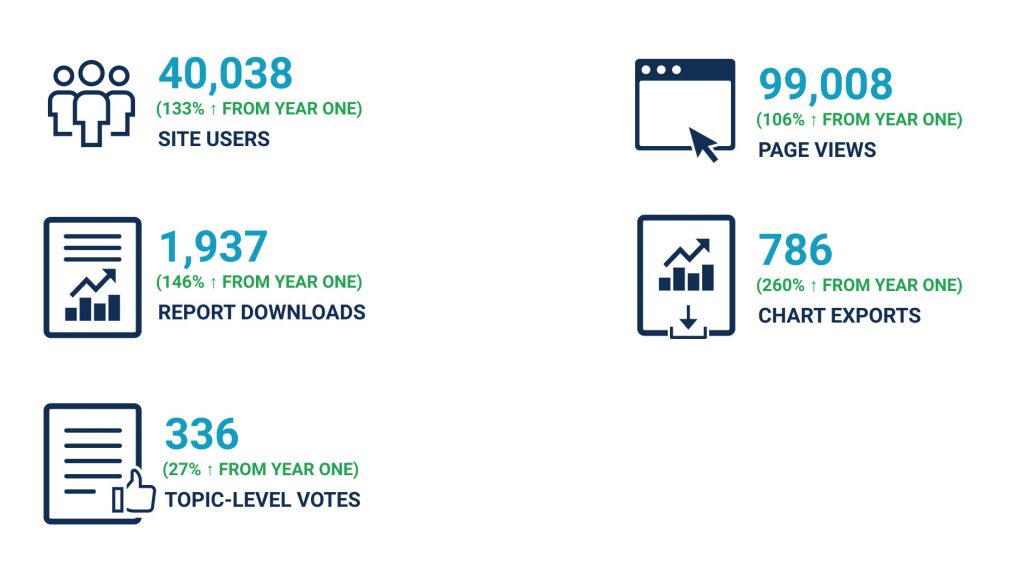
  • The pandemic turns one: 6 ways COVID-19 has impacted Greater Houston

    The pandemic turns one: 6 ways COVID-19 has impacted Greater Houston

    March 4, 2020: A Fort Bend County area man became the Houston area’s first presumptive positive case of COVID-19 after traveling on a Nile River cruise. From there, the situation worsened rapidly. Just one week later, the Houston Livestock Show and Rodeo was cancelled for the first time in 88 years after evidence of community spread was confirmed through a case in Montgomery County. Businesses began to close their doors and store shelves were quickly emptied as people across the region and the nation scrambled for answers. What will happen to me if I get the virus? How can I get tested? Will I keep my job? Will there be enough food? How long will this last? 

    One year later: we know much more than we did during those chaotic first weeks. With multiple vaccines receiving emergency use authorization, accessible testing and more treatment options, we’ve made some remarkable strides in our battle against the health effects of the pandemic. However, we also know more about the incredible toll the pandemic has taken on our region, and the impact it has had on the lives of millions of Houstonians. The data are irrefutable. Latino and Black communities have been hardest hit by the pandemic. They have paid the highest price: lost jobs, lost businesses, lost homes, lost loved ones and lost lives.

    While relief may be in sight for many, the toll of COVID-19 still looms large — both for the families of people who have lost loved ones and those who have lost livelihoods. Understanding what lies ahead for our region starts with understanding where we stand today, and in a year as catastrophic as any in recent memory, it behooves us to look back and reflect on what COVID-19 has meant for Houstonians and Houston to date.

    1. Nearly 465,000 Houstonians infected and 6,300 dead

    Despite some early hopes that the virus would be limited in its severity and short in its duration, the grim figures one year later tell a much different tale. In the three-county area alone, nearly 465,000 people have been infected as of March 7, 2021. More than 6,300 of those infected did not survive, and residents of color and low-income communities have been hit disproportionately hard throughout the region. 

    As the most populous county in the region by far, Harris County has seen both the highest number of cases and the highest number of deaths in the three-county region. However, each county has had roughly the same infection rate per 100,000 residents, ranging between 7,305 out of 100,000 residents in Montgomery County to just over 7,600 out of 100,000 residents in Fort Bend and Harris counties.

    Erica’s two adult brothers passed away due to COVID, only three weeks apart. As a result, Erica became the guardian for her young nephews. This has caused a great amount of stress for Erica and her husband, as they now have a family of five children to care for. When her application to the Lost Loved One Fund was accepted, she exclaimed, “Oh my God, thank you so much…you are a blessing. My family and I really appreciate it. God bless you.”

    – Client story from COVID-19 Lost Loved One Fund administered by Memorial Assistance Ministries (MAM), a Greater Houston COVID-19 Recovery Fund nonprofit partner

    While COVID-19 may have spread through the three counties at similar rates, it has not affected everyone equally. In all three counties, Hispanic and/or Black Houston-area residents represent a higher share of COVID-19 deaths than they do the overall population. 

    A recent study estimated that nine family members are affected by one person who dies of the coronavirus, which means nearly 60,000 people are grieving in our region. As Dr. Julie Kaplow wrote in a recent Understanding Houston blog, “the context in which the deaths are occurring (e.g., social distancing that prevents in-person, ongoing support and collective mourning) makes the grief-related impact even more pronounced, particularly for children and adolescents.” Compounding layers of devastation is the fact that the communities experiencing the majority of infections and deaths from the novel coronavirus are the same ones who have been most affected by employment and income loss. 

    2. Houstonians have unequal and inequitable access to vaccines

    In a year filled with difficult questions, one of the most pressing continues to be unanswered. To those who’ve spent the past year wondering when will the COVID-19 vaccine be ready? the answer is “it depends.”

    According to official vaccination data tracked by the Houston Chronicle, 18% of Fort Bend County’s population has received at least one vaccine, with 12% being fully vaccinated, as of the first week in March 2021. Vaccination rates in Harris and Montgomery counties are lower in comparison, with 14% and 12% of the population vaccinated, respectively.

    However, not all residents have equal access to the vaccine. The least likely to die from the pandemic are the first to become inoculated. This trend is already clear in the national data and in Texas where Hispanics/Latinos have suffered 43% of all COVID-19 cases, yet have received only 16% of vaccinations. Black Texans comprise 19% of all cases but only 7% of vaccine recipients, while Asian-American residents represent 9% of all cases but only 1% of vaccine recipients.

    An analysis by the Community Design Resource Center at the University of Houston found that “vaccination sites are glaringly sparse in neighborhoods where the pandemic has been most severely felt, and instead are overwhelmingly located in the same westside neighborhoods as the rest of Houston’s resources.”

    Source: Kinder Institute for Urban Research, Urban Edge: Mapping inequity in Houston’s COVID-19 vaccination rollout

    While race/ethnicity data on who has been vaccinated in Greater Houston is not publicly available, ZIP code-level data confirms that the highest vaccination rates are in communities with fewer COVID-19 cases. We can also use survey data from the U.S. Census Bureau to understand general vaccination trends by demographic characteristics — it is important to note the data presented below are not official vaccination rates.

    Vaccination rate estimates correlate with income level, as residents from higher income households are more likely to have already received a vaccination against COVID-19. On the high end, 43% of residents in households earning $200,000 or more per year have received the vaccine, compared to about 17% of residents in households with annual incomes below $25,000. 

    3. Houstonians have lost 141,000 jobs

    Rebecca is a single mom of three who found herself in a scary situation during March 2020. She contracted COVID-19 and could not go to work. As the sole provider of support for her children, the family’s livelihood depended upon her ability to work. When she was able to return to work in April, her employer had to close due to the impacts of the shutdown, leaving her unemployed and struggling to make ends meet. Rebecca received an eviction notice and had nowhere to turn. Helping her with gaining employment was essential to assisting her to get back on her feet in order to sustain herself beyond the COVID-19 funding that paid her rent. She joined our Financial Opportunity Center and enrolled in healthcare training. Rebecca now has a part time job at Texas Children’s Hospital, and will go full time earning $14/hr after gaining valuable credentials.

    – Client story from Volunteers of America Texas, a Greater Houston COVID-19 Recovery Fund nonprofit partner

    Between lockdown orders and massive shifts in demand, COVID-19 was a destructive force throughout the global economy, and Greater Houston was no exception to this trend. In addition to the pandemic’s well-documented effect on employment in Houston’s oil and gas industry, COVID-19 had devastating effects on construction workers, service industry professionals and arts professionals throughout the region, as unemployment skyrocketed throughout Greater Houston.

    By April 2020, unemployment rates had more than tripled from their previous average, soaring to 13.0% in Fort Bend, 14.6% in Harris, and 13.2% in Montgomery counties — setting new records for the region as more than 909,800 Greater Houston residents filed for unemployment between March 7, 2020 and February 13, 2021. While the Houston region has lost 141,000 official jobs in 2020 (the countless number of workers who were employed without official record — like in domestic work — will never be known), employment is slowly bouncing back. Though unemployment rates were down to 7.5–8.3% as of January 2021, the wide-ranging economic impacts continue to disproportionately impact lower-income workers.

    Those who were already vulnerable prior to the pandemic were also those hit the hardest by the pandemic’s economic fallout. According to Pulse survey data from the U.S. Census Bureau, residents in lower income households prior to the pandemic were more likely to have lost income a year later. 

    As of February 2021, 76% of residents who earn less than $25,000 per year had experienced a loss of income since March 13, 2020. Similarly, 60% of residents with annual earnings between $25,000 and $34,999 reported lost income. Conversely, those with higher incomes reported lost income at nearly half the rate of lower-income individuals, with 26% of those earning $150,000 to $199,999 annually and 33% of those earning $200,000 or more per year reporting lost income.

    Similarly, racial trends in pandemic-related job losses largely track with existing data on poverty in the Greater Houston region. In the three-county area, 53.4–81.4% of residents living in poverty are Black or Hispanic, and residents of both groups experienced higher rates of employment income loss during the pandemic. 

    As of February 2021, more than half of Greater Houston residents still report employment income loss. However, Black and Hispanic residents have lost income at the highest rates. In the Houston metropolitan area, nearly two-thirds of Black and Hispanic residents have lost income since mid-March 2020 compared to 41% of white residents. And while signs of recovery are beginning to emerge, the long-term effects of these disparities will have additional ramifications for our region in the years to come. A recent study from consulting firm McKinsey estimates that it could take two years longer for women and people of color to recover jobs lost during the pandemic.

    4. Hundreds of thousands of Houstonians are going hungry and worried about losing their homes

    Of the many questions that arose early in the pandemic, two concerns loomed especially large: How will I be able to feed my family? and How will I be able to pay my rent? As various levels of income loss swept the region, these questions became all too urgent for many, as the financial resources needed to cover life’s basic necessities became less and less assured with each passing day. 

    Approximately one-third of families receiving financial assistance and groceries had never visited [our agency for help] prior to the COVID-19 crisis. 

    – Mission Northeast, a Greater Houston COVID-19 Recovery Fund nonprofit partner

    Food insecurity in Houston during COVID-19

    Throughout the pandemic, The U.S. Census Bureau has been conducting Pulse surveys to assess the needs and status of major metropolitan areas throughout the country. In 10 of the 25 Pulse surveys issued, the Houston Metro Area reported the highest levels of food insecurity of any major metropolitan area in the country

    Since mid-April 2020, about 700,000, or 15%, Greater Houston households have “often” or “sometimes” not had enough to eat. Among households with children, that rate has climbed to an average of 20%. While rates have lowered as of February 2021, complications from Winter Storm Uri could see those rates continue to increase.

    There was a family that ran out of gas while in the [food distribution] line. It was a family of seven inside, (mom, dad and five children). The children were crying because they were hungry and hot. So, I went to get gas and took it to them. When they arrived for their turn in line, the mom instantly got out to get the groceries to see what she could immediately give to the children. As I watched them, I could see they must not have eaten much in days. I asked if they would like to come inside to eat more. The mom nodded her head yes and started crying. She asked her daughter to translate that it had been five days since they last ate. That they had gone to two other places in the last couple of days, but their electricity is off so they can’t cook the food. They could not pay their rent, nor electricity. Leveraging funds from GHCRF, we were able to help them with both their electric and rent.

    – Client story from My Brother’s Keeper Outreach Center, a Greater Houston COVID-19 Recovery Fund nonprofit partner

    Evictions and housing in Houston during COVID-19

    Even in normal circumstances, housing costs are the number one expense for Houston householders. And when lost incomes and uncertain financial futures became a fact of life for half of Greater Houston residents, the consequences were swift and severe. Greater Houston quickly found itself facing an eviction crisis that persists for many to this day, despite official moratorium orders. In fact, Houston has ranked among the top three cities in the nation for evictions filed during the pandemic.

    While early rent deferral programs protected some through the early days of the pandemic, the lasting effects of lost wages/employment caused many Houston residents to struggle with rent and mortgage payments as the pandemic wore on.

    Houston-area renters are typically more cost-burdened than homeowners, and the pandemic was no exception. Renters’ ability to pay rent largely decreased as the pandemic wore on. In early May 2020, just under 20% of renters reported missing the previous month’s mortgage payment. But as deferment programs and unemployment benefits ran out, missed rent checks increased, as the percentage of Houston-area renters who missed the previous month’s rent spiked to 35% in early February 2021.  

    Amanda lost her job shortly before the pandemic and was unable to find new employment as the pandemic struck the United States. She also struggled to obtain unemployment benefits. Then Amanda’s landlord filed for eviction. By searching through the property records, a Lone Star Legal Aid attorney discovered that Amanda’s apartment complex was backed by a loan through Freddie Mac. This meant it was subject to the CARES Act, which prevented landlords from filing evictions against tenants of federally-backed properties between March 27 and July 25, 2020 during the pandemic. The lawyer requested that the landlord dismiss the case immediately. Just a few hours later, the property manager filed a Motion to Dismiss the cases against Amanda and four other tenants in Amanda’s complex.

    – Client story from Lone Star Legal Aid, a Greater Houston COVID-19 Recovery Fund nonprofit partner

    Homeowners faced a similar experience, with missed mortgage payments spiking to nearly 24% in late December 2020 before gradually declining back down to 18% as of February 2021. Heading into March 2021, 41% of renters reported low confidence in their ability to make next month’s payment compared to 14% of homeowners. 

    As with other trends related to the COVID-19 pandemic, increased difficulty paying for housing has disproportionately impacted Black and Hispanic residents, who are also more likely to be renters than white residents. As of late February 2021, 42% of Black renters said they were behind on housing payments. Without further action and assistance, the housing crisis facing Houston-area renters is likely to last well into the vaccination phase of the pandemic — and possibly beyond.

    5. Learning has been disrupted for more than a million students in Houston

    Just over a week after Houston’s first confirmed case of COVID-19, Houston Independent School District closed down all campuses. What began as a one week closure turned into months of at-home learning as the pandemic showed no signs of stopping, forcing educators across the state to adapt and develop online learning models fast as this unprecedented crisis took hold.

    Despite valiant efforts from teachers and school districts, the impact on most students has been significant

    By the end of the 2019-2020 school year, 35% of students had gone without formal schooling due to outright cancellation of learning. As hard as teachers worked to make these programs effective, parents increasingly took on a significant share of the burden.

    In the early days of remote learning, Houston-area students spent an average of 15.5 hours per week learning from members of their household, compared to just 3.7 hours per week of formal education between teachers and students. While the transition from the 2019-20 school year to the 2020-21 school year saw improvements, many students are still learning less than they would under normal circumstances.

    As recently as late February, 37% of students in the Houston Metro Area reported spending less time on learning activities than they had prior to the pandemic. While most Houston-area students say they are spending as much or more time on learning activities than they did prior to the pandemic, one-third of Hispanic students — who currently represent more than half of Houston-area students — report less time spent on learning. The consequences of lost learning can be particularly pronounced for English language learners whose parents may not know or speak English at home and do not have full access to the resources needed for full online education. 

    For more information about COVID-19 and education in Houston, click here.

    6. Three out of four Houstonians are suffering from worse mental health

    Before COVID-19, Xochitl was already having a hard time providing for her family, which consisted of her partner and three children, because she was unemployed. COVID-19 has only exacerbated her financial problems. Since schools have closed she now has to balance taking care of her children, helping them with their school work, and providing them with meals — an unforeseen expense that increased her financial stress, in turn affecting her mental health. The financial assistance program has allowed Xochitl a little bit of reprieve to pay her bills.”

    – Client story from BakerRipley, a Greater Houston COVID-19 Recovery Fund nonprofit partner

    Between the stresses listed above and myriad others including prolonged isolation and feelings of uncertainty, COVID-19 has had a severe impact on the mental health of adults and children alike. As of late February 2021, nearly 3-in-10 Houston-area adults have reported feeling anxious or on edge for at least more than half the days of a week. 

    At its peak, during the week of July 21, 2020, 74% of Houston-area adults reported feeling anxious, nervous or on edge — 23% of whom reported feeling anxious every day that week. And while the most severe levels of anxiety have been in slight decline, the mental effects of the pandemic will continue to impact many in our region.  

    Looking back to prepare for what’s ahead

    Understanding Houston has worked with experts across disciplines to keep Houston connected with the insight and data it needs to make sense of the ongoing pandemic, and that mission will outlive the virus’s spread in our community. As we look toward recovery, we’ll continue to monitor our region’s progress, sharing valuable perspectives and new data as it becomes available. 

    But the road to recovery is far from over. The Greater Houston COVID-19 Recovery Fund has already helped thousands of Houston-area residents attain much-needed relief, but the need has not gone away. In fact, in the aftermath of the severe winter storm the region experienced in mid-February, the need is even greater. Please consider making a donation to the Houston Harris County Winter Storm Relief Fund to help our most vulnerable communities recover as we look toward brighter days ahead. 

    We also invite you to follow Understanding Houston on social media and subscribe to our newsletter to stay informed and help us do what matters for all residents of Greater Houston. 

    *Note, all names changed to protect clients’ privacy.