Category: Sub Topic

For 8 Indicators/Topics child pages

  • Transportation Access

    Transportation Access

    Transportation Access in Houston

    Our ability to easily access safe, affordable, and reliable transportation shapes how we interact with our larger community

    Houstonians tend to love their cars and love driving them. But they also have few other options to meet their transportation needs, forcing thousands of residents to bear the costs of a personal car or forgo accessible transportation altogether.

    Why transportation access matters to Houston

    Going to work, making it to a doctor’s appointment, or buying groceries all require the same task: navigating the Houston region’s roads and highways. That is easier said than done in an area larger than some states, and for residents without a driver’s license, personal vehicle, disposable income to use on rideshare platforms, or reasonable access to public transportation, this sprawling region, and its opportunities, can be incredibly small. Transportation is essential to seizing the many opportunities — social and economic — available in Houston. When residents do not have safe, affordable, and reliable access to transportation, their access to opportunities — employment, education, food security, banking, and healthcare — fades.

    To improve region-wide transportation and ensure that a lack of mobility does not impede anyone from reaching their goals, we must understand the complexities of accessing transportation in Houston’s three-county region.

    The data

    Houstonians overwhelmingly depend on private vehicle ownership to meet transportation needs

    Even in the famously car-centric United States (where 92% of households own a car), Greater Houston is a relative outlier for its reliance on private vehicles (and robust car culture). Over nine out of 10 Harris County residents own at least one car, and more than half own two or more. Vehicle ownership rates are even higher in the suburbs than in the city.

    While this system ensures that drivers can take their car anywhere, it offers few options to Houstonians without a private vehicle. Additionally, relying on a system of freeways and private cars makes accessing transportation difficult for residents without a driver’s license. These Houstonians often struggle to meet their transportation needs for the same reason why Houstonians rely on private vehicles to get around: driving is incentivized by inadequate public transportation and poor walkability in most of the city.

    In 2023, 7% (125,000) of households in Harris County reported having no vehicle— the highest rate in the region. Similarly, between 2014 and 2023, the proportion of households with no vehicles increased one percentage-point to 3% in Fort Bend County and declined one percentage-point to 3% in Montgomery County, More than a quarter of households in the suburban counties own at least three vehicles, compared to about a fifth in Harris County and the nation overall.

    97%

    Of households in Fort Bend and Montgomery counties own a private vehicle.

    The increase in the share of households with no vehicles in 2021 suggests an increased reliance on public or alternative methods of transportation particularly in Harris County. Limited public transportation choices mean many households are forced to purchase an additional vehicle, adding burdensome car payments to a household’s annual budget.

    Only 2% of Houston-area workers use public transportation

    One of the most dreaded aspects of life in Houston’s three-county region is “rush hour.” The Census Bureau tracks whether workers worked from home, in addition to the typical methods: driving alone, carpooling, using public transit, and walking.

    Nearly all workers in Houston’s three-county region either drive alone to work (71%), carpool (11%), or work from home (13%), leaving a small minority to navigate the region on foot (1%) or using public transportation (2%). In Fort Bend County, known for its large workforce in professional and technical services, 17% work from home, and an additional 70% drive alone. A similar proportion of workers in Harris County (71%) and Montgomery County (71%) drive alone to work. Compared to the nation, Houston-area workers are less likely to take public transit or walk to work.   Work from home rates are highest in the suburban counties of Fort Bend (17%) and Montgomery (16%).

    Drivers spend lots of time on Houston roads, which is costly

    Houstonians own a lot of cars and the majority travel to work in their car alone. To understand how much, on average, a person drives in a given area, we measure Daily Vehicle Miles of Travel (VMT) per capita. This indicator provides a measure of roadway travel by motor vehicles and is derived by the total annual miles of vehicle travel divided by the total population in an area. Reducing VMT creates many benefits, including alleviating traffic congestion and reducing air pollution and emissions.

    Among the 10 most populous Metropolitan Statistical Areas (MSAs), Houston ranks fourth in the number of Daily Vehicle Miles-Traveled per Capita (VMT) with 27.6 Daily VMT per Capita. In 2022 (latest available data as of June 2025), Atlanta MSA, Dallas-Ft Worth MSA, and Phoenix MSA had at least 30 Daily VMT per capita.

    Because Houston-area residents drive so much, we often find ourselves in our cars for longer than we hope due to traffic and congestion. In 2023, the average travel time to work for residents was 33.7 minutes in Fort Bend, 29.3 minutes in Harris, and 32.5 minutes in Montgomery counties. These times are higher than the averages for Texas (27.2 minutes) and the nation (26.8 minutes) overall. But these averages mask the vast differences people in our region spend traveling to and from their workplace.

    Not surprisingly, workers in the suburban counties spend more time traveling to work, with 58% of workers in Fort Bend and 52% of workers in Montgomery commuting for at least half an hour. Residents of Fort Bend and Montgomery counties are also more likely to spend at least an hour commuting to work, 13% and 15%, respectively. Slightly over half of workers in Harris County travel to work within 30 minutes. These rates are similar to the state and nation, but Houston-area commutes are slightly longer in comparison.

    These longer commutes result in many wasted hours. The Texas A&M Transportation Institute produces an annual urban mobility report which provides analysis of traffic conditions in 494 urban areas across the United States. TTI reports on the annual delay per auto commuter, a measure of the extra travel time throughout the year by auto commuters who make trips during the peak period.

    Each Houston-area commuter was delayed by an average of 69 hours in 2022. Annual delays per auto commuter in Houston MSA gradually ticked up after 2013, peaking at 76 hours in 2019 before falling to a decade-low of 49 hours in 2020 during the COVID-19 pandemic. Delay times increased thereafter with Houston-area commuters delayed by an average of 69 hours in 2022 (most recent available data as of June 2025). Other major metro areas followed a similar pattern, with delays in Phoenix MSA, Dallas-Ft Worth MSA, and Philadelphia MSA matching that of Houston in 2022.

    The Urban Mobility report found that these delays cost Houston-area commuters about $6.2 billion from lost productivity and wasted fuel due to congestion, averaging about $1,645 per commuter.

    Houstonians have hundreds of miles of bike trails to discover

    Biking is considered an excellent form of transportation and exercise. The Recreational Bicycling Access Tool from People for Bikes measures the accessibility, quality, and connectivity of recreational bicycling facilities across the United States. A key indicator, miles of bikes per resident, is a common measure that reflects both access to recreational infrastructure and quality of life in a community.

    Texas ranks 33rd among states with 1,080 miles of bike trails per resident in 2024. Comparatively, Fort Bend has 185 miles of bike trails per resident, Harris County has 412, and Montgomery County has 541.

    Helpful Articles by Understanding Houston:

    Resources

    References:

  • Public Safety & Criminal Justice

    Public Safety & Criminal Justice

    Public Safety & Criminal Justice in Houston

    Public safety is foundational to building a healthy environment that allows a community to thrive.

    Gun death rates in the Houston region continue to increase, except in Fort Bend County, and while traffic-related deaths have fallen since 2000 they have begun to increase in recent years in Fort Bend and Harris counties. The number of reported hate crimes in the region has decreased since 2021 while reported human trafficking cases have increased slightly in recent years. And while adult incarceration rates have fallen, the rate at which juveniles are referred to probation has risen.

    Why Public Safety & Criminal Justice matter to Houston

    The feeling of being safe is a foundational need for each of us. When we do not feel safe, it is difficult to focus on much else. Public safety is the backbone of society; without a sense of security, people are unable to freely and fairly pursue their goals, communities suffer from disinvestment and population loss, and the threads of social connectivity frays as we live in fear of and suspicion toward our neighbors. Currently, we establish public safety using the criminal and legal system — but that system itself can threaten the safety of our communities when it allows for unjust outcomes. All Houstonians want to be and feel safe in this region we call home, which is why we’re exploring multiple aspects of public safety: gun deaths, traffic deaths, crime, and incarceration rates.

    The more we understand what is currently threatening public safety, the more effective our actions will be to protect the security of all Houstonians.

    The data

    Gun deaths rise in last decade

    For four consecutive years, between 2020 and 2023, the top cause of death for American children was related to firearms. Of children who died in 2023, 16% of those deaths were a result of a gunshot wound. The number of people, especially children, who die as a result of a firearm is a public health threat — in 2023, that totaled nearly 2,600 children.

    Firearms are involved in most killings in the United States, including 79% of all homicides and 55% of all suicides in 2023, according to the Centers for Disease Control and Prevention (CDC).

    In 2023, the firearm fatality rate in Harris County was the highest in the Houston region at 16.4 deaths from firearms per 100,000 people. The firearm fatality rate in Fort Bend County was the lowest in the region at 8.5 per 100,000. Fort Bend County has boasted the lowest gun death rate consistently since 2000.

    16.4 deaths from firearms

    Per 100,000 people in Harris County, the highest in the Houston region

    Gun violence is rising at the state and national level as well. Since 2010, the firearm fatality rate increased 35.7% across the country, 37.5% statewide and 30.6% within Houston’s three-county region. In Montgomery and Harris counties, the firearm fatality rate increased 38.1% and 34.6% from 2010 to 2023, respectively. In Fort Bend County, the firearm fatality rate increased 10.7% in the past decade, slower than the national pace.

    Traffic deaths fall by nearly half in Montgomery and Fort Bend counties

    Motor vehicle crashes were the second leading cause of death for Americans under the age of 25, behind firearm fatalities. According to estimates from the CDC, over 43,000 Americans lost their lives in motor vehicle traffic crashes in 2023. The human toll is devastating, but the economic impact is also costly. TRIP, a national transportation research nonprofit, estimates that the total social cost of these crashes — which accounts for the economic costs of fatalities, injuries, and vehicle damage — was $460 billion in 2023 alone.1

    Historically, traffic death rates across the Houston region, Texas, and the United States declined over the past two decades. From 2000 to 2023, Montgomery County cut its vehicle death rate by more than half, while Fort Bend County saw a decline of 40%, compared to the statewide decline of 20% and 10% in Harris County and the nation. This decrease is part of a trend dating back to the mid-20th century attributable to advancements in car safety, increased seatbelt usage, and a successful campaign against drunk driving.2 

    However, it is crucial to note that the decline in traffic fatalities has slowed down or, in some cases, even reversed in the 2010-2020 period. During this time, Montgomery County continued to experience a decrease in the rate of vehicular collision deaths. However, rates started increasing in Harris County by 2015, following statewide and national trends, and increased in Fort Bend County between 2020 and 2023. Scholars point to increased distracted driving and the prevalence of cell phone usage while driving as contributors to this concerning trend. Despite these increases, Houston’s three-county area still has a below average rate of traffic fatalities compared to the statewide and national averages.

    In 2023, Harris County recorded 635 traffic deaths, equivalent to around 1.7 deaths every day. This translates to a traffic death rate of 13.1 per 100,000 population in Harris County. In the United States and Texas, the figures are 14.3 and 15.4, respectively, meaning that Harris County has relatively less traffic fatalities than the nation despite being less walkable and more car dependent. The traffic death rate In Fort Bend County (8.3 deaths per 100,000) was less than that of Montgomery County (12.8 deaths per 100,000).

    At least one person dies in a car wreck on Harris County’s roads every day

    The number of reported hate crimes decreased in Houston and across Texas after 2021

    A hate crime is a committed criminal offense that is motivated entirely or partly by the offender’s bias against a race, ethnicity, religion, sexual orientation, disability, gender or gender identity.

    It is widely known that hate crimes are vastly underreported. In 2023, there were nearly 12,500 hate crime incidents reported by the U.S. Department of Justice. However, a study by the Bureau of Justic Statistics estimates that about 250,000 hate crimes occurred each year between 2005 and 2019.3 Historically, hate crimes have been chronically underreported because victims may not trust the authorities, experience language barriers, and find the reporting process difficult.4 And while the number of reported hate crimes declined across Houston and Texas since 2021, they continue to rise across the country.

    Over time, the number of hate crimes reported to Houston Police Department (HPD) has generally increased. The number of reported hate crimes in 2020 exceeded the decade’s previous peak in 2015 and the number of reported crimes in 2021 exceeded those in 2022. While the numbers fell in 2022 and 2023, they are still higher than in the early 2010s. Historically, the majority of reported hate crimes are motivated by the victim’s race, ancestry, or ethnicity. However, for the first time in 2023, hate crimes motivated by the victim’s sexual orientation took up the largest proportion of hate crimes reported.

    Across Texas and the United States, crimes motivated by race, ancestry, or ethnicity make up over half of all hate crimes reported. However, nationally, in the past decade since 2013, the number of hate crimes motivated by gender identity increased by over 1,500% and those motivated by gender increased by over 500%. The number of reported hate crimes motivated by race, ancestry, or ethnicity in the Lone Star State jumped from 88 in 2013 to 286 in 2023, increasing more than threefold while the number of similarly motivated hate crimes reported in Houston has nearly doubled during the same period.

    Human trafficking rates in Texas continue to decline

    Often described as modern-day slavery, human trafficking involves the use of force, intimidation, coercion, fraud or threats to exploit vulnerable individuals, including men, women, and children. While human trafficking takes various forms, sex trafficking and forced labor are the most common. Sex trafficking occurs when individuals use forms of coercion and intimidation to sexually exploit others and labor trafficking occurs when contractors, employers and others use forms of coercion to force people to work against their will. Because of its proximity to the U.S.-Mexico border and its central position relative to major cities on the East and West Coasts, Houston is known as a hub for human trafficking.

    Human trafficking data, from the National Human Trafficking Hotline statistics, paint a picture of statewide and national trends. Note that these statistics only reflect calls to the hotline, and not criminal charges.

    In Texas, 890 cases of human trafficking were reported to the hotline in 2023. This represents a significant increase from just eight years earlier when 450 cases were reported. This surge in reported trafficking cases was observed for both trafficked children and adults, although the overall number of adult cases reported to the hotline was higher. Over this period from 2015 to 2023, the number of human trafficking cases reported nearly doubled, however, they are still slightly below the peak in 2019 when 940 cases were reported to the hotline.

    In 2023, the rate of human trafficking cases in Texas reported to the National Human Trafficking Hotline (2.95 cases per 100,000 population) was only slightly higher than in the U.S. (2.87). In both Texas and the U.S., the rate of trafficking peaked in 2019 and continued to decline through 2022. Across Texas, rates continued to decrease but saw a slight uptick nationally.

    The incarceration rate in Harris County is more than double the national rate

    The incarceration rate measures the rate of people in federal/state prisons and/or local jails per 100,000 residents. The Vera Institute of Justice compiles data from the Bureau of Justice Statistics to calculate the “total incarceration rate,” which accounts for both the state prison population and the county jail population, the latter of which is less typically included in measurements of incarceration.

    In 2005, Harris County’s peak incarceration rate for ages 15-64 was nearly 1,600 per 100,000, triple Fort Bend’s rate, double Montgomery’s and the national rate, and slightly above Texas. By 2020, Harris County’s rate dropped 40% to 947 (below Texas’s 983 but over double the national 404). Meanwhile, Montgomery County’s rate stagnated, rising from parity with the US in 2000/2005 to 875 in 2020 (over double the national 404). Fort Bend County consistently had the lowest rate, at 355 in 2020, below the national average.

    Across Houston’s three county region, there are pronounced disparities in the incarceration rates of different racial/ethnic groups.5 In the past decade, Black people are incarcerated at consistently the highest rates, reflecting — according to scholarly consensus — years of War on Drugs discriminatory policing and a legacy of economic exploitation and abandonment. In Harris County, the incarceration rate of Black adults in local jails is double that of white adults. In Fort Bend and Montgomery counties, Black people are 3.7 and 2.7 times more likely to be imprisoned, respectively.

    Harris County’s juvenile probation referral rate rises after 2021

    The juvenile detention system in Texas is a dedicated system focused on the “treatment and rehabilitation” of youth at least 10 years old but not yet 17 and are meant to be “protective, not punitive.” In lieu of being charged for a crime like adults, juveniles are “referred” to the court, which can then decide whether or not to place the minor on probation, pursue incarceration by charging the minor as an adult, or some other repercussion.

    The juvenile probation referral rate, which adjusts for population changes over time, began increasing in 2022 after two years of declines. The Harris County Juvenile Probation Department expected this increase in the aftermath of the pandemic and predicted that numbers would eventually return to pre-pandemic levels. In 2023, just over 1,000 per 100,000 young people received referrals, which is almost on par with the rate of referrals in 2019 (1,160 per 100,000 people aged 10 to 17). Despite this recent uptick, referral rates in Harris County are still 71% lower than they were in 2010.

    Additionally, the rate of referrals diverted from the juvenile justice system has increased in recent years. These diversion programs, designed for youth involved in lower-level offenses, offer a constructive alternate to detention and minimize these youths’ exposure to the criminal justice system,

    71% decline

    In the juvenile probation referral rate in Harris County between 2010 and 2023.

    This general decline in referrals since 2010 applies to all examined racial/ethnic groups, although there was a recent uptick for Black and white juveniles between 2021 and 2023. Additionally, racial/ethnic disparities persist. In 2021 and 2023, Black juveniles in Harris County were referred to probation at rates roughly four times higher than Hispanic youth and seven times higher than white youth.

    Local policy experts attribute the overall decline in referrals to the successful implementation of innovative programs within the county.6 These programs, which include mental health services and drug diversion initiatives, are designed to redirect young individuals away from the juvenile justice system.

    Resources

    References:

    1. TRIP. (2024, July). Addressing America’s Traffic Safety Crisis: Examining the Causes of Increasing U.S. Traffic Fatalities and Identifying Solutions to Improve Traffic Safety TRIP. Retrieved from https://tripnet.org/wp-content/uploads/2024/07/TRIP_Addressing_Americas_Traffic_Safety_Crisis_Report_July_2024.pdf
    2. Cummings P, Rivara FP, Olson CM, et alChanges in traffic crash mortality rates attributed to use of alcohol, or lack of a seat belt, air bag, motorcycle helmet, or bicycle helmet, United States, 1982–2001. Injury Prevention 2006;12:148-154.
    3. Grace Kena; Alexandra Thompson, J.D., “Hate Crime Victimization, 2005-2019,” September 2021, bjs.ojp.gov: https://bjs.ojp.gov/sites/g/files/xyckuh236/files/media/document/hcv0519_1.pdf
    4. Culotta, K. A. (2005). Why victims hate to report: Factors affecting victim reporting in hate crime cases in Chicago. Kriminologija i Socijalna Integracija, 13, 15.
    5. Note about the data: Bureau of Justice Statistics data as compiled by the Vera Institute use race/ethnicity data as reported by prison staff, which can be inaccurate. Per the Vera Institute: “Although Latino people are overrepresented in jails and prisons nationally, common misclassification leads to distorted, lower estimates of Latino incarceration rates and distorted, higher estimates of white incarceration rates.” Source: “Texas.” https://trends.vera.org/state/TX. Access 28 Feb 2023.
    6. Texas Policy Lab. Historical Analysis of Lifetime Justice Involvement of Harris County Youth. 2023. Texas Policy Lab at Rice University, https://tplreports.rice.edu/shiny/HCJPD-longitudinal-analysis/.
  • Maternal & Child Health

    Maternal & Child Health

    Maternal & Child Health

    Pregnant women and children in Houston’s three-county region have worse outcomes on about half of health indicators compared to the nation, jeopardizing their well-being

    Overall infant and child mortality rates in the region are down, but we’ve seen declines in health and well-being in pregnant women, infant vaccinations and child nutrition over the last decade. Disparities have either widened or remained flat — the result of variation in underlying chronic conditions and disproportionate access to quality health care.

    Why maternal and child health matter to Houston

    A more vibrant Houston region with opportunity for all is built on a foundation of healthy women, mothers and children. Babies who are born in good health and who continue to thrive with positive experiences tend to grow into healthy and productive adults who sustain our population and contribute to our economic vitality. Of course, a newborn’s health depends not only on the mother’s health during gestation but also her state of health before pregnancy.

    Women who are most likely to have a healthy pregnancy are under 40 years old, are college-educated, have good-paying jobs that provide medical insurance; live in a supportive home in a safe neighborhood with access to parks, clean air and water; and have a supportive network. However, even among women who check all the boxes, there is no guarantee of a healthy pregnancy or baby.1,2 Black women have significantly higher maternal mortality rates than white women, and babies born to Black mothers have higher mortality rates than babies born to white mothers — even when controlling for a variety of factors such as education3,4 and health conditions.5

    The more we know about the health and well-being of mothers, infants and children in the Houston region, the more we can target solutions and interventions to improve the lives of our most vulnerable residents.

    The data

    The national maternal mortality rate decreased 44% between 2021 and 2023

    One of the more troubling trends in health is the increasing number of women who die while pregnant or from pregnancy-related complications. Maternal deaths can be measured in two ways: the Maternal Mortality Rate (MMR) include deaths that occur during pregnancy or within 42 days of the end of pregnancy (excluding deaths due to accidental causes); and the pregnancy-related mortality ratio (PRMR), which measures the death of a woman during pregnancy or within one year of the end of pregnancy from a pregnancy complication, a chain of events initiated by pregnancy, or the aggravation of an unrelated condition by the physiologic effects of pregnancy. Each of these are measured as a ratio of the number of deaths per 1000,000 live births. Essentially, the key differences between the two measures are the time period and the range of causes of deaths, with Maternal Mortality representing a more narrow view and PRMR representing a broader view.

    Between 1987 and 2023, the pregnancy-related mortality ratio (PRMR) in the United States more than doubled. The PRMR increased significantly during the COVID-19 pandemic, peaking in 2021 when over 1,200 women died from pregnancy-related causes within one year of giving birth, resulting in a PRMR of 33.2 per 100,000 live births. For comparison, in 2019, roughly 660 women died from pregnancy-related complications—a rate of 17.6 per 100,000 live births.

    Pregnancy-related deaths have decreased significantly with about 670 women, or 18.7 per 100,000 live births, dying from pregnancy-related causes in 2023—a 44% decrease from the peak in 2021. However, this is still significantly higher compared to nearly four decades ago when, in 1987, the PRMR was 7.2 per 100,000 live births.

    The maternal mortality ratio (MMR) — the number of women who die from pregnancy-related causes while pregnant or within 42 days of the end of pregnancy per 100,000 live births — in the United States increased from 17.4 per 100,000 live births in 2018 to a five-year peak of 32.9 in 2021 before declining to 18.6 in 2023, according to the CDC.

    To place these figures in a global context, other wealthy nations do not experience the high rates of maternal deaths found in the U.S. The World Bank finds that the U.S. MMR is 17 per 100,000 live births in 2023 compared to 12 per 100,000 live births in Canada, 8 in the U.K., 4 in Germany, and 3 in Japan. The U.S. trend is also at odds with several less developed countries, where maternal mortality has declined.

    Other wealthy nations are not experiencing the high rates of maternal mortality found in the U.S.

    Texas’ maternal mortality rate has risen in recent years

    Texas uses an enhanced method to measure maternal mortality that involves matching death certificates with birth or fetal death certificate and a review of medical records for deaths with pregnancy indicates on the death certificate. Since Texas utilizes a method different from other states, it cannot be compared with other maternal mortality ratios (MMR).

    The enhanced MMR (death during pregnancy or within 42 days of giving birth) in Texas between 2013 and 2017 remained relatively stable at around 20 deaths per 100,000 live births, before dipping in 2018 and 2019 to 17 per 100,000. After 2019, during the height of COVID-19, the MMR increased significantly, reaching a peak of 37.7 deaths per 100,000 live births in 2021.

    Texas state law requires a biennial report from the Maternal Mortality and Morbidity Review Committee to study and review cases of pregnancy-related deaths and make recommendations to reduce deaths. Their 2024 report found that the leading causes of pregnancy-related death in Texas in 2020 included infections, cardiovascular-related issues, hemorrhaging, embolisms, and mental health conditions. The Texas Department of State Health Services estimates 80% of these deaths in 2020 could have been prevented.

    Because the Texas method to calculate MMR is unique, we can see how the state compares to others and the nation using a different data set that combines data from 2018 through 2022. This data set finds that the MMR in Texas was 28.2 —higher than the nation at 23.2. Among the 39 states for which a rate was calculated, Texas ranks 27th, with the highest rate in Tennessee (41.1) and the lowest rate in California (10.5)

    80% of pregnancy-related deaths in Texas are preventable

    Disparities in maternal and child health outcomes across racial/ethnic groups are deep and pervasive

    Disparities in maternal, infant and child mortality and health have been evident for many years.6 Women of color, particularly Black women, consistently have the highest maternal mortality rates. Multiple factors contribute to these disparities, including variation in underlying chronic conditions and lower access to quality health care.

    For a variety of environmental and social reasons, Black women are more likely to have pre-existing conditions such as obesityheart disease, and diabetes prior to being pregnant, which increases pregnancy risks and the likelihood of maternal and child health issues.7 Further, the health care they receive is typically of lower quality — not only because of lower-quality health care establishments and caregivers8 but also because of implicit racial bias embedded in the health care system. For example, health concerns and reported pain from Black patients are more likely to be dismissed than those from white people.9 The Listening to Mothers Survey III found that one in five Black and Hispanic women reported poor treatment from hospital staff — citing factors such as race, ethnicity, cultural background or language — compared with 8% of white mothers.10

    National data show that Black women are more likely to receive delayed prenatal care (after the first trimester) or none at all.11 While Medicaid covers women who are pregnant, women must first learn they are with child, apply for coverage, and wait to be approved before they are able to seek care. By the time this happens, it could be after the first trimester of gestation.

    Black women are also more likely to receive poor follow-up care after the baby’s birth or none at all.12 Black women have higher maternal mortality rates than white women even when income and education are controlled.13 This phenomenon led some researchers to theorize that extreme emotional and psychological stress can produce a sufficient physiological reaction, called “weathering,” that harms, or ages, the body and could lead to negative health outcomes, including maternal and infant mortality rates.14 Meaning, the compounding trauma and stress simply from being both Black and a woman could contribute to racial disparities and negative outcomes in maternal and child health. This could also explain why the mortality rate for Black mothers over 40 is nearly triple that for white mothers in the same age group.15,16,17

    While the national pregnancy-related mortality ratio (PRMR) — death during or within 1 year of the end of pregnancy — trend over time is similar amongst different racial/ethnic groups, significant disparities exist and have widened over time. Pregnancy-related mortality rates for Black, Hispanic, and white women peaked in 2021 and then decreased the following year. However, between 2018 and 2023, the difference in PRMR between Black and white women increased with the rate for Black women being 2.5 times higher than for white women in 2018 (37.3 vs 14.9) and widening to over 3 times higher in 2023 (49.4 vs 14.9).

    In 2023, the national pregnancy-related mortality rate for Black women was 49.4 deaths per 100,000 live births — more than three times that for white women (14.9).

    When the Texas Health and Human Services Maternal Mortality and Morbidity Review Committee determines if the death of a recently pregnant person was pregnancy-related, they ask themselves, “If she had not been pregnant, would she have died?” According to a 2024 report prepared by this committee, the pregnancy-related mortality ratio (PRMR), which measures the number of deaths during or within 1 year of the end of pregnancy per 100,000 live births, increased for Hispanic women between 2019 and 2020 from 13.4 to 22.2 as well as Black women from 27.9 to 39.0. For white women during the same time, this rate decreased from 18.8 in 2019 to 16.1 in 2020. In 2020, the PRMR for Black women was about 2.5 times greater than that for white women.

    Maternal mortality also varies by age, with younger women typically experiencing lower mortality rates.

     In 2023 maternal mortality rates (MMR) (pregnancy-related complications while pregnant or within 42 days of giving birth per 100,000 live births) varied by age: 12.5 for all women under 25 years of age, 18.1 for ages 25 and 39, and 59.8 for women 40 and older. Black women experience the highest rates of maternal mortality across all ages.

    Women over 40 face a much higher rate of maternal mortality than women under 40. Women 40 and older saw encouraging progress from 2018-2023, with overall MMR declining 27% (from 81.9 to 59.8). This improvement varied by race: Black women 40+ experienced a 45% decrease, white women 21%, and Hispanic women 7%. Despite this progress, younger Black women showed alarming increases during this period. For Black women under 25, MMR increased by 83% while white women saw a 20% decrease. For Black women ages 25-39, rates increased by 40% while white women’s rates remained unchanged. As a result, Black women ages 25-39 remain twice as likely to die from pregnancy-related causes as white women in the same age group.

    Pregnant women in Texas access prenatal care in their first trimester at lower rates than the nation

    Early prenatal care is defined as pregnancy-related care beginning in the first trimester (1-3 months). It has been viewed as a strategy to improve pregnancy outcomes for more than a century. According to the CDC, nationally, 2% of pregnant women received no prenatal care during their pregnancy in 2023. In Texas, the rate was double at 4%. In the three-county area, the rate of no prenatal care ranged from 4.8% in Harris County to 2.6% in Montgomery County and 2.2% in Fort Bend County.

    1 in 20 women in Harris County do not receive any prenatal care.

    While none of the three counties is considered maternity care deserts, a lack of health insurance is the largest contributor to women delaying or not accessing prenatal care.18 While Medicaid covers women who are pregnant, women must first learn they are with child, apply for coverage, and wait to be approved before they are able to seek care. By the time this happens, it could be after the first trimester of gestation. In an analysis of national data, researchers found women with Medicaid were less likely to begin prenatal care in the first trimester and were less likely to receive adequate prenatal care compared to privately insured women.19

    Lack of health insurance is the largest contributor to women delaying or not accessing prenatal care.

    More than 77% of pregnant women in the U.S. received prenatal care in the first trimester in 2020, unchanged since 2016. While early prenatal care has slightly increased recently in Texas to nearly 70% in 2020 from 67% in 2016, it remains below the national rate. In fact, Texas was ranked last in the country for early prenatal care in 2016, according to the most recent report on the topic from National Center for Health Statistics.

    Texas was ranked last in the country for early prenatal care in 2016.

    Around 3 out of every 4 (76%) pregnant women in the U.S. received prenatal care in the first trimester in 2023, mostly unchanged since 2010 when the rate was 73%. While early prenatal care access in Texas has increased from 62% in 2010 to 67% in 2023, it remains below the national rate. In fact, in 2023 amongst all states and the District of Columbia, Texas had the third lowest rate of pregnant women who accessed early prenatal care (67%) just ahead of Hawaii and Florida at 66%.

    Texas has the third lowest rate of pregnant women accessing early prenatal care amongst all 50 states and the District of Columbia.

    Regionally, pregnant women in Montgomery County receive early prenatal care at higher rates, 67% compared to 64% in Fort Bend County and 60% Harris County.

    In 2023, the rate of women in Harris County who accessed early prenatal care was 16 percentage points lower than the national rate.

    Overall infant mortality in the Houston area has ticked down in the last decade (except in Fort Bend County), while racial disparities have persisted

    Infant mortality, defined as the death of a baby before their first birthday and measured by the number of deaths per 1,000 live births, is regarded as a strong indicator of the overall health of a population. The five leading causes of infant death are congenital malformations, low birth weight, maternal complications, sudden infant death syndrome (SIDS), and unintentional injuries. The health of the mother, level of prenatal and postnatal care, and access to health care also influence infant mortality.20

    The national infant mortality rate has been in a steady decline from 7.6 deaths per 1,000 live births in 1996 to 5.6 in 2022. In 2022, infant mortality rates were highest among infants born to Black women (10.9) and teenagers younger than 15 (14.3). Babies born to mothers with obesity, who smoke, or consume alcohol during pregnancy also have a greater risk of infant mortality, particularly during the first 28 days after birth.21,22,23,

    Despite the progress made to reduce infant mortality in the past decades, the national rate is still higher than that of other developed countries. Data from Organization for Economic Co-operation and Development (OECD) shows the 2023 infant mortality rate in the U.S. is higher compared to several nations, including Russia, Canada, the Netherlands, France, and Poland.

    Infant mortality in Texas was 5.6 per 1,000 live births in 2021-23, the same as the national average. Locally, the highest infant mortality rate is in Harris County and the lowest is in Montgomery County. Between 2009-11 and 2021-23, infant mortality rates decreased across Texas and in Harris and Montgomery counties while they increased in Fort Bend County.

    Across the U.S., Texas, and in Harris County, the infant mortality rate for babies born to Black mothers is two times that for babies born to white women and has not improved since 2011. Nationally, the infant mortality rate between 2011 and 2023 declined for both Black and white women while it was mostly flat in Texas during this period. In Harris County over the same time, the infant mortality rate increased by 22% among white women and increased 11% among Black women.

    The infant mortality rate for babies born to Black mothers is two times that for babies born to white women.

    The mortality rate in 2023 for babies born to Black mothers was lower in Harris County (9.87 per 1,000 live births) compared to the nation (10.25) and Texas (10.93). This is similar to rates among white mothers. The mortality rate in 2023 for babies born to white mothers was lower in Harris County (4.45 per 1,000 live births) than in Texas (4.89) and the nation overall (4.48).

    Continue reading about disparities in life expectancy in Texas and how it varies across neighborhoods in Houston’s three-county region. 

    Babies in Fort Bend and Harris counties have the lowest birth weights in the region

    Newborns weighing less than 2,500 grams, or 5.5 pounds, are considered low birth weight. In addition to the high risk of infant mortality, infants with low birth weight also face short- and long-term health conditions that can permanently affect their quality of life, such as intestinal disorders, learning and behavioral problems, and type 2 diabetes.24,25

    The most common causes of low birth weight are premature birth (birth prior to 37 weeks gestation) and restricted fetal growth (when a fetus is smaller than expected for its gestational age). Environmental risk factors contribute to fetus development — exposure to air pollution (both indoor and outdoor) and drinking water contaminated with lead are also found associated with low birth weight.26  Additional risk factors such as smoking or drinking alcohol during pregnancy may also lead to slower fetus development even if the baby was born full-term.

    Continue reading about water and air pollution in Houston.

    Nationally, the percentage of infants born with low birth weight has ticked up slightly to nearly 9% in 2020 from 8% in 2010. Regionally, 9% of babies in Fort Bend and in Harris counties, and 8% in Montgomery County were born with low birth weight in 2023. Between 2016 and 2023, the low birth rate has remained relatively flat for most racial and ethnic groups except for infants born to Black mothers. The percentage of infants with a low birth weight born to Black mothers increased by 3 points in Montgomery County and 2 points in Fort Bend County. Low birth weight is more prevalent among babies born to Black women than those born to Hispanic or white women, even when controlling for education, according to a national analysis.27 Again, this can be attributed to many of the same aforementioned reasons.

    Vaccination rates have fallen in Houston

    Immunization is a safe and cost-effective means of preventing illness in young children and interrupting disease transmission within the community.

    The seven-vaccine series provides immunization against diphtheria, pertussis, tetanus, poliovirus, measles, mumps, rubella, hepatitis b, Haemophilus influenza b, chicken pox, and pneumococcal infections. The seven-vaccines series indicator measures overall compliance with the recommendations of the Advisory Committee on Immunization Practices (ACIP) for young children younger than 24 months.

    For children born in 2019 and 2020, the seven-vaccine coverage rate by age 24 months was 69% in the U.S. In Texas, the rate was lower at 67%, and in the city of Houston, the rate was 68%.

    Coverage by age 2 was lower for most vaccines among children who did not have private health insurance. Coverage was lower for both Black and Hispanic children compared with white children for most vaccines. The lowest coverage for all groups was for the influenza vaccine (63%). Research suggests racial disparities in vaccine uptake could be due to overall lower insurance rates, apprehensions or distrust of the health care system, or misconceptions about vaccine efficacy.28

    Child mortality rates are highest in Harris County and lowest in Fort Bend

    Because of advances in medicine, child mortality (a person who dies before their 20th birthday) has declined so significantly that even though youth comprise a quarter of the U.S. population, they represent less than 2% of all deaths.29 The leading causes of death in 2023 among children and adolescents 5 to 19 years old include accidents, assaults, suicide, and cancer.30

    In Texas, 53 per 100,000 children die before their 20th birthday. Within Houston’s three-county region, child mortality rates are highest in Harris County (54 per 100,000) and lowest in Fort Bend (39).

    Child mortality rates for Black youth are consistently the highest compared to other race/ethnicity groups. Mortality rates in Harris County among Black children are the highest (101 per 100,000) — nearly 2 times that of white children. Even with the overall decline in child mortality in the U.S., racial disparities continue and are greatest for certain medical conditions that are sensitive to delays in medical care, suggesting poor access to health care and mental health care in the Houston area.31

    Black children in Harris County are 2 times as likely to die before their 20th birthday as white children.

    Nearly 236,000 Houston-area children do not have health insurance

    Goals for maternal and child health don’t end after the postnatal period. While maternal and child health is focused on the health of mothers during pregnancy, childbirth and the postnatal period (defined as up to one year after birth), the field of study also covers a child’s health during these stages and the first five years of life — the most important time of early childhood development.

    Children may receive health insurance coverage from a variety of sources, including private insurance or public programs such as Medicaid and the Children’s Health Insurance Program (CHIP). However, some have no insurance at all. In 2023, nearly 4.2 million American children under the age of 19 did not have access to health insurance coverage.

    Over 900,000 children in Texas do not have any form of health insurance coverage — about one in eight. Nearly 236,000, or 25%, of Texas’s uninsured children reside in Houston’s three-county region. The level of uninsured children in the Houston area (13.5%) is slightly higher than in Texas (12%), which is double that of the nation overall (5%). Fifteen percent of children in Harris County do not have insurance — the highest rate in the region — compared with 9% of children in Fort Bend and 12.5% Montgomery.

    Nearly 236,000 Houston-area children do not have any form of health insurance coverage — about one in eight.

    Consistent with coverage trends among adults, Hispanic children in the Houston region have the highest uninsured rates. One out of five Hispanic children in Harris and Montgomery counties does not have health insurance compared to one out of 15 white children. One out of five Black children in Montgomery County does not have health insurance.

    Hispanic children in Harris County are three times more likely than white children to not have health insurance.

    Children from low-income families may be able to get access to health insurance coverage through Medicaid and CHIP.

    On average in 2024, 3.3 million children in Texas were enrolled in Children’s Medicaid and CHIP. In State Fiscal Year 2024,32 nearly 710,000 children enrolled in Medicaid, and 32,000 children enrolled in CHIP each month in the three-county region.

    Food insecurity among children has increased since the pandemic

    The U.S. Department of Agriculture (USDA) defines food insecurity as a lack of consistent access to adequate food for a healthy life. Children who do not have enough to eat tend to experience lifelong health problems. Food insecurity has been found to not only have clear and consistent harmful impacts on children’s general health, chronic health, and acute health,33 but also on their physical, behavioral and brain development.34

    Feeding America provides estimates for food insecurity at different community levels. Using the relationship between food insecurity and its closely linked indicators (poverty, unemployment, homeownership, disability prevalence, etc.) an estimated food insecurity rate is generated.

    In 2023, 13.8 million (19%) children in the U.S. were food insecure, a rate higher than the general population (14%).

    According to Feeding America, child food insecurity in the Houston area fell from 2017 to 2019. However, the effects of COVID-19 were estimated to have led to an increase in food insecurity in 2020. Rates declined in 2021 but then rebounded in 2022, likely due to the expiration of many expanded COVID-era public benefits and the sharp rise in inflation. As of 2023, food insecurity rates have remained the same. Feeding America estimates one in four children in Harris County are food insecure — about 300,000 children.

    Nearly two in five City of Houston students are overweight or have obesity

    Even when children have enough to eat, they may have poorer nutrition or eat lower-quality food as budget constraints may prompt families to purchase cheaper, more energy-dense foods.35 Childhood obesity is defined as having a body mass index (BMI) at or above the 95th percentile for their gender and age, according to the CDC sex-specific BMI-for-age growth charts. About 21% of children and adolescents in the United States have obesity, putting them at higher risk for poor health.

    In 2020, the obesity rate in Texas for children who are 2-4 years old and are enrolled in the Special Supplemental Nutrition Program for Women, Infants, and Children (WIC) was 16%. While this is one percentage point lower than the 2010 rate, it remained above the national level of 14.5%.

    The percentage of American high school students who are overweight ticked down slightly from 15.2% in 2011 to 14.7% in 2023. In Texas, that rate also fell from 16% to 15% during the same period. The rate of high school students considered overweight increased during this time with 18% classified as overweight in 2023. Obesity rates in Houston grew faster than the rate of those who are overweight increasing by 7 percentage points from 14% in 2011 to 21% in 2023. Combined, 39% of high school students in Houston are either overweight or have obesity compared to 34% in Texas and 31% nationally.

    One in five high school students in the city of Houston have obesity.

    More Helpful Articles by Understanding Houston:

    Resources

    References:

    1. Nelson, A. (2002). Unequal treatment: confronting racial and ethnic disparities in health care. Journal of the National Medical Association, 94(8), 666.
    2. Martin, N., & Montagne, R. (2017). Nothing protects black women from dying in pregnancy and childbirth. ProPublica, December, 7, 2017. Retrieved from https://www.propublica.org/article/nothing-protects-black-women-from-dying-in-pregnancy-and-childbirth
    3. Schoendorf, K. C., Hogue, C. J., Kleinman, J. C., & Rowley, D. (1992). Mortality among infants of black as compared with white college-educated parents. New England Journal of Medicine, 326(23), 1522-1526.
    4. New York City Department of Health and Mental Hygiene. (2016). Severe Maternal Morbidity in New York City, 2008–2012. New York, NY. Retrieved from https://www1.nyc.gov/assets/doh/downloads/pdf/data/maternal-morbidity-report-08-12.pdf
    5. Tucker, M. J., Berg, C. J., Callaghan, W. M., & Hsia, J. (2007). The Black-White disparity in pregnancy-related mortality from 5 conditions: differences in prevalence and case-fatality rates. American Journal of Public Health, 97(2), 247–251. https://doi.org/10.2105/AJPH.2005.072975
    6. Petersen EE, Davis NL, Goodman D, et al. Racial/Ethnic Disparities in Pregnancy-Related Deaths — United States, 2007–2016. MMWR Morb Mortal Wkly Rep 2019;68:762–765. DOI: http://dx.doi.org/10.15585/mmwr.mm6835a3external
    7. Texas Maternal Mortality and Morbidity Review Committee and Department of State Health Services Joint Biennial Report (Sep 2020, Rev. Feb 2022). Retrieved from https://www.dshs.texas.gov/legislative/2020-Reports/DSHS-MMMRC-2020.pdf
    8. Howell, E. A., Egorova, N., Balbierz, A., Zeitlin, J., & Hebert, P. L. (2016). Black-white differences in severe maternal morbidity and site of care. American Journal of Obstetrics and Gynecology, 214(1), 122.e1–122.e1227. https://doi.org/10.1016/j.ajog.2015.08.019
    9. Nelson, A. (2002). Unequal treatment: confronting racial and ethnic disparities in health care. Journal of the National Medical Association, 94(8), 666.
    10. Declercq ER, Sakala C, Corry MP, Applebaum S, Herrlich A. Listening to MothersSM III: Pregnancy and Birth. New York: Childbirth Connection, May 2013. Retrieved from https://www.nationalpartnership.org/our-work/resources/health-care/maternity/listening-to-mothers-iii-pregnancy-and-birth-2013.pdf
    11. Agency for Healthcare Research and Quality. (2012, October). Disparities in Health Care Quality Among Minority Women Selected Findings From the 2011 National Healthcare Quality and Disparities Reports. U.S. Department of Health and Human Services.
    12. Essien, U. R., Molina, R. L., & Lasser, K. E. (2019). Strengthening the postpartum transition of care to address racial disparities in maternal health. Journal of the National Medical Association, 111(4), 349-351.
    13. Martin, N., & Montagne, R. (2017). Nothing protects black women from dying in pregnancy and childbirth. ProPublica, December, 7, 2017. Retrieved from https://www.propublica.org/article/nothing-protects-black-women-from-dying-in-pregnancy-and-childbirth
    14. Bryant, A. S., Worjoloh, A., Caughey, A. B., & Washington, A. E. (2010). Racial/ethnic disparities in obstetric outcomes and care: prevalence and determinants. American Journal of Obstetrics and Gynecology, 202(4), 335–343. https://doi.org/10.1016/j.ajog.2009.10.864
    15. Geronimus, A. T. (1992). The weathering hypothesis and the health of African-American women and infants: evidence and speculations. Ethnicity & Disease, 207-221.
    16. Geronimus, A. T., Hicken, M., Keene, D., & Bound, J. (2006). “Weathering” and age patterns of allostatic load scores among blacks and whites in the United States. American Journal of Public Health, 96(5), 826-833.
    17. Holzman, C., Eyster, J., Kleyn, M., Messer, L. C., Kaufman, J. S., Laraia, B. A., … & Elo, I. T. (2009). Maternal weathering and risk of preterm delivery. American Journal of Public Health, 99(10), 1864-1871.
    18. Osterman, M.J.K., & Martin J.A. (2018) Timing and adequacy of prenatal care in the United States, 2016. National Vital Statistics Reports,l 67(3). Hyattsville, MD: National Center for Health Statistics. Retrieved from https://www.cdc.gov/nchs/data/nvsr/nvsr67/nvsr67_03.pdf
    19. Medicaid and CHIP Payment and Access Commission (MACPAC). (2018) Access in Brief: Pregnant Women and Medicaid. Washington, DC: MACPAC. Retrieved from https://www.macpac.gov/wp-content/uploads/2018/11/Pregnant-Women-and-Medicaid.pdf
    20. Singh, G. K. & Yu S. M. (1995). Infant mortality in the United States: trends, differentials, and projections, 1950 through 2010. American Journal of Public Health, 85(7), 957-964. https://doi.org/10.2105/AJPH.85.7.957
    21. Meehan, S., Beck, C. R., Mair-Jenkins, J., Leonardi-Bee, J., & Puleston, R. (2014). Maternal Obesity and Infant Mortality: A Meta-Analysis. Pediatrics, 133(5), 863–871. https://doi.org/10.1542/peds.2013-1480
    22. Salihu, H.M., Aliyu, M.H., Pierre-Louis, B.J. et al. (2003). Levels of Excess Infant Deaths Attributable to Maternal Smoking During Pregnancy in the United States. Maternal and Child Health Journal, 7, 219–227. https://doi.org/10.1023/A:1027319517405
    23. O’Leary, C. M., Jacoby, P. J., Bartu, A., D’Antoine, H., & Bower, C. (2013). Maternal Alcohol Use and Sudden Infant Death Syndrome and Infant Mortality Excluding SIDS. Pediatrics, 131(3), e770–e778. https://doi.org/10.1542/peds.2012-1907
    24. Squarza, C., Picciolini, O., Gardon, L., Giannì, M. L., Murru, A., Gangi, S., Cortinovis, I., Milani, S., & Mosca, F. (2016). Learning Disabilities in Extremely Low Birth Weight Children and Neurodevelopmental Profiles at Preschool Age. Frontiers in Psychology, 7. https://www.frontiersin.org/article/10.3389/fpsyg.2016.00998
    25. Mi, D., Fang, H., Zhao, Y., & Zhong, L. (2017). Birth weight and type 2 diabetes: A meta-analysis. Experimental and Therapeutic Medicine, 14(6), 5313–5320. https://doi.org/10.3892/etm.2017.5234
    26. Zheng, T., Zhang, J., Sommer, K., Bassig, B. A., Zhang, X., Braun, J., Xu, S., Boyle, P., Zhang, B., Shi, K., Buka, S., Liu, S., Li, Y., Qian, Z., Dai, M., Romano, M., Zou, A., & Kelsey, K. (2016). Effects of Environmental Exposures on Fetal and Childhood Growth Trajectories. Annals of Global Health, 82(1), 41–99. https://doi.org/10.1016/j.aogh.2016.01.008
    27. Ratnasiri, A. W., Parry, S. S., Arief, V. N., DeLacy, I. H., Halliday, L. A., DiLibero, R. J., & Basford, K. E. (2018). Recent trends, risk factors, and disparities in low birth weight in California, 2005–2014: a retrospective study. Maternal Health, Neonatology and Perinatology, 4(1), 1-13. https://doi.org/10.1186/s40748-018-0084-2
    28. Institute of Medicine. (2002) Introduction and literature review. In: Unequal Treatment: Confronting Racial and Ethnic Disparities in Health Care. Washington, DC: National Academy Press:21–62.
    29. Cunningham, R. M., Walton, M. A., & Carter, P. M. (2018). The Major Causes of Death in Children and Adolescents in the United States. New England Journal of Medicine, 379(25), 2468–2475. https://doi.org/10.1056/NEJMsr1804754
    30. Centers for Disease Control and Prevention, National Center for Health Statistics. Underlying Cause of Death 1999-2020 on CDC WONDER Online Database, released in 2021. Data are from the Multiple Cause of Death Files, 1999-2020, as compiled from data provided by the 57 vital statistics jurisdictions through the Vital Statistics Cooperative Program. Accessed at http://wonder.cdc.gov/ucd-icd10.html
    31. Howell, E., Decker, S., Hogan, S., Yemane, A., & Foster, J. (2010). Declining child mortality and continuing racial disparities in the era of the Medicaid and SCHIP insurance coverage expansions. American Journal of Public Health, 100(12), 2500–2506. https://doi.org/10.2105/AJPH.2009.184622
    32. September 1, 2019 through August 31, 2020
    33. Thomas, M. M. C., Miller, D. P., & Morrissey, T. W. (2019). Food Insecurity and Child Health. Pediatrics, 144(4), e20190397. https://doi.org/10.1542/peds.2019-0397
    34. Gallegos, D., Eivers, A., Sondergeld, P., & Pattinson, C. (2021). Food Insecurity and Child Development: A State-of-the-Art Review. International Journal of Environmental Research and Public Health, 18(17), 8990. https://doi.org/10.3390/ijerph18178990
    35. Thomas, M. M. C., Miller, D. P., & Morrissey, T. W. (2019). Food Insecurity and Child Health. Pediatrics, 144(4), e20190397. https://doi.org/10.1542/peds.2019-0397
  • Vulnerability & Impacts

    Vulnerability & Impacts

    Vulnerability to and Impacts from Disasters

    Exploring unequal effects of natural disasters on Houston communities

    Natural disasters have impacted hundreds of thousands of families in Greater Houston over the past 40 years. Non-white and low-income communities are not only more vulnerable to the impacts of disasters but also are disproportionately affected in significant ways.

    Why measuring vulnerability to the impacts of natural disasters matters to Houston

    Disasters affect people’s lives in many different ways — financially, physically, emotionally and more — and the effects can linger well after the storm passes. However, not everyone is affected in the same way. Research has shown that some populations and communities are disproportionately affected by natural disasters. Just as one’s ability to fight an illness depends a good deal on the health of the individual, a community’s ability to defend itself from negative shocks caused by a disaster largely depends on its economic, demographic and social health before a storm hits. Black, Latino, low-income and immigrant communities are more vulnerable to the stresses and shocks caused by natural disasters — the result of discrimination, economic and racial segregation, disinvestment, and other challenges – both past and present.

    The more we understand about which communities are hardest hit by disasters and in what ways, the better job we can do to prioritize resources to strengthen communities before disasters strike.

    The data

    Social vulnerability to disasters in the Houston area

    Before diving into the data on social vulnerability in Houston, let’s define what it means to be socially vulnerable. How does FEMA define vulnerability? FEMA defines social vulnerability as the susceptibility of social groups to the adverse impacts of natural hazards, including disproportionate death, injury, loss, or disruption of livelihood.

    The extent to which natural disasters affect households depends largely on their situation before disaster strikes. Non-white, low-income and immigrant families typically report impacts from disasters that are more severe than those experienced by white, higher-income and native-born families. In part, this is because these groups tend to have lower levels and quality of economic and job security, housing stability and conditions, health insurance coverage, and financial windfall, even prior to a disaster. At the same time, the neighborhoods impacted most are those that were established by segregation, are typically located in low-lying areas, and have experienced decades of disinvestment.1 When disaster comes, these challenges are only exacerbated. 

    The Centers for Disease Control and Prevention’s (CDC) Social Vulnerability Index (SVI) measures the social vulnerability of counties and census tracts on a scale from 0 (indicating the lowest vulnerability) to 1 (highest vulnerability). Research suggests counties with high vulnerability tend to be less resilient to hazards or shocks and have higher levels of human and economic suffering and loss.2 Part of this is associated with the level of access to resources needed to prepare for, cope with and recover from disasters.

    Among Houston’s three most populous counties, Harris County’s SVI is the highest at 0.72, meaning that it is more vulnerable to the negative effects of disasters than 72% of counties across the nation. Fort Bend (0.29) and Montgomery (0.39) counties are less vulnerable by comparison. Their overall vulnerability relative to other counties remained relatively flat between 2014 and 2018.

    A total of 3.4 million residents — or 58% — in the three-county region live in a census tract with at least medium-high vulnerability (greater than 0.5). In Harris County, almost 3 million residents, or 64% of the population, live in a census tract that is more vulnerable than half the census tracts in the nation. In Fort Bend County, 239,110 residents (32%), and in Montgomery County, 247,766 (45%), live in census tracts with medium-high vulnerability or higher.

    3.4 million residents

    in the three-county region live in a census tract with at least medium-high vulnerability (greater than 0.5).

    View your neighborhood’s Social Vulnerability Index ranking with the map below.

    What makes a person vulnerable to disasters?

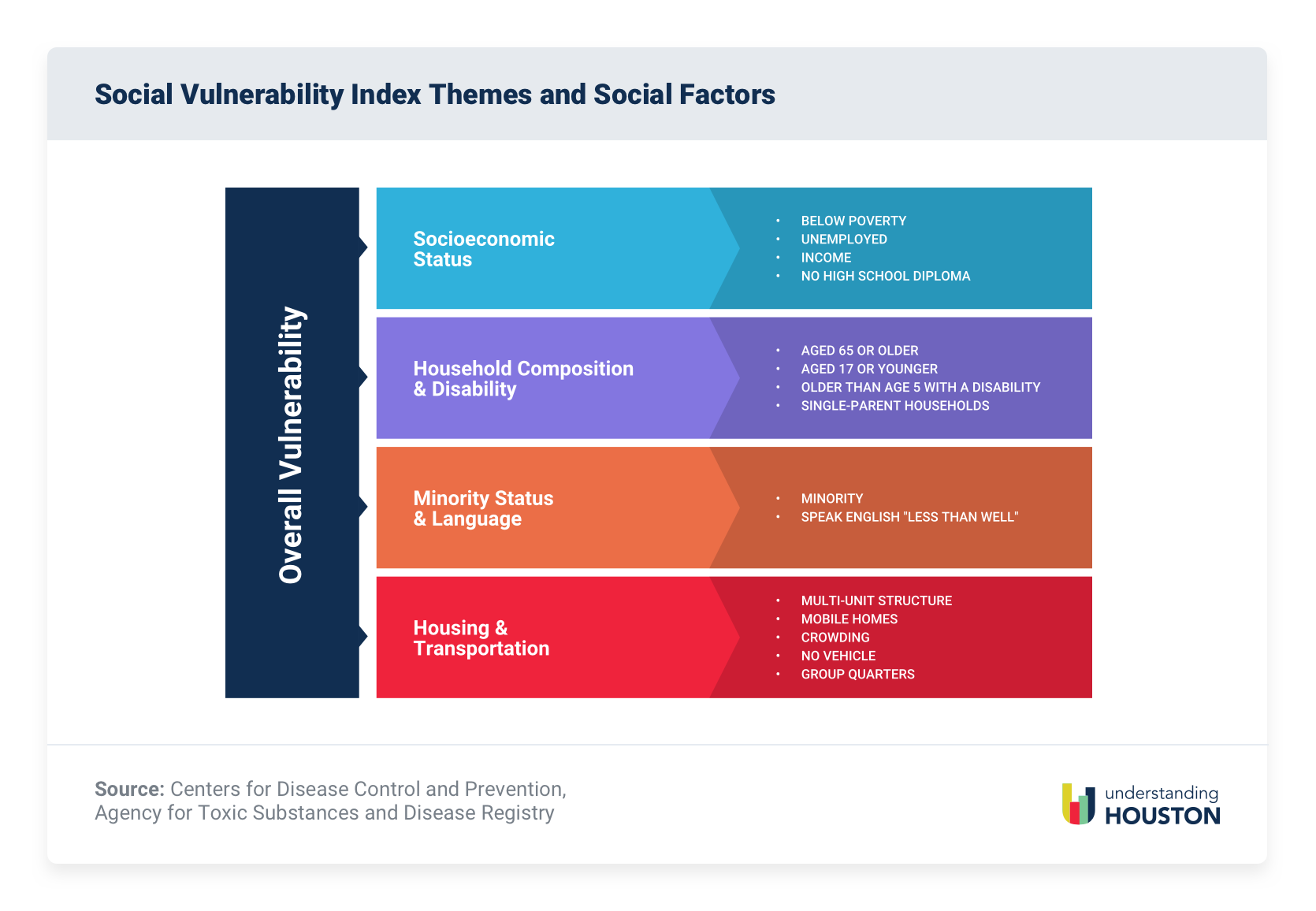
    The SVI comprises 15 demographic characteristics and social factors across four themes: socioeconomic status, household composition and disability, non-white status and language, and housing and transportation. Examples of vulnerabilities that increase a community’s SVI (i.e., indicating more vulnerability to impacts from disasters), include higher proportions of residents living in poverty, residents older than 64 years or younger than 18 years, non-white residents, and those with poor housing conditions and unreliable transportation.

    One of the strongest determinants of community resilience is income and wealth. Higher-income communities are most likely to have access to resources that mitigate disaster impacts and facilitate recovery, allowing residents to be able to move on from disasters relatively swiftly. However, income is only part of the equation. Families of four that earn the median income for the region can still be economically insecure after incorporating the high costs of housing, transportation and other necessities.

    Vulnerable households are more likely to experience food insecurity in times of disaster as food prices increase, food availability diminishes from disrupted supply chains, and public transportation halts. Of course, households with more disposable income that can regularly stock non-perishable goods, hygiene products and water are less likely to feel these impacts.

    Fort Bend’s medium-low overall vulnerability index masks the fact that the county’s substantial non-white population could be at higher risk of vulnerability to disaster impacts. Any disaster preparedness plan in Fort Bend County should include protocols to target its residents who are potentially more vulnerable to disaster because of limited English language skills and/or social capital to call upon for help. Montgomery County reports higher social vulnerability than Fort Bend on household composition/disability and housing. Harris County is more vulnerable than the other two counties on all measures.

    Read more about disaster relief in Houston.

    Financial impacts of disasters in the Houston area

    To address urgent basic needs, the Federal Emergency Management Administration (FEMA) provides housing vouchers or cash directly to those affected through its Individual and Household Program (IHP), which is used to cover expenses caused by the disaster, including medical care, dental care, child care, funeral and burial costs, essential household items, clean-up items, moving and storage costs, and vehicle maintenance. Typically, the number of IHP requests from residents to FEMA indicates the scope of impact and need after a disaster.

    More than half a million households across the three-county area applied for FEMA assistance in the aftermath of Hurricane Harvey, compared to 104,000 after Hurricane Rita and 442,000 following Hurricane Ike. The majority of those seeking assistance after Hurricane Harvey were renters, whereas more homeowners sought assistance after Hurricane Ike. The number of households seeking assistance after floods and tropical storms is smaller than after hurricanes, and homeowners typically make up the majority of requests.

    However, not all households that request assistance from FEMA receive it. Low-income households are less likely to receive government assistance.3 One reason for this is that FEMA uses the home’s value before the disaster to determine the level of assistance. If homes have “substantial damage” after the storm combined with “pre-existing” conditions, they are less likely to receive funding for repairs. 

    The approval rate in the three-county area rarely rose above 50% for most disasters occurring since 2005, and homeowners were more likely to be approved than renters in seven of the last nine disasters. Approval rates for both homeowners and renters are lower in Harris County than in Fort Bend or Montgomery counties.

    Half of applicants

    in the three-county region have been denied assistance through FEMA’s Individual & Household Program.

    Three out of five Harris County residents reported financial challenges after Hurricane Harvey, according to a survey conducted one year after the storm by the Episcopal Health Foundation in partnership with the Kauffman Family Foundation. About 51% of white residents experienced financial struggles, compared to nearly 64% of Latinos and 75% of Black residents. One year later, 31% of Black respondents reported being in a worse financial position, compared to 25% of whites, as a result of the hurricane.

    Housing impacts of disasters in the Houston area

    FEMA provides data on the average cost of damage homeowners experience after disasters, regardless of whether the agency provides financial assistance to rebuild or repair.

    Homeowners in the three-county region experienced damage at an average cost of $8,937 after the Memorial Day Flood in 2016, which caused the most damage to homeowners in Fort Bend County. Montgomery County homeowners experienced the most damage from the 2016 Memorial Day Flood and Tropical Storm Imelda. The average damage in Harris County was highest for Tropical Storm Erin and the 2016 Memorial Day Flood.

    Slightly more than 8% of Harris County respondents who were displaced by Hurricane Harvey were still living in a temporary shelter a year later, according to the Episcopal Health Foundation Survey. Many returned home to find an unlivable space and reported their current living conditions were not safe. Nearly three out of 10 households with incomes less than 200% of the Federal Poverty Level (FPL) cited unsafe living conditions, compared to one in 10 households with higher incomes. Hispanic residents of the 24-county area also reported higher rates of unsafe living conditions due to damage from Hurricane Harvey.

    Environmental impacts of disasters and public health in the Houston area

    Environmental impacts from flooding and other natural disasters in Houston’s three-county region can have significant effects on public health, both short-term and long-term. Sewage, debris and chemicals mix with flood waters.4 Chemicals known to be carcinogenic and gasses that worsen respiratory problems are released into the soil, water and air.

    Water Quality

    Rising water levels, flooding and heavy rainfall can carry pollutants into water bodies, residential homes and potable water supply.5 Sewage plants, for instance, are often located in low-lying areas, and are susceptible to flooding.6 When these plants or streets flood, sewage discharges into the flood water. The same happens when refineries and chemical plants are flooded — industrial waste from factories mixes with the flood water.7 Contaminated flood water flows into streets, streams and rivers, and also infiltrates groundwater.

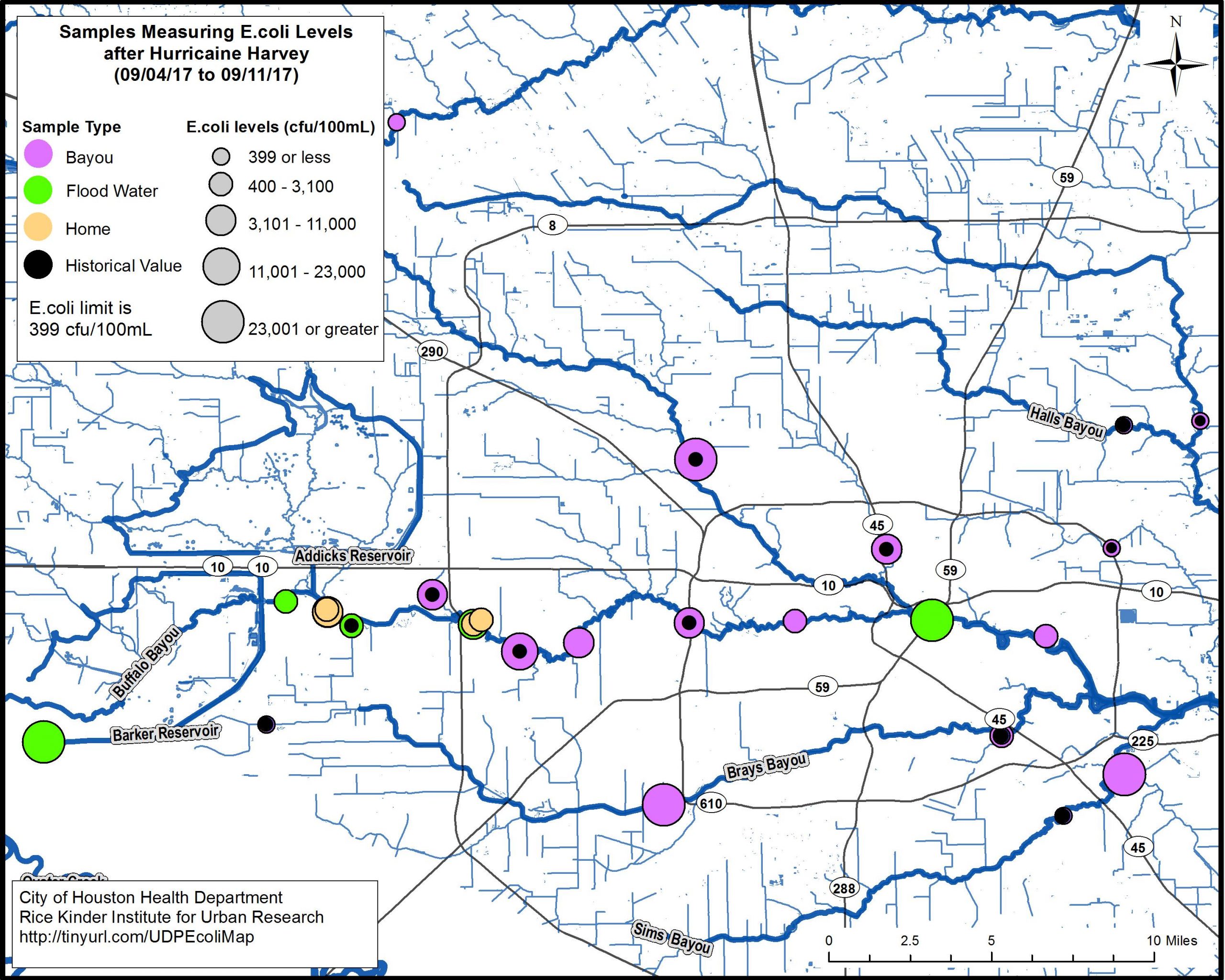
    During Hurricane Harvey in August 2017, thousands of gallons of sewage mixed with the one trillion gallons of rain  dumped on the region, resulting in high levels of E. coli contamination in local bayous and creeks, neighborhood streets, and residents’ living rooms.8 The map below shows the results for 37 water samples, taken between September 4 — 11, 2017 from surface water, flood water, and the interior of homes across Harris County.

    E. coli levels were much lower before Harvey (denoted by black circles), indicating the significant impact hurricanes and flooding can have on water quality. Large purple, green, and yellow circles indicate post-Harvey E. coli levels far greater than the limit set by Texas Commission on Environmental Quality (TCEQ). In some cases, contamination levels were more than 57 times above the acceptable limit. This is especially evident along Buffalo Bayou and in Southeast Houston outside the 610 Loop where levels were far above the limit (23,000 cfu/100mL or greater as opposed to the limit of 399 cfu/100mL).

    57 times higher

    E. coli levels in some areas of Harris County were 57 times higher than the acceptable limit after Hurricane Harvey.

    Air Quality

    Air pollution in the greater Houston area can worsen during major storms and hurricanes as oil refineries and chemical plants often conduct emergency shutdowns in preparation and then restart systems after the storm passes. This process involves burning excess fuels and chemicals in the pipelines which emits volumes of pollution into the air. At the same time, air quality monitoring has often been suspended in anticipation of a major storm to prevent equipment damage and can take days to get back online. This makes it difficult to track the exact amount of air pollution emitted during a storm. 

    Industrial facilities in Greater Houston generated an additional 340 tons of toxic air pollution during Hurricane Harvey because of shutdowns, restarts and malfunctions.9 This figure is likely an undercount since facilities self report the data and it includes only 13 of nearly 400 major industrial facilities operating in Harris and Jefferson counties, according to the Environmental Protection Agency.

    Houston Advanced Research Center mapped the environmental impacts of Hurricane Harvey in 2017 and found significant increases in water and air pollution in the region.

    Public Health

    The cumulative effect of environmental hazards such as contaminated water and air can negatively affect one’s health immediately after a natural disaster and for an extended period of time afterward. Ingesting contaminated water can make us sick and a surge in air pollution can precipitate or aggravate respiratory conditions — or worse in more severe cases.

    Not all physical health conditions that present after a natural disaster are caused by polluted water and air. Residents whose homes flood face unique hazards such as mold exposure or adverse effects sustained during clean-up activities. Mold typically grows on damp surfaces within 24 to 48 hours — and even faster in humid climates.10 Mold exposure affects everyone differently depending on the type and level, but typical symptoms include respiratory problems, nasal/sinus congestion and eye, nose, throat irritation.

    After Hurricane Harvey, the Texas Flood Registry found that 63% of respondents experienced at least one negative health symptom such as runny nose, headaches/migraines, problems concentrating, shortness of breath, or skin rash. For the two storms surveyed after Harvey — the May 2019 storms and Tropical Storm Imelda — the results were less severe. Tropical Storm Imelda resulted in negative health symptoms for 9% of respondents, while 8% experienced negative health symptoms after the May 2019 storms.

    Low-income communities in predominantly-Black and Latino neighborhoods are disproportionately subjected to environmental hazards and resulting public health problems.11 Communities of color and low-income residents are more likely to reside in Houston areas that flood or contain petrochemical plants because of historical discriminatory housing policies, such as redlining, among other factors.12 These neighborhoods also tend to lack effective wastewater infrastructure, exacerbating flooding risks. As more-intense storms are forecasted, health risks will only increase for Houstonians.

    Mental health impacts of disasters in the Houston area

    In addition to negative physical health outcomes, disasters hurt residents’ mental health.13

    Nearly one-third of Harris County residents experienced negative effects on their mental health after Hurricane Harvey, according to the Episcopal Health Foundation Harvey survey.14 Black residents were most likely to report experiencing negative mental health. And individuals with lower incomes experienced more mental health distress than their higher-income counterparts. To make matters worse, only a small proportion received mental health services in the year following the storm. Latinos were least likely to receive help for mental health distress.

    For recent, less intense storms, the Texas Flood Registry still found negative emotional impacts. In the three-county area, 27% of respondents to the Tropical Storm Imelda survey experienced negative emotional changes, while 20% also experienced negative mental health outcomes as a result of the May 2019 storms. An overwhelming majority of respondents in both surveys indicated that their mental health change was due to their experiences during Hurricane Harvey. In other words, mental health outcomes are tied to previous disaster experiences and have a long-term effect. Each new storm may exacerbate negative mental health outcomes from previous storms.15

    The mental health impact of exposure to disasters, however, is not limited to storms. In mid-December 2021, almost two years after the arrival of COVID in Houston, more than 20% of Houston MSA residents reported that they felt nervous, anxious or on edge for at least more than half the days of a week.

    1 out of 3

    adults suffered from worse mental health after Hurricane Harvey.

    Helpful Articles by Understanding Houston:

    Resources

    References:

    1. Smiley, K.T. (2020). Social inequalities in flooding inside and outside of floodplains during Hurricane Harvey. Environmental Research Letters, 15(9). https://doi.org/10.1088/1748-9326/aba0fe
    2. Bergstrand, K., Mayer, B., Brumback, B., & Zhang, Y. (2015). Assessing the Relationship Between Social Vulnerability and Community Resilience to Hazards. Social Indicators Research, 122(2), 391–409. https://doi.org/10.1007/s11205-014-0698-3
    3. National Low Income Housing Coalition. (2020). Fixing America’s Broken Disaster Housing Recovery System. https://nlihc.org/sites/default/files/Fixing-Americas-Broken-Disaster-Housing-Recovery-System_P1.pdf
    4. Chakraborty, J., Collins, T.W., & Grineski, S. E. (2019, February 1). Exploring the Environmental Justice Implications of Hurricane Harvey Flooding in Greater Houston, Texas. American Journal of Public Health 109, no. 2: pp. 244-250. https://doi.org/10.2105/AJPH.2018.304846
    5. UNC- Asheville Environmental Quality Institute. (2006, January). Assessment of Water Quality Impacts of Hurricanes in Western North Carolina Through Strategic Monitoring and Statistical Analysis (Technical Report No. 06-153). http://www.environmentalqualityinstitute.org/vwin/pdf/Hurricane-Project-EQI.pdf

      Schaffer-Smith, D., Myint, S. W., Muenich, R. L., et. al. (2020). Repeated Hurricanes Reveal Risks and Opportunities for Social-Ecological Resilience to Flooding and Water Quality Problems. Environmental Science & Technology, 54 (12), 7194-7204. https://doi.org/10.1021/acs.est.9b07815
    6. Yu, P., Zaleski, A., Li, Q., He, Y., Mapili, K., Pruden, A., Alvarez, P. J. J, & Stadler, L. B. (2018). Elevated Levels of Pathogenic Indicator Bacteria and Antibiotic Resistance Genes after Hurricane Harvey’s Flooding in Houston. Environmental Science & Technology letters, 5, 481-486. https://doi.org/10.1021/acs.estlett.8b00329
    7. National Oceanic and Atmospheric Administration. (2019, February). Watersheds, flooding, and pollution. https://www.noaa.gov/education/resource-collections/freshwater/watersheds-flooding-and-pollution
    8. Texas Commission on Environmental Quality. (2017, December). Wastewater: Hurricane Harvey Related Sanitary Sewer Overflows and Other WW Discharges. https://www.tceq.texas.gov/assets/public/response/hurricanes/sso-ww.pdf
    9. U.S. Environmental Protection Agency. (2019, December). EPA Needs to Improve Its Emergency Planning to Better Address Air Quality Concerns During Future Disasters (Report No. 20-P-0062). https://www.epa.gov/sites/production/files/2019-12/documents/_epaoig_20191216-20-p-0062.pdf
    10. U.S. Federal Emergency Management Administration. Dealing With Mold and Mildew in your Flood Damaged Home. https://www.fema.gov/pdf/rebuild/recover/fema_mold_brochure_english.pdf
    11. Joint Center for Political and Economic Studies, Health Policy Institute. (2008). Environmental justice through the eye of Hurricane Katrina. https://inequality.stanford.edu/sites/default/files/media/_media/pdf/key_issues/Environment_policy.pdf

      Villalón, J. (2020, September 18). Flooding Disproportionately Impacts People of Color. Bayou City Waterkeeper. https://bayoucitywaterkeeper.org/flooding-disproportionately-impacts-people-of-color/
    12. Flores, A. B., Collins, T. W., Grineski, S. E., & Chakraborty, J. (2020). Disparities in Health Effects and Access to Health Care Among Houston Area Residents After Hurricane Harvey. Public Health Reports, 135(4), 511–523. https://doi.org/10.1177/0033354920930133
    13. Stanke, C., Murray, V., Amlôt, R., Nurse, J., & Williams, R. (2012). The effects of flooding on mental health: Outcomes and recommendations from a review of the literature. PLoS currents, 4, e4f9f1fa9c3cae. https://doi.org/10.1371/4f9f1fa9c3cae
    14. Experienced any of the following since and as a result of Harvey: They have had a harder time controlling their temper; Their mental health has gotten worse; They started taking a new prescription medicine for problems with mental health; or Their use of alcohol increased.
    15. Lowe, S. R., McGrath, J. A., Young, M. N., Kwok, R. K., Engel, L. S., Galea, S., & Sandler, D. P. (2019). Cumulative Disaster Exposure and Mental and Physical Health Symptoms Among a Large Sample of Gulf Coast Residents. Journal of Traumatic Stress, 32(2), 196–205. https://doi.org/10.1002/jts.22392
  • Risks

    Risks

    Natural Disaster Risks in Houston

    Exploring natural disaster risks in our region

    In the greater Houston region, natural disasters have become more frequent, dangerous and costly. The risks are only projected to increase in the future, threatening Houstonians’ lives and livelihoods.

    Why natural disaster risks matter to Houston

    Those who live in Greater Houston are all too familiar with the risk of natural disasters in the form of flooding or hurricanes. Hundreds of thousands of properties in the region are currently at risk of flooding, and that figure is only projected to increase over time as storms become more intense and common. This increasing risk poses a threat to the safety of all residents. Without a stronger understanding of our current and future risk, our region’s residents and leaders cannot fully prepare for or mitigate the catastrophic consequences of frequent disasters.

    The more we understand the scope of disasters and the effects of climate change in our region, the more we can do to minimize risks to our community.

    The data

    History of Disasters in the Houston area

    The Federal Emergency Management Agency (FEMA) has declared a disaster in Fort Bend, Harris or Montgomery counties — the three most populous counties in Greater Houston — 26 times in the past 41 years, including the most recent severe winter storm in February 2021. Nearly a third of those (eight) have occurred since 2015.

    26 disasters in 41 years

    FEMA has declared a disaster in Greater Houston 26 times in the past 41 years. Eight have occurred since 2015.

    History of Disasters in Greater Houston's Three-County Area (1980-2021)

    Since 1980, the Greater Houston region has experienced 12 major rain/thunderstorm and/or flood events, five hurricanes, five tropical storms, two wildfires, a pandemic caused by the new coronavirus, and, most recently a severe winter storm in February 2021 which caused week-long power and water outages, busted pipes, and boil water notices.

    Frequency of Disasters in Greater Houston's Three-County Area (1980-2021)

    The fact that about half of these disasters were caused by unnamed storms would not surprise most residents of the Greater Houston area, where heavy rains and flooding are commonplace.

    Flooding risk in the Houston area

    FEMA creates flood maps to designate areas lying in different flood zones based on varying levels of risk. Properties identified as having at least a 1% chance of flooding in any given year (also known as the base flood or 100-year flood) are designated as a Special Flood Hazard Area (SFHA) — the highest risk. Areas that have a 0.2% annual chance of flooding (a 500-year flood) are considered more “moderate” risk.

    Inaccurate flood maps

    An analysis of flood claims in southeast Harris County between 1999 and 2009 found that 75% of damages were outside the 100-year flood plain.

    However, these maps have limitations that don’t accurately predict where flooding occurs. An analysis of flood claims in southeast Harris County between 1999 and 2009 found that 75% of damages were outside the 100-year flood plain.1 The region experienced five major floods during that time, none of which met the criteria of a 100-year storm. Additionally, a 2012 study across the three decades before Hurricane Harvey found that 47% of flood damage claims made by Harris County residents were outside the 100-year flood zone.2 More than half (55%) of homes damaged in the Tax Day Flood in 2016 were outside the 500-year zone, as were one-third of homes damaged during the Memorial Day Flood in 2015, according to an analysis by the Houston Chronicle. Three out of four homes and apartments in Harris County that flooded during Hurricane Harvey were outside the 100-year flood zone, and half of homes damaged were outside all flood zone designations.

    First Street Foundation has developed specialized floodplain maps using a model that expands on FEMA’s current maps. While the FEMA maps are based on risk from a single 1-in-100-year or 1-in-500-year event, First Street’s model considers additional factors, such as rainfall flood risk, current climate risk, and areas not mapped by FEMA.

    First Street identified 244,842 properties that are at substantial risk of flooding (located within their 100-year flood area) in the three counties — that’s 56,680, or 30%, higher than current FEMA estimates of 188,162. First Street’s model found 60,411  properties are at risk of flooding in Fort Bend County compared to 13,227 identified by FEMA. This is primarily due to incorporating the chance of levee failure in their models.

    Given Houston’s history of flooding well-beyond the designated “high risk” zone, current flood maps haven’t accurately predicted the extent of flooding in the region. The broadest measure of flood risk expands beyond the number of properties within the 100-year flood zone to include those located in floodways, “protected” by levees, and are in the 500-year flood zone. Using this definition, more than 322,000 residential properties (21.7% of all residential properties) in Greater Houston are located in a flood plain.

    322,000 residential properties at risk of flooding

    In Houston’s three-county area – more than one in five.

    Harris County has the most residential properties located in a floodplain (234,404), the majority of which are in 500- and 100-year flood zones. In Fort Bend County, where 68,264 residential properties are at some risk of flooding, the majority of those properties are protected only by a levee. Most residential properties in Montgomery County that are at risk of flooding are located in the 500-year flood zone.

    In Fort Bend, 29.5% of residential properties are located in all flood areas combined, compared to 21.8% in Harris County and 11.1% in Montgomery County.

    Disproportionate flood risks

    Research has shown that the communities most vulnerable to flooding are low-income and non-white.3 This is especially true in Houston where these groups have historically lived on low-lying land (a result of decades of discriminatory housing policies), receive fewer flood mitigation projects, and are characterized by decades of disinvestment, such as poor stormwater infrastructure.4 A recent study found that Black and Latino Harris County residents who lived outside the FEMA-designated 100-year flood zone were flooded at disproportionately high rates during Hurricane Harvey.5

    Research has shown that the communities most vulnerable to flooding are low-income and non-white.

    This proves particularly challenging as low-income homeowners seek to rebuild or prepare for the next disaster. FEMA’s “50% rule” states that if the cost of improvements or the cost to repair a property exceeds half its [pre-disaster] market value (known as “substantial damage”) it must be brought up to current floodplain management standards. This regulation is particularly challenging for households living in homes appraised at lower values because the typical minimum cost of home repair after a flood is around $25,000. That means homes valued at less than $50,000, for example, are typically out of repair options and at greater risk of further damage when the next storm hits.

    More than 32,000 residential properties valued at less than $50,000 are located in flood areas in the three-county region, with the majority being located in Harris County.

    In Harris and Montgomery counties, homes that are valued below $50,000 are more likely to be found in a flood area. Across the three-county region, 23.3% of residential properties valued at $50,000 or less are located in flood areas, compared to 21.7% of all residential properties.

    Future flood risk

    We know that extreme rain poses a growing threat to the Houston area, which means the frequency and intensity of flooding will continue to increase. First Street Foundation projects more properties will flood in the future because of rising sea levels and changing hurricane patterns — consequences of climate change.

    The number of properties in Harris County at risk of flooding is projected to increase to 204,513 in 2050 (up 21.7% from 2020). As many as 64,000 in Fort Bend and 17,600 in Montgomery counties are at “substantial” risk of flooding in 2050.

    That means potentially one in seven (14.2%) of properties in the three-county region will be at risk of flooding by 2050. That is about one in five properties in Fort Bend, one in seven in Harris, and one in 15 in Montgomery counties — each higher than the rate for Texas overall.

    One in seven

    Potentially one in seven (or 14.2%) of properties in the three-county region will be at risk of flooding by 2050.

    Resources

    References:

    1. Blessing, R., Sebastian, A., & Brody, S. (2017). Flood Risk Delineation in the United States: How Much Loss Are We Capturing? Natural Hazards Review, 18, 04017002. https://doi.org/10.1061/(ASCE)NH.1527-6996.0000242.
    2. Highfield, W.E., Norman, S.A. & Brody, S.D. (2013). Examining the 100‐Year Floodplain as a Metric of Risk, Loss, and Household Adjustment. Risk Analysis, 33: 186-191. https://doi.org/10.1111/j.1539-6924.2012.01840.x.
    3. National Academies of Sciences, Engineering, and Medicine. (2019). Framing the Challenge of Urban Flooding in the United States. https://doi.org/10.17226/25381.
    4. Chakraborty, J., Collins, T.W., & Grineski, S. E. (February 1, 2019). Exploring the Environmental Justice Implications of Hurricane Harvey Flooding in Greater Houston, Texas. American Journal of Public Health, 109, no. 2: pp. 244-250. https://doi.org/10.2105/AJPH.2018.304846.
    5. Smiley, K.T. (2020). Environmental Research Letters, 15 0940b3. https://doi.org/10.1088/1748-9326/aba0fe.
  • Response & Recovery

    Response & Recovery

    Response to and Recovery from Disasters

    Exploring how our region responds to and recovers from disasters

    After disaster strikes, all levels of government, as well as the private sector, respond to provide assistance, though some in our region benefit more than others. The result is that some residents take much longer to recover, if they do at all.

    Why an accessible response to disasters matters to Houston

    The way in which we respond to disasters affects the total recovery time for a region and, in many cases, whether and how its most vulnerable residents recover, if at all. Many residents receive assistance from the government and have private and personal resources that enable them to make home repairs or rebuild and move on. Others are not so quick to recover, a consequence of experiencing disproportionate impacts combined with difficulty in accessing the resources necessary to rebuild their lives. The results lead to disparate recoveries both in terms of the recovery time and pathways, thereby worsening pre-existing disparities such as the wealth gap.

    The more we understand the federal, local and private response and approach to disasters, the better we can identify gaps in assistance delivery for different communities and work to ensure a more equitable and timely response, so that everyone in our region not only recovers but is also made stronger.

    The data

    Federal response to natural disasters in the Houston area

    FEMA’s Individual and Household Program

    The Federal Emergency Management Administration (FEMA) addresses urgent basic needs through the Individual and Household Program (IHP), which provides financial assistance to those affected. Thousands apply, but more than half of the applications are denied. Applications that are approved receive varying amounts depending on the extent of damage and disruption, and if property is owned or rented.

    The total amount in IHP assistance FEMA distributed after Hurricane Harvey in 2017 dwarfs that of other regional disasters in recent history. Residents of the three-county region received $918.2 million in FEMA disaster assistance as a result of damage from Hurricane Harvey. 

    FEMA’s IHP program provides assistance to homeowners to repair or rebuild their houses and funding for temporary housing. It also provides funds for owners of multifamily housing complexes, like apartments or condominiums, to fix units. Renters are only eligible for funds for uninsured or under-insured disaster-caused expenses and serious needs, such as repair of personal vehicles, funds for moving and storage, and other miscellaneous expenses approved by the government. Consequently, homeowners typically get more federal financial assistance than renters, who typically receive 64% of the IHP assistance dollars homeowners receive. 

    The average amount Houston homeowners in the three-county region received after Hurricane Harvey was $6,586, compared to $2,018 for renters. While FEMA paid out more for Hurricane Harvey overall than it did for other disasters, the highest average amount both renters and homeowners received in recent history was for the Memorial Day Flood in 2016. Across all disasters, Fort Bend County residents typically received more than residents of Montgomery and Harris counties.

    Small Business Administration

    In contrast to the direct aid of FEMA disaster assistance, the U.S. Small Business Administration (SBA) provides low-interest, long-term loans to homeowners, renters and business owners of all sizes, including nonprofit organizations, that experienced damage from a declared disaster. These loans can be used to cover operating expenses for small businesses as well as repairs and replacement of physical assets that were not previously covered through other means like insurance.

    After Hurricane Harvey, the SBA issued $1.5 billion in home loans to residents in the three-county region, which is 50% more than the entire amount FEMA provided ($918.2 million). The three-county region received an additional $116.9 million in home loans for the four flood events in 2015 and 2016 combined.

    Supplemental Nutrition Assistance Program

    The U.S. Department of Agriculture’s Supplemental Nutrition Assistance Program (SNAP), known previously as “food stamps,” helps eligible low-income households buy food and groceries. For up to three months immediately after a declared disaster, SNAP eligibility requirements are expanded to benefit more people.

    The greatest uptick in SNAP recipients occurred after Hurricane Harvey. The number of people using SNAP in Greater Houston increased by 50% — from 767,000 in August 2017 to 1,153,000 the following month. SNAP usage increased 53% in Harris County, 44% in Fort Bend County, and 6% in Montgomery County during the same time period.

    National Flood Insurance Program

    Possession of flood insurance alone does not necessarily translate to a quick recovery,1 but it acts as a safety net. FEMA manages the National Flood Insurance Program (NFIP) that is designed to compensate for damage from natural disasters. NFIP is the nation’s largest flood insurance program with more than 5 million policyholders nationwide. Properties located in the 100-year flood zone with mortgages from government-backed lenders are required to have flood insurance.

    While properties outside FEMA’s designated 100-year flood zone are not required to get flood insurance, it is recommended, though most people are not aware of the dangers of flooding in their neighborhoods, partly because of outdated flood maps and the absence of state laws requiring landlords to disclose flooding history to renters. That’s one reason why about 80% of flood victims after Harvey did not have flood insurance. Affordability also plays a major role in whether one secures insurance — low-income households, even those who live in the 100-year flood zone are less likely to carry flood insurance. In a nationwide analysis, FEMA found that even though 41% of households are low-income, they comprise 51% of households inside the 100-year flood zone without an NFIP policy.2

    More than half of NFIP policies in Texas are issued in the Greater Houston area. There are nearly half a million active insurance policies for both residential and non-residential properties in the three-county region, the vast majority of which are in Harris County. About 15-16% of Harris County residents carry flood insurance through NFIP. In high-risk areas, that climbs to 28%.3

    Local response to natural disasters in the Houston area

    Local government plays a large role at the beginning of the disaster recovery process. In the immediate aftermath of a disaster, local governments establish shelters, provide basic necessities, coordinate and conduct rescues, and clean up and remove debris.

    Local municipalities and districts also play a large role in mitigating the effects prior to the occurrence of disasters through investments in infrastructure and the adoption and enforcement of flood plain management policies. However, a majority of residents don’t believe the local government is successful in protecting their homes from flooding.

    Six months after the flooding in Houston caused by Hurricane Harvey, about 40% of people in the region rated efforts by the local government to protect homes from flooding as “poor,” according to the Kinder Institute’s 2018 Houston Area Survey. Residents in Harris County have slightly more confidence in local governments than those in Fort Bend or Montgomery counties. Additionally, nearly half of both Black (49%) and white (45%) residents in the three-county region rated local government efforts as “poor.”

    40%

    of Houstonians rated efforts by the local government to protect homes from flooding as “poor.”

    Buyouts

    One method local governments use to mitigate the impact of future disasters is through property buyouts. The buyout program uses federal and local dollars to purchase properties in qualifying areas that have been flooded or affected by other natural disasters multiple times. Then, the land is used as parks, green space, or flood storage or overflow. Eligible properties include single-family homes, commercial buildings, places of worship and multi-family residences, but residential properties are the highest priority. This benefit is available to property owners only. If multi-family properties are bought out, the funds go to the owners, and tenants are required to leave. The average buyout takes longer than five years4 and only one in five typically qualifies.5

    Harris County has used the buyout program more than any county in the nation. Harris County Flood Control District has spent roughly $342 million to purchase about 3,100 homes since 1985, according to a 2017 ProPublica report. There are still approximately 3,300 homes on the District’s priority-buyout list, which represents about 20% of homeowners who have volunteered.

    Between 1995 and 2016, 2,400 properties were bought out, according to FEMA data reported by NPR, among which nearly 90% occurred in Harris County (2,092). An additional 290 buyouts took place in Montgomery County and 18 in Fort Bend. More recent data from Harris County Flood Control District shows an additional 576 properties have been purchased and 695 buyouts are in process since 2017.

    #1

    Harris County ranks first in the nation for use of the buyout program.

    Buyouts are concentrated in areas that experience multiple floods to maximize the effectiveness of the strategy. Buyouts in Harris County have concentrated in Jersey Village (430 buyouts between 1995 and 2016), East Aldine (132), Acres Homes (130), Greenspoint (121), George Bush Intercontinental Airport (119), and Kingwood (114).  Buyouts in Montgomery County have been concentrated in Conroe (158). Fort Bend used the buyout program in 2016 to convert eight properties in Simonton to vacant land.

    Private philanthropic response to natural disasters in the Houston area

    The public sector plays the largest role in natural disaster recovery and response, though it can take time for public dollars to trickle down to individuals. Private philanthropic dollars often support an immediate response — including filling gaps in assistance for the most vulnerable — but philanthropy can also invest in innovative models of program and service delivery.

    Between 2011 and 2019, about $202.6 million philanthropic dollars have been invested in Houston’s three-county region — the vast majority went to organizations based in Harris County, according to data from Measuring the State of Disaster Philanthropy. Over the past decade, disaster philanthropy in the region peaked in 2017 and 2018, with foundations, business and individuals investing $75.8 and $82.3 million in the region, respectively. 

    Nonprofits in Houston that have been top recipients of disaster philanthropy between 2011 and 2019 include Attack Poverty, Fort Bend Family Health Center, and Focus Humanitarian Assistance USA in Fort Bend County; United Way of Greater Houston, BakerRipley, and Greater Houston Community Foundation in Harris County; and Connect Outreach, Missions on Wheels, and Habitat for Humanity in Montgomery County, according to data from Candid.

    An analysis by the Houston Chronicle found that nearly $1 billion was donated after Hurricane Harvey — the most on record after a disaster. That includes $522.7 million by the Red Cross; $114 million by the Greater Houston Community Foundation; $100 million by the Rebuild Texas Fund; $87.5 million by the evangelical group Samaritan’s Purse; $61.4 million by United Way; $41.6 million by JJ Watt’s campaign; $30 million by the Salvation Army; and $14 million by the Center for Disaster Philanthropy. A Charity Navigator report found 5.4 million people donated $742.6 million specifically for Hurricane Harvey relief.

    Slow and uneven natural disaster recovery in the Houston area

    Some residents in our region are not only hit harder by natural disasters in Houston, but also receive less assistance to recover. Research indicates that federal disaster assistance policies tend to place vulnerable groups at a disadvantage and reduce their ability to access resources and assistance for natural disaster recovery.6 As a result, the many impacts of disasters can last more than several years for those with the fewest resources needed to recover. Disasters can also widen the wealth gap. Joint research between Rice University and the University of Pittsburgh found that whites accumulated more wealth after natural disasters between 1999 and 2013 while residents of color accumulated less, even after controlling for a variety of demographic and household factors.7 In Harris County, the disaster-related increase in the Black-white wealth gap averaged $87,000.

    Has Houston recovered from Harvey?

    Data from the Episcopal Health Foundation’s Harvey survey found that Black, low-income and immigrant families were most likely to report they were not getting the help they needed to recover after Hurricane Harvey, and the financial assistance they did receive (if any) covered “very little” or “none” of their financial losses. 

    $87,000

    Disasters can widen the wealth gap between Blacks and whites in Harris County by $87,000.

    About 41% of Black residents who were affected by Hurricane Harvey reported that their lives were still “somewhat” or “very” disrupted one year later, compared to 26% of white residents. Nearly one in five (17%) Harris County residents reported their overall quality of life one year after the storm is worse as a direct result of Hurricane Harvey, with Black (31%) and low-income households (20%) reporting higher levels of disruption than the region overall. 

    Learn about social vulnerability and the Social Vulnerability Index

    Helpful Articles by Understanding Houston:

    Resources

    References:

    1. U.S. Government Accountability Office. (2017, April). Flood insurance: Comprehensive reform could improve solvency and enhance resilience. https://www.preventionweb.net/go/52896
    2. U.S. Department of Homeland Security, Federal Emergency Management Administration. (2018, April). An Affordability Framework for the National Flood Insurance Program. https://www.fema.gov/sites/default/files/2020-05/Affordability_april_2018.pdf
    3. Insurance Information Institute. (2020, June). Fact file: Texas hurricane insurance.
    4. NRDC. (2019, September). Going Under: Long Wait Times for Post-Flood Buyouts Leave Homeowners Underwater. https://www.nrdc.org/sites/default/files/going-under-post-flood-buyouts-report.pdf
    5. ProPublica and The Texas Tribune. (2017, November). Buyouts Won’t Be the Answer for Many Frequent Flooding Victims. https://features.propublica.org/houston-buyouts/hurricane-harvey-home-buyouts-harris-county/
    6. Urban Institute. (2020, September). Federal Disaster Policy Reforms — Including Flood Insurance Treatment—Should Center Racial and Economic Equity. https://www.urban.org/urban-wire/federal-disaster-policy-reforms-including-flood-insurance-treatment-should-center-racial-and-economic-equity/
    7. Howell, J. & Elliott, J.R. (2019). Damages Done: The Longitudinal Impacts of Natural Hazards on Wealth Inequality in the United States. Social Problems, 66(Issue 3), 448-467. https://doi.org/10.1093/socpro/spy016

  • COVID-19

    COVID-19

    Coronavirus Disease 2019 (COVID-19)

    Exploring how COVID-19 and its impacts have affected Houston

    Beyond the human toll of COVID-19, the pandemic has caused the worst financial situation we have seen in generations. Thousands of families are struggling while also grieving the loss of loved ones.

    As of August 2021, the data on this page will no longer be updated. While the content remains accessible for reference, please note that it does not reflect the most current information.

    How COVID-19 and the resulting economic crisis is affecting Houston

    The novel coronavirus disease in 2019 (COVID-19) began to emerge in Greater Houston in March 2020. Since then, life in Houston — like most of the world — has been upended. Hundreds of thousands have contracted the virus, and thousands have died. Unemployment has soared to levels never before seen. The resulting health and economic crisis is ongoing, getting worse, and disproportionately affecting Black, Hispanic and low-income Houstonians.

    By understanding which communities are hit hardest by the various impacts of COVID-19 we can better target resources and assistance to ensure all residents get the support they need.

    The data

    Note about the data

    While we summarize authoritative sources on COVID-19 case and death counts for the three-county area, we’ve made an intentional effort to shed light on the broader impacts of the pandemic across a range of quality of life topics here.

    The majority of data on the social and economic impacts of COVID-19 are from the Household Pulse Survey conducted by the U.S. Census Bureau. All Household Pulse Survey data presented for Houston are at the Houston Metropolitan Statistical Area (MSA) level — a statistical region delineated by the Office of Budget and Management that includes nine counties: Austin, Brazoria, Chambers, Fort Bend, Galveston, Harris, Liberty, Montgomery, and Waller counties. 

    This new survey began in late spring and is currently in its third phase. Phase 1 of the survey was conducted weekly and ran from April 23, 2020 through July 21, 2020. Phase 2 moved to a bi-weekly survey conducted from August 19, 2020 through October 26, 2020. Phase 3 is also conducted bi-weekly and began October 28, 2020. Due to the nature of surveys, the data may change significantly depending on the time period, which is why we offer as much historical data as possible to provide a more complete picture. 

    We will continue to update the site based on more recent data releases and research on how COVID-19 is affecting our region and residents.

    Employment and financial impacts

    COVID-19’s sweeping impacts on the nation’s economy began in March as individuals began staying at home and governments began to issue lockdowns in an effort to flatten the negative health curve. As the economy slowed, workers were laid off and production levels were cut. From the individual worker to entire industries, almost everyone was financially affected, though some more than others. 

    Job losses

    In January and February 2020, unemployment rates in each of Greater Houston’s three counties and Texas was below four percent. Of course, unemployment peaked in April and May, 2020 — soaring to 13.0% in Fort Bend, 14.6% in Harris, and 13.2% in Montgomery counties — the highest on record. As of November 2021, unemployment rates are closer than what they were before the pandemic — 4.8% in Fort Bend, 5.1% in Harris, and 4.7% in Montgomery. November 2021 unemployment rates in the three-county region are slightly higher than they are for Texas (4.5%) and the U.S. overall (3.9%).

    Unemployment insurance claims filed by individuals for the first time in the three-county region spiked late-March and early-April 2020, reaching a peak of 67,221 across the region during the week of April 4 alone. More than 1,217,400 people have filed for unemployment insurance at least once in the region between March 7, 2020 and December 18, 2021 — 136,592 in Fort Bend, 988,718 in Harris, and 92,102 in Montgomery counties.

    1,217,400+ residents

    have filed for unemployment insurance at least once in the three-county region between March 7, 2020 and December 18, 2021.

    In Year 1 of the pandemic, more than half of households in the Houston Metropolitan Statistical Area (MSA) have experienced income loss since March 13, according to March 2021 Household Pulse Survey data from the U.S. Census Bureau. That rate climbs to 64% for Hispanic, 53% for Black, and 50% for Asian Houstonians. While white Houstonians have experienced the lowest rates of job loss, about two out of five have still been affected since the beginning of the pandemic.

    In Year 2 of the pandemic, about one-quarter of Houstonians report lost employment income in the last four weeks as of September 2021. Hispanic and Black Houstonians continue to report higher levels of employment income than the regional average.

    More than half

    of households in the Houston metro area lost employment income in Year 1 of the pandemic. For Hispanic households, that figure increases to nearly two-thirds.

    In Year 1 of the pandemic, adults in lower-income households in the Houston metro area have experienced the highest rates of income loss since March 13, 2020 while those in households within the highest income group have experienced the lowest rates of income loss. In March 2021, 70% of households with annual incomes less than $25,000 have lost income compared to 21% of households that earn more than $200,000 per year. An increasingly larger share of adults in households that earn between $35,000 and $49,999 per year have reported income loss since the beginning of the survey in mid-April 2020.

    Lower-income workers overwhelmingly work on the front lines of the service industry such as in retail, restaurants and bars, accommodation — the sectors with the most job losses as a result of business closures due to the virus.

    In Year 2 of the pandemic, Houstonians report lower levels of lost income in the last four weeks, though the trend of the lowest-paid workers experiencing the highest rates of income loss continues. 

    Economic stimulus payments

    The economic stimulus payments that eligible Americans received around mid-April seemed to provide a much needed boost for Houstonians. The vast majority used the money to pay for important expenses rather than add it to savings, indicating the urgency with which people need an infusion of cash.

    About one out of five respondents did not receive or expect to receive the payment. Of those that did receive a stimulus payment, two-thirds of adults in the Houston metro area used stimulus checks to pay for basic needs such as food, clothing, rent, etc. A smaller proportion of the population used it to pay down debt or add to savings. 

    Nearly three out of 10 Hispanic Houstonians reported they did not receive or expect to receive the stimulus benefit — the highest rate among racial/ethnic groups. One possible reason for this could be that most of Houston’s undocumented population is Hispanic, and households with even one unauthorized member were ineligible for this aid — including those in mixed-status families (i.e., where some family members are U.S. citizens and others are undocumented).

    In general, lower-income households were more likely to spend the stimulus check on everyday expenses. For example, 84% of adults living in households with incomes between $35,000 and $49,999 spent their stimulus checks to pay for needs such as food, shelter, and clothing. While higher-income households were the least likely to receive a check, about a quarter who did put it toward savings rather than spend it.

    Difficulty paying for expenses

    The unprecedented number of job losses in the region, particularly among the working poor, has further constrained families who already lived paycheck to paycheck. The result is that more and more families are having trouble paying for basic necessities.

    The proportion of families struggling to make ends meet gradually increased between August 2020 and the end of the year, but has tapered down since then as we head into Year 2 of the pandemic. However, over three out of 10 Houstonians still had a “very” or “somewhat” difficult time paying for the usual household expenses in mid-December 2021.  

    Black and Latino households have had the most difficulty paying for expenses during the pandemic, though that figure has declined in Year 2. As of mid-December 2021, 53% of Black Houstonians and 41% of Hispanic Houstonians report “very” or “somewhat” difficulty in paying for regular household expenses, although a quarter and nearly two in five white and Asian-American households, respectively, have also experienced some difficulty.

    Food insecurity

    Food insecurity is most common amongst people living below the poverty line, minorities, single adults and single-parent households. Although it is closely linked to poverty, people living above the poverty line also experience food insecurity. This is particularly true during the pandemic when many more households face economic hardship due to employment and income losses and have difficulty accessing food due to fear of catching the virus and limited transportation options.

    Since April 2020, about 15% of households in the region have “often” or “sometimes” not had enough to eat. Among households with children, that rate climbs to an average of 20%. Since the Census Bureau began tracking in mid-April 2020, food insufficiency for families peaked around the end of October/early November and then again in late February, likely a result of the severe winter storm that knocked out power and water for about a week for millions of Houstonians.

    At mid-December 2021 in the Houston Metro Area, 15% of all households reported “often” or “sometimes” not having enough food to eat. The Houston Metro Area has had the highest rate of reported food insecurity among metros 15 times out of the 40 surveys conducted by the Census Bureau, including the one which occurred during and immediately after Winter Storm Uri in February 2021.

    For households with children, food insecurity by mid-December was 15%. Almost one-quarter of Hispanic households with children were food insecure mid-December 2021 compared to 4% of white families with children.

    Highest rate of food insecurity

    The Houston Metro Area has had the highest rate of reported food insecurity among the 15 most populous metros 15 times out of the 40 surveys.

    Housing impacts

    Housing costs typically comprise the biggest expense for households. When large numbers of people lose their jobs and incomes, housing vulnerability increases. Families are at a risk of falling into homelessness, among other challenges.

    Rent/Mortgage Payment

    The majority of Houstonians report being able to pay their rent or mortgage on time. However, homeowners are more likely to be current with housing payments than renters. Between December 1-13, 2021, about 21% of renters were behind on payments compared to 10% of homeowners. While a larger proportion of homeowners have been able to make housing payments since the beginning of the pandemic, renters appear to continue to struggle to do so. Earlier in 2020, homeowners were more likely than renters to have payments deferred, affording them extra time to pay.

    1 in 5 renters

    report being behind on housing payments in December 2021.

    Renters are more likely to be Black and Hispanic, which means these communities are disproportionately impacted by rent — and the consequences of not paying — during the pandemic. 

    A large proportion of Black, Hispanic and Asian Americans in Houston report not being able to pay their mortgage or rent on time. In mid-December 2021, a staggering 41% of Black renters reported not being able to pay last month’s rent compared to 3% of white renters.

    41% of Black renters in Greater Houston

    report being behind on payments in mid-December 2021.

    Looking into the future, renters are consistently about twice as likely to have lower confidence in being able to pay the next month’s rent than homeowners. Over the last several months, an average of 40% of renters are worried about future housing payments compared to 21% of homeowners.

    During the survey conducted between December 1 and December 13 2021, 41% of renters reported “no” or “slight” confidence in making next month’s payment compared to 17% of homeowners. Owners were over three times as likely as renters to expect payments to be deferred. About 45% of Hispanic, 51% of Black and 70% of Asian renters reported low confidence compared to 19% of white renters during the same time period. About 33% of Hispanic homeowners reported low confidence in making next month’s payment compared to 5% of white homeowners.

    Evictions and Foreclosures

    A number of local and federal efforts have been made to protect families from evictions during the pandemic. Government and private rental and direct financial assistance funds have been established and the Centers for Disease Control and Prevention (CDC) issued a moratorium on evictions. Despite these efforts, evictions have still been happening at an unprecedented rate.

    Houston is among the top three cities for the most evictions during the pandemic, according to Eviction Lab. Over 57,000 evictions have been filed in Harris County alone between March 1, 2020 and December 31, 2021, according to the Evictions Dashboard created by January Advisors. Most evictions have occurred in the Greenspoint, Spring Southwest, Eldridge/West Oaks, Westchase, and Alief areas. This official figure is likely an undercount as many evictions in our region happen without a paper trail. 

    57,284 evictions

    have been filed in Harris County alone between March 1, 2020 and December 31, 2021, according to January Advisors.

    Families who are evicted face significant challenges. Many are forced to find subpar housing, move in with others, live in cars or go to shelters, while some end up homeless.1 This is particularly dangerous during a pandemic as overcrowding can facilitate the spread of disease. Moreover, it is nearly impossible to follow CDC guidelines regarding social distancing, staying home, and regular hand hygiene without a permanent residence.

    Houston metro renters are consistently much more concerned about being evicted than homeowners are about foreclosure. In August 2021, 58% of renters who are behind on housing payments reported a high likelihood of losing their home within the next two months compared to 27% of homeowners.

    Looming fears of losing one’s home

    In August 2021, about 58% of renters thought eviction was “extremely” or “very” likely within two months compared to 27% of homeowners feeling similarly about foreclosure.

    Mental health impacts

    COVID-19’s rapid spread and significant death count are enough to negatively impact our collective mental health. Adverse mental health crises — fear of ourselves and loved ones catching the virus, perpetual anticipatory grief — add to the invisible health toll communities are facing. The simultaneous economic crisis has caused hundreds of thousands to lose their jobs, increased the risk of homelessness, and resulted in business and individuals bearing the brunt of massive financial losses. 

    While public health strategies like social distancing reduce the risk of spreading the disease, they may also limit access to our social network and support system, causing feelings of loneliness.2 As a result, most Americans have experienced increased levels of anxiety and depression since the onset of the COVID-19 pandemic.3 And it’s not just adults that are affected. Children’s lives have also been disrupted. Children often lack the ability to process and the tools to adapt to changes which negatively impacts their mental health

    The proportion of adults in the Houston Metropolitan Area that have felt nervous, anxious, or on edge for at least more than half the days of a week has remained elevated in Year 1 of the pandemic, though it has ebbed and flowed as eviction moratoriums were instated and expired, the holidays came and went, and the winter storm in February 2021 exacerbated challenges.

    Heading into Year 2 of the pandemic, a slightly larger proportion of adults report not experiencing anxiety symptoms. In the most recent Census Bureau survey, 22% of adults report anxiety symptoms for at least half the days of the week – similar to rates from the beginning the survey was conducted one year ago.

    As previous data show, the pandemic-induced recession has hit lower-income Houstonians the hardest. This, in part, could explain elevated feelings of anxiety among those who earn between $25,000 – $75,000 per year, compared to those who earn more than six figures. 

    More Than One out of Five

    adults in the Houston metro area have felt nervous, anxious or on edge for at least more than half the days of a week in mid-December 2021.

    Education impacts

    The way children “went to school” was transformed in the pandemic’s early months as districts and campuses moved to online learning. While the lasting impacts of the pandemic on learning and academic outcomes is still unclear,  research suggests the pandemic has and will continue to severely exacerbate pre-existing opportunity gaps that put low-income students at a disadvantage relative to their better-off peers.4

    According to survey data between March 17 -29, 2021 from the U.S. Census Bureau, about 37% of students in Houston MSA have spent less time on learning activities relative to before the pandemic. In this most recent survey, Hispanic and white students were most likely to report spending less time on learning. This question was discontinued by the Census Bureau after March 2021.

    Higher education plans have also changed. Among adults who were planning to pursue education beyond high school, about 17% have canceled their plans and 5% will take fewer classes.

    Among adults who canceled their higher education plans, 59% cite financial constraints as a reason.

    More than half

    of adults in the Houston metro area who have cancelled higher education plans cite financial constraints as the reason.

    Digital Divide

    Even before the pandemic, consistent and reliable access to a computer and the internet was considered a modern necessity to learning. The pandemic has made it even more critical as families decide whether to send their kids back to school in-person or remain virtual. Recent preliminary research suggests online learning and teaching are effective only if students have consistent access to the internet and computers.5 Texas has made substantial efforts to reduce the digital divide among its students, and we can see that progress over time.

    The most recent data from the Household Pulse Survey shows the majority of Houston children always have a computer or other digital device available for educational purposes. Hispanic and Black children typically have the lowest rates of reliable access, making virtual learning impossible and limiting their resources and technical ability. Students were more likely to report never having a device available early in the pandemic, particularly between mid-April and mid-July 2020 and in late February, possibly due to the widespread power outages resulting from Winter Storm Uri.

    As of the most recent data available from the Household Pulse Survey, over 80% of students in Houston reported always having access to the internet in early July. Similar to their access to computers, children from Black households had less consistent access than their white counterparts. 

    COVID-19 confirmed cases

    As of December 30, 2021, there have been over 814,000 confirmed cases of COVID-19 in Houston’s three-county region. There have been 98,501 cases in Fort Bend, 641,760 in Harris, and 74,038 in Montgomery counties.

    From the beginning of March to mid-June, the daily case count in Harris County stayed below 400 per day. However, at the end of June cases began to rise. This increase coincides with what many reports have called the “Memorial Day spike” (a sharp increase in cases associated with holiday-weekend activities). It also coincides with the State of Texas’s order to allow restaurants to open at 75% capacity — previously, restaurants were open at half capacity. The next major increase occurred from September 20-22 was a result of a delay in counting backlogged cases, according to the New York Times. Cases in Harris County were on a steady rise from October 3, 2020 to January 14, 2021 and have been declining since. 

    Fort Bend County also experienced a spike around June 15, as cases started rising at a higher rate, although the increase wasn’t as rapid as it was for Harris County. Fort Bend saw a sharp increase around August 3, due to the addition of backlogged cases to the tally. As with Harris County, cases in Fort Bend County were also climbing steadily in September, 2020 peaking in December and have been declining since mid-January 2021.

    Montgomery County witnessed its steepest increase in COVID-19 cases between early June and mid-July. Positive cases have been fluctuating since. Montgomery County also saw a steady rise in COVID-19 cases in mid-November which started declining the beginning of February 2021.

    Cases per 100,000 Residents

    Between March 4, 2020 and December 30, 2021, Texas recorded 13,032 COVID-19 cases per 100,000 residents. Within the three-county region, Harris County leads with 13,616 cases per 100,000 residents. Fort Bend and Montgomery counties recorded 12,135 and 12,190 cases per 100,000 residents, respectively.

    COVID-19 deaths

    COVID-19 deaths have also been on the rise in Houston’s three-county region, where 11,919 people have died from COVID-19 as of December 30, 2021, including 1,006 deaths in Fort Bend, 9,772 in Harris, and 1,141 in Montgomery counties. 

    Deaths per 100,000 Residents

    Texas has recorded 258 deaths per 100,000 residents due to COVID-19 between March 4, 2020 and December 30, 2021. In the greater Houston area, Harris County has recorded 207 deaths per 100,000 residents. Fort Bend and Montgomery Counties have recorded 124 and 188 deaths per 100,000 residents, respectively.

    COVID-19 Deaths by Race/Ethnicity

    Overwhelming evidence supports the fact that Black, Hispanic and Indigenous people are contracting — and dying from — COVID-19 at a much higher rate than whites. While the virus seemingly doesn’t discriminate, underlying socio-economic factors and existing patterns of inequality contribute to the virus disproportionately impacting these racial and ethnic groups.

    Black and Hispanic populations are more susceptible to dying from COVID-19 because they disproportionately work on the front lines, have lower access to health care, historically live in poor-quality environments, and tend to have a higher prevalence of preexisting conditions.

    In simple terms, if the virus were to affect everyone in relatively similar ways we would expect each group’s proportion of cases and deaths to be comparable to their share of the overall population. However, that’s not what is happening — we see significant disparities in who is succumbing to the virus. 

    For example, while Hispanics make up 25% of Fort Bend County’s population, they comprise over 32% of the county’s COVID-19 deaths.

    A similar pattern exists in Montgomery County. While Black residents make up about 5% of the county’s population, they comprise over 10% of all COVID-19 deaths. 

    Disproportionate Deaths

    Hispanics make up about 25% of Fort Bend County’s population but comprise 32% of all COVID-19 deaths.

    In Fort Bend County, Hispanic Houstonians are dying from COVID-19 at the highest rates. COVID-19 deaths per 100,000 Hispanic residents in Fort Bend County is 107 per 100,000 Hispanic residents. COVID-19 deaths per 100,000 Black residents in Montgomery County is 403 per 100,000 Black residents — over twice the rate among whites in the county.

    Vaccines

    Vaccines started rolling out in mid-December 2020. Official vaccination figures tracked by Texas Department of State Health Services data are below.

    As of January 3, 2022, 83% of Fort Bend County’s eligible population (5 years of age and older) has received at least one vaccine, with 73% being fully vaccinated. Vaccination rates in Harris and Montgomery counties are lower in comparison, with 64% and 57% of the eligible population fully vaccinated, respectively. However, not all residents have equal access to vaccines.

    As of January 3, 2022, Asian Americans have the highest vaccination rates across all three counties and the state of Texas. Black residents are vaccinated at the lowest rates in Harris County as well as the state of Texas while white residents are vaccinated at the lowest rates in Fort Bend and Montgomery counties.

    While income data on who has been vaccinated is not publicly available, we can use survey data from the U.S. Census Bureau to understand general trends. It is important to note these are not official vaccination rates.

    Vaccination rates tend to correlate with income level as well. The higher a household’s income, the more likely they are to have been vaccinated. According to estimates from the most recent Household Pulse Survey, about 72% of adults in households that earn less than $25,000 per year have received a vaccination compared to 85% of households that earn more than $200,000 annually. Vaccination rates for all groups appear to have increased since the beginning of 2021.

    Houston-area residents give a number of reasons for not receiving or planning to receive a COVID-19 vaccine. According to surveys conducted in December the top three reasons for this are concerns over potential side effects (45%), residents don’t trust the COVID-19 vaccines (42%), and wanting to wait and see if it is safe (37%).

    Resources

    References:

    1. Collinson, R., & Reed, D. (2018). The effects of evictions on low-income households. https://economics.nd.edu/assets/303258/jmp_rcollinson_1_.pdf
    2. Kaiser Family Foundation. (2020, August 21). The Implications of COVID-19 for Mental Health and Substance Use. https://www.kff.org/coronavirus-covid-19/issue-brief/the-implications-of-covid-19-for-mental-health-and-substance-use
    3. Pfefferbaum, B., & North, C. S. (2020). Mental Health and the Covid-19 Pandemic. New England Journal of Medicine, 383(6), pp. 510–512. https://doi.org/10.1056/nejmp2008017
    4. García, E., & Weiss, E. (2020). COVID-19 and Student Performance, Equity, and US Education Policy: Lessons from Pre-Pandemic Research to Inform Relief, Recovery, and Rebuilding. Economic Policy Institute. https://www.epi.org/publication/the-consequences-of-the-covid-19-pandemic-for-education-performance-and-equity-in-the-united-states-what-can-we-learn-from-pre-pandemic-research-to-inform-relief-recovery-and-rebuilding/
    5. Ibid
    6. Boehmer TK, DeVies J, Caruso E, et al. (2020, May–August). Changing Age Distribution of the COVID-19 Pandemic — United States, 15(9). MMWR Morb Mortal Wkly Rep 2020;69:1404–1409. http://dx.doi.org/10.15585/mmwr.mm6939e1
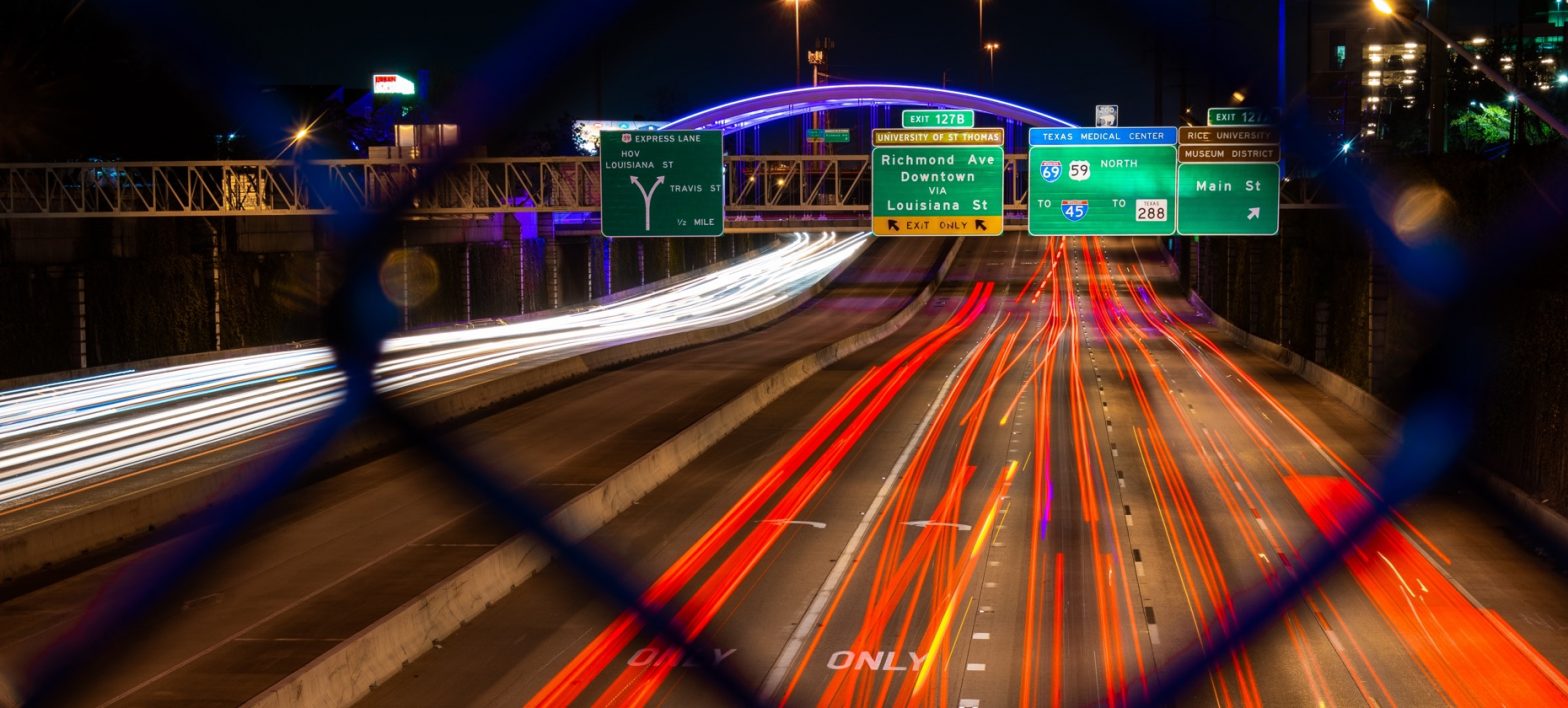
  • Employment in the Arts

    Employment in the Arts

    Arts Employment in Houston 

    Houstonians employed in the arts can make decent wages, but employment rates and troubling disparities leave room for improvement

    Opportunities for Houston creative professionals are strong, but racial and economic inequalities persist throughout the sector.

    As of August 2021, the data on this page will no longer be updated. While the content remains accessible for reference, please note that it does not reflect the most current information. If you’d like to explore the most up-to-data data available, please refer to:

    Why employment in the arts matters to Houston

    Houston may be most recognized for its contributions in energy, technology and medicine, but our talented community of artists provides a valuable foundation for our region’s success. For example, it contributes more than $45.6 million per year in local tax revenues and $51.8 million in state taxes in Harris County. Further, our ability to attract, nurture and retain these talented individuals has serious implications for our regional economy as we continue the shift toward a knowledge-based economy.1 Despite this, only 30,000 Houston-area residents are employed in the arts, making up only 1.1% of total employment in the region.

    The more we understand the factors affecting artistic employment in our region, the more we can do to strengthen and support this vital sector.*

    *Due to data limitations, our analysis reflects the full nine-county Houston metro area, including Houston, The Woodlands and Sugarland. The only exception is information from the Arts Vibrancy Index, which specifically measures county-level figures.

    The data

    Artist occupations in the Houston area

    Thanks to our vibrant, diverse communities and relatively affordable cost of living in Houston, the three-county region is home to a wide range of people with careers in art and design. 

    Consistent with national trends, designers make up the largest share of artists, representing nearly one-third of the total  jobs in the arts in Houston.2  The “Other” category, which represents 18% of employed artists in Houston, consists of a variety of sports-related workers, entertainers and performers, announcers and more working for any of our six professional sports organizations and other entertainment institutions. 

    Art employment scores

    The Arts and Culture Employees Score from the Arts Vibrancy Index, created by our partners at SMU DataArts, measures key indicators of artistic health in a region on a scale from 0 to 100. The Arts Vibrancy Index scores are akin to percentiles, meaning that if an area has a score of 52, it outperforms 52% of other similar areas (in this case, counties) on that measure.* 

    The Arts and Culture Employees Score provides more valuable context, measuring how Houston’s three main counties compare to other areas based on their numbers of salaried employees or independent contractors in the art sector, which includes museums, historical sites, theaters, dance, music, opera and other performing arts.

    Harris County far-and-away leads the region in employment for artists, outperforming 73% of counties nationwide. While Fort Bend County does better when it comes to arts and cultural employment than 57% of the country, Montgomery County lags behind with a score of 39. 

    “Harris County outperforms 73% of counties nationwide on arts and cultural employment.”

    Race and employment in the arts

    Since 1980, all three counties have been growing increasingly diverse. And while growing regional diversity can open the door for greater diversity in artistic expression, Houston’s multicultural sensibilities have not yet translated into more equitable employment within Houston arts and culture organizations. 

    Though every ethnic group is represented in each artist occupation, white workers occupy a distinct majority of virtually all arts jobs in Houston. White artists account for well over 50% of employees in every artistic occupational category but one — in some cases, as in fine artists, over 60% or 70% — of the workforce. Only in the performing arts category do white performers hold under 50% of the jobs in the arts. This data represents a noteworthy divergence from the region’s increasing diversity in other industries. 

    31% of Greater Houston media employees are Hispanic

    The largest share of arts employment held by any non-White group in the Houston metro area.

    Artist earnings in the Houston area

    Earnings and compensation are some of the most important factors determining the health and viability of creative professions in our area. On average, artists working in Houston earn more than $27 per hour, well above the $17 an hour that is considered as the living wage for a family of four.3 However, wages for the majority of artist occupations are unfavorable when compared to what many other technical and professional workers earn across the region. 

    While there are some art careers that pay well, there are large discrepancies between different jobs in the arts sector. Architects are the highest-earning artists with a mean hourly wage of $52.56. On the opposite end of the wage spectrum are floral designers, who earn only $12.07 an hour on average. As an employment category, large income disparities exist between careers in art and design. For instance, commercial and industrial designers make more than three times the wages of floral designers with mean hourly earnings of $39.53.

    Read more about the importance of equitable access to the arts from Arts Connect Houston.

    $52.66/hr

    Non-landscape architects are the highest-paid arts employees in the Houston metro area.

    Data Note: 

    * The Arts Vibrancy Index includes 12 measures that fall under three main rubrics: total arts providers, considering the number of independent artists, arts and culture employees, nonprofit arts and cultural organizations and arts, culture and entertainment firms in the community; total arts dollars in the community, including earned revenue from program activities, contributed revenue supporting the arts, total compensation to artists and staff and total expenses; and public support using state and federal arts funding.

    Helpful Articles by Understanding Houston:

    Resources

    References:

    1. Americans for the Arts. (2012). Arts and Economic Prosperity IV: The Economic Impact of Nonprofit Arts and Culture Organizations and Their Audiences. Washington D.C.
    2. Iyengar, S., Nichols, B., Moore Schaffer, P., Akbar, B., Menzer, M., Moyseowicz, A., … Santoro, H. (2019). Artists and Other Cultural Workers: A Statistical Portrait. Retrieved from National Endowment for the Arts website.
    3. Center for Public Policy Priorities, “Family Budget Calculator

  • Arts Attendance

    Arts Attendance

    Arts Attendance in Houston 

    Houstonians value the arts in their communities, but socioeconomic barriers make engagement difficult

    While interest in the arts is high, residents of color aren’t always able to participate at the same rates as White residents.

    As of August 2021, the data on this page will no longer be updated. While the content remains accessible for reference, please note that it does not reflect the most current information. If you’d like to explore the most up-to-data data available, please refer to:

    Why arts participation matters to Houston

    Houstonians are passionate about the arts. After all, there aren’t many cities that can support year-round professional ballet, opera, symphony and theater companies, and attract more than 10 million to about 22,000 artistic performances and events per year.As our region becomes more diverse, open access to artistic activities and events provide us with a valuable opportunity to connect across races, cultures and income levels.

    By exploring the data and staying informed on arts participation, Houstonians can do more to ensure that all our communities are able to engage with and benefit from the arts in the ways that align with their interests and lifestyles.*

    *The data presented in this section are at the county level and specifically pertain to Harris County. Due to a lack of comparable data in Fort Bend and Montgomery counties, the two counties are not included in this analysis. 

    The data

    How race and income affect arts participation in Harris County

    As one of the most diverse regions in the country, it’s crucial that our artistic community cater to people of all backgrounds. Based on a 2012 survey of 1,200 Houstonians, there appears to be no relationship whatsoever between the ethnic background of an individual and their participation in the arts.

    Black, Asian, Hispanic and White residents are all nearly just as likely to say they attended at least one live performance in the arts during the year preceding the survey. However, more said “no” than “yes” across the board. Asians saw the smallest gap, with 46.1% saying “yes” and 53.9% saying “no.” 

    The slightly lower arts participation exhibited by Blacks and Latinos seems to be entirely due to differences in household income, as 75% of those surveyed in both groups agreed that the arts are “very important, ” compared to 72% of Whites and 71% of Asians. 

    Looking at arts attendance by education level, about 60% of respondents with graduate degrees said they had attended at least one live performance in the arts during the past year, compared to 56% of residents with college degrees, 46% of those with some college education and only 30% of those with high school diplomas or less. 

    This correlates with income levels, as just 29% of Harris County residents who reported household incomes below $37,500 said they had attended live arts performances in the year before the survey. That number nearly doubles to 52% for residents earning between $37,501 and $62,500 annually, and only continues to increase with higher earnings. 

    Venues visited for artistic performances

    More than 80% of Houston residents who said they attended an art performance within the preceding year said they did so at a traditional venue such as a concert hall or theater. Also noteworthy is that more than a third (37%) of those surveyed said they attended a performance at a church or religious facility. A national study of congregations has shown that the arts (specifically music) are an important part of most worship services.1 The arts and spiritual institutions can be deeply beneficial to their communities, but both often struggle to garner sufficient resources. A strong partnership between the two types of institutions can serve as an economic and creative model in the face of increasingly limited funding and space in the arts and cultural sector. 

    Houstonians’ music preferences

    Almost a third of Harris County residents said they most often listened to rock, pop, hip-hop or rap music, and 16% listened to country or folk music. Classical or choral music, jazz or blues, gospel or other religious music were each favored by approximately 10% of Harris County adults. Perhaps unsurprisingly, certain ethnicities account for a greater share of listeners for certain genres. Whites tended to prefer country music, while Black residents were more likely to listen to jazz, blues, and gospel and Hispanic respondents were more likely to say they listened to Latin music.

    Resources

    References:

    1. Klineberg, S., Wu, J., & Aldape, C. (2012). The Houston Arts Survey: Participation, Perceptions, and Prospects. Retrieved from The Kinder Institute for Urban Research website.
  • Access to the Arts

    Access to the Arts

    Access to the Arts in Houston 

    Spending on arts and culture is increasing in our region, but not at a pace consistent with our growing population

    While access to and interest in art and cultural organizations is generally increasing, the three-county area still lags behind the nation in overall support. 

    As of August 2021, the data on this page will no longer be updated. While the content remains accessible for reference, please note that it does not reflect the most current information. If you’d like to explore the most up-to-data data available, please refer to:

    Why access to arts matters to Houston

    A strong artistic community is vital to the ongoing success of our region, and its importance goes far beyond entertainment — that is, if it’s accessible. Why is access to art important? Access to the arts promotes inclusion, community improvements, academic achievement and even improved mental health for residents.2,3 And in order for creativity to work positively in Houston, artistic professionals must be able to access the organizations that enable their work.

    By exploring the data and staying informed on art accessibility, Houstonians can do more to keep these valuable resources available where they’re needed most.

    The data

    Measuring arts and cultural organizations in Houston

    What does access to the arts mean? One way to measure access to the arts in Houston is to measure the number of arts and cultural organizations operating in the three-county region. More arts and cultural organizations mean more art in our communities and more opportunities for artists with different skill sets and backgrounds to contribute to our cultural landscape. And over the past 25 years, these nonprofit organizations have enjoyed consistent growth throughout the three-county area. 

    As of 2015, there were 602 nonprofit arts and cultural organizations across Fort Bend, Harris and Montgomery counties, up from just 181 in 1990. In Fort Bend County, nonprofit arts and cultural organizations have grown sevenfold from six in 1990 to 49 in 2015. Both Harris and Montgomery counties also saw significant growth in their arts and culture sectors. Harris County gained 358 organizations, and the number of arts and cultural institutions in Montgomery County more than tripled. 

    Arts and cultural organizations per 100,000 residents

    Perhaps unsurprisingly, Harris County is home to the vast majority of our region’s artistic and cultural resources. However, Fort Bend and Montgomery County are also experiencing some growth relative to the size of their populations. 

    When compared to similarly-sized communities throughout the country, all three counties fall near the middle of the pack or lag behind. While Harris County experienced the largest total growth in arts and cultural organizations per 100,000 residents between 1990 and 2015, all counties have seen growth during the time period.

    “When compared to the overall rate of population growth in Fort Bend and Montgomery counties, the growth of artistic organizations is still relatively small.”

    Art providers in the Houston area

    Another way to measure art access in Greater Houston is through the Arts Vibrancy Index. Created by our partners at SMU DataArts, the Arts Vibrancy Index measures key indicators of artistic health in a region on a scale from 0 to 100. The Arts Vibrancy Index scores are akin to percentiles, meaning that if an area shows a score of 52, it outperforms 52% of other similar areas (in this case, counties) on that measure.*  

    The art providers score is part of the Arts Vibrancy Index and evaluates the overall presence of art in a given area as indicated by the number of artistic organizations and practitioners per capita. These components are combined in an overall score ranging from 0 to 100. 

    Although arts, culture and entertainment firms are well represented across the three-county area, our overall arts providers scores place us near the middle or the bottom of the pack. Notably, Montgomery County has both the highest score for independent artists (36) and the lowest score for arts and culture organizations (24) in the area. 

    Cultural and ethnic awareness organizations in the Houston area

    Houston is one of the most ethnically and culturally diverse cities in the country. And as our diversity continues to increase, cultural organizations that reflect the contributions and traditions of our multi-ethnic population are becoming increasingly important. 

    Consistent with our growing diversity, the numbers of cultural and ethnic organizations have skyrocketed in the three-county area, with Harris County contributing the lion’s share of growth. In 1990, only six cultural and ethnic organizations existed and all of them were in Harris County. As of 2015, Fort Bend, Harris and Montgomery County have all seen growth in this vital category, with Harris County jumping from six to 87, and Fort Bend County jumping from zero to eight. Although these numbers may seem low, growth in this area suggests that the nonprofit arts sector is aware of the cultural needs of our region’s diverse populations and is taking meaningful steps toward serving and engaging them. 

    Sixteen-fold increase in cultural and ethnic awareness organizations

    Consistent with our region’s growing diversity, the number of artistic organizations dedicated to cultural and ethnic awareness skyrocketed between 1990 and 2015.

    Measuring spending by arts and cultural organizations

    Houston’s art and cultural sector plays a crucial role in our overall economic prosperity, and examining how creative organizations use their resources in our communities helps us understand their larger role in the Greater Houston economy. Per the Arts Vibrancy Index, this spending indicates how much money the region uses on arts and cultural programming, helping to gauge the overall demand for arts and culture offerings in Houston. 

    Between 2000 and 2015, total spending by arts and cultural organizations in the three-county area more than doubled, jumping from $267 million to $563 million. The vast majority ($514.4 million) of the spending in 2015 occurred in Harris County. Fort Bend County’s spending increased by 32% over the 15-year period, moving from $4.8 million to $6.4 million; and Montgomery County’s arts and cultural spending also saw a twofold increase, rising from about $21 million to nearly $42 million. 

    However, these increases are much more modest when weighed against overall population growth. Between 2000 and 2015, Fort Bend County’s per capita arts and cultural spending actually decreased by 35%, suggesting that Fort Bend’s population growth over that time outpaced the growth of arts spending in the region. 

    What we spend on art and culture

    The Arts Vibrancy Index also tells us how much money is spent on the arts, including state and federal funding for Texas art grants.. Scores range from 0 to 100 and are comparative based on other areas of similar size and population.

    Across the three-county area, total expenses scores range from 84–92%, indicating greater levels of spending by nonprofit arts and cultural organizations than in the majority communities across the country. And while government support is largely consistent with the total expenses in each county, Montgomery County shows a striking disparity with a Government Support Score of 20 compared to a score of 86 in total expenses. 

    Learn more about arts attendance and jobs in the arts in Houston

    Data Note: 

    * The Arts Vibrancy Index includes 12 measures that fall under three main rubrics: total arts providers, considering the number of independent artists, arts and culture employees, nonprofit arts and cultural organizations and arts, culture and entertainment firms in the community; total arts dollars in the community, including earned revenue from program activities, contributed revenue supporting the arts, total compensation to artists and staff and total expenses; and public support using state and federal arts funding.

    Helpful Articles by Understanding Houston:

    Resources

    References:

    1. Jackson, M.-R., Kabwasa-Green, F., & Herranz, Jr., J. (2006).Cultural Vitality in Communities: Interpretation and Indicators. Retrieved from Urban Institute website.
    2. Patterson, G., & Binkovitz, L. (2019). Artist-Planner Collaborations: Lessons Learned from the Arts and Culture Ecosystems of Three Sun Belt Cities for a New Model of Inclusive Planning. Retrieved from The Kinder Institute for Urban Research website.
    3. Arts, Culture, and Community Mental Health. (2019, April 19). Retrieved June 28, 2019.