Exploring the factors influencing Houston’s famed entrepreneurial spirit
Houston’s business culture is unique — both distinctly global and local, it owes its evolution as much to every hardworking Houstonian as it does to the frontier mentality from which its industry grew. Entrepreneurship is an essential part of what it means to live in Houston, and whether you’re buying new business software or a cup of coffee, Houston small businesses and the entrepreneurs who run them likely play a role in your purchase.
Industry is in our history
Houston owes its existence to brothers John Kirby and Augustus Chapman Allen, two entrepreneurs who saw opportunity in the unrest following the bloody Battle of San Jacinto. They bought their initial spit of 6,600 acres for just $10,000, successfully lobbied the Texas Congress for capital status, and put some ads in the paper claiming glory for Sam Houston and the Republic — all with about a dozen citizens sitting on a muddy bayou in land that wasn’t considered particularly desirable.
First, they built a railway (that would go on to join the Union Pacific Railroad) and advertised the city as the place “where 17 railroads meet the sea,” despite the fifty miles in between Houston and the Gulf of Mexico. Once the railroad was underway, the city spent the next 50+ years bringing the sea to its borders, dredging Buffalo Bayou and Galveston Bay incrementally to accommodate larger and larger ships.1 They eventually turned that muddy stream into the second largest port in the United States, beginning the project before oil was ever even found in the state.
Oil did, however, change everything. It made Houston the unofficial capital of the energy industry, combining the maverick spirit of its founders with the industry boom of many in the country chasing down the valuable resource, and contributing significantly to the growth of our region.
Houston’s origins tell a story not just of the quality of the human spirit, but of the inherent balance and imbalance of economic opportunity. To continue improving our great city through years of its exponential industrial and population growth, it is necessary to look unceasingly into how our entrepreneurial nature can better serve every single Houstonian.
In Houston, small business is big
Houston is certainly a huge, global city, but it just wouldn’t be the same without Mom and Pop.
Houston is famous for its maverick founders, its tycoons, for the big business and even bigger briskets — but the reality is that business in Houston isn’t always so “big.”
Small businesses employed about 14% of our region’s workforce in 2019 — nearly 400,000 people. In addition, 81% of entrepreneurial firms in the Houston Metropolitan Area have fewer than 20 employees. According to estimates from the Greater Houston Partnership, the Metropolitan Area had 663,800 “non-employee businesses” in 2018; these are most often consultants or freelancers — the entrepreneurial spirit exemplified.
What is the main business in Houston, Texas for small business owners? While real estate is Houston’s number one industry for small businesses, with 95% of firms employing fewer than 20 , industries like retail and administrative services are right on their heels, and smaller companies exist in all sectors (even energy!). These small businesses benefit Houston’s economy in important ways. In particular, creation of small businesses among communities of color — sometimes a necessity to overcome employment barriers, challenges in building personal wealth, and discrimination — can help increase economic opportunity..
Continued intentional support of Houston small businesses, especially among communities that disproportionately face challenges like lack of credit access, social capital and accumulation of generational wealth, is what the path toward a healthier and more vibrant local economy looks like.
81% of Houston-area firms have fewer than 20 employees.
Source: U.S. Census Bureau, 2020 Annual Business Survey, data year 2019
Diversity and disparities in Houston small business
As well as its reputation for entrepreneurship, Houston is also a city known for its diverse population. Its cultural diversity today mirrors what demographers predict the U.S. population will look like in half a century. Houston’s reputation for entrepreneurship is inextricably linked to the city’s diversity. The growing populations in Houston from diverse backgrounds, namely immigrants and people of color, are not only the economic and cultural driving force for the evolution of our city, but also the future of our country.
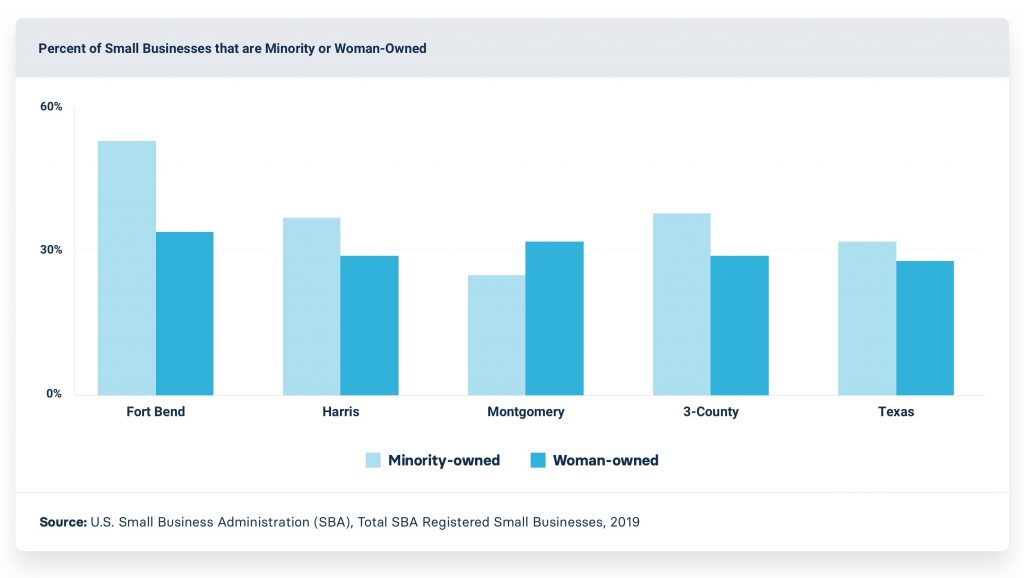
Houston ranks fourth in the nation for start-ups owned by Black, Indigenous, and other people of color (BIPOC), with 35% of start-ups in the Houston Metropolitan Area being BIPOC-owned. While 35% is high enough to outpace most major metros in the United States, it obviously falls short of true representation; the BIPOC population share of Houston Metro is far greater, at about 65%, according to 2020 Census data. Black and female residents remain particularly underrepresented in the small business community, with only 25% of small businesses in the Houston area being solely woman-owned, and only 3% being Black-owned, according to the 2020 Annual Business Survey.
These trends underline the fact that simply being diverse is not enough, and that disparity will edge out prosperity if not given the proper attention and resources.
Continue reading about income inequality and diversity in Houston
Only 35% of new Houston businesses are BIPOC-owned
By contrast, these residents represent 65% of our region’s population.
Source: U.S. Census Bureau, 2020 Annual Business Survey, data year 2019
A region filled with allies for Houston entrepreneurs
So, is Houston a good city for business? What kind of resources do Houston entrepreneurs have aside from an industrious culture? Despite common perceptions, the entrepreneurial spirit is not solely an individual cause. Houston’s penchant for entrepreneurship is aided in great part by our philanthropic, academic and nonprofit communities, which work to cultivate and support aspiring business owners from all walks of life.
These are just a few of the organizations whose work empowers entrepreneurs throughout Greater Houston.
Houston Fund for Social Justice and Economic Equity
This new initiative led by Houston Mayor Sylvester Turner and some of Houston’s top community leaders is working to fund and drive strategic progress for Black-owned Houston businesses and nonprofits.
Impact Hub Houston
With their Black Marketing Initiative, Impact Hub Houston is raising funds and offering training programs to elevate and support Houston’s Black entrepreneurs as they recover from the effects of the COVID-19 pandemic.
The Prison Entrepreneurship Program
The beauty of entrepreneurship is that its benefits are open to all — even those currently behind bars. The people at the Prison Entrepreneurship Program work directly with those currently incarcerated to foster and encourage their entrepreneurial spirits, so that they might find and create new opportunities for themselves and their communities once released.
The Wolff Center For Entrepreneurship
The Wolff Center for Entrepreneurship at UH’s Bauer College of Business has been ranked the number one or two entrepreneurship program in the country, including a number one ranking in 2021 for the third consecutive year. Over the past decade, more than 1,400 businesses have been started by Wolff Center students, earning a collective $399 million in funding.
Entrepreneurship matters to Houston
Ensuring that Houston-area entrepreneurs have access to the tools and resources they need in order to thrive is vital to the continued success of our region. By understanding the challenges and barriers current and aspiring entrepreneurs face in Greater Houston, we can better equip our region with the tools it needs to foster an even healthier small business community that positively impacts us all.
As important as they are to our region’s health and prosperity, Houston’s entrepreneurs are also a reflection of other truths about life in our city. Be sure to follow along on social media and in our newsletter to keep up with the “Houston Is …” series all year long.
Helpful Articles by Understanding Houston:
- A Closer Look at Financial Hardship in Houston
- Is Houston Affordable?
- COVID-19 Recovery and the Ongoing Challenges Facing Houston Entrepreneurs
- Houston’s Three-County Region Accounts for a Quarter of Texas’ Population Growth
- Houston is Vibrant
References:
1Understanding Houston utilizes the U.S. Census term, “Hispanic,” “Latino” or “Hispanic/Latino” when referring to the overall population. For the purposes of this article, we will use these terms interchangeably depending on the nomenclature used in our cited sources.