Category: Community Context

For blogs that talk about Community Context

  • Domestic Violence in Texas: Trends, Challenges, and the Houston Perspective

    Domestic Violence in Texas: Trends, Challenges, and the Houston Perspective

    Domestic violence, also known as domestic abuse or intimate partner violence (IPV), is a pattern of behavior in a relationship used to gain or maintain power and control over an intimate partner.

    According to the Centers for Disease Control and Prevention’s (CDC) National Intimate Partner and Sexual Violence Survey published in 2022, half of women and 40% of men experience IPV (i.e., sexual or physical violence, stalking, and psychological aggression by an intimate partner) in their lifetime. These statistics only include individuals who experienced violence in a romantic or sexual relationship. However, domestic violence can occur in many other types of relationships, including between parents and children, grandparents and grandchildren, siblings, current or former spouses, individuals who live together, and both current and former dating partners.

    In the U.S., half of women and 40% of men report experiencing intimate partner violence in their lifetime.

    Experiencing domestic violence can have long-term impacts on an individual and contribute to prolonged mental and physical health problems. About 34% of women (42 million) and 15% of men (17.2 million) who have experienced IPV also report post-traumatic stress disorder (PTSD) symptoms.

    Beyond the impact on individuals, domestic violence poses a significant public health concern.  The National Center for Injury Prevention estimates the cost of intimate partner rape, physical assault, and stalking exceeds $5.8 billion each year—nearly $4.1 billion of which is for direct medical and mental health care services.

    It is important to acknowledge that no single study or dataset can fully capture the true prevalence of domestic violence, as it is significantly underreported. The U.S. Department of Justice estimates that less than half of domestic violence cases are actually reported to the police.

    The 2021 Harris County Health and Relationship Study found that among domestic violence survivors who sought help, the majority turned to friends or family members. For Houstonians, recognizing the many forms domestic violence can take, who it can affect, and the barriers survivors face when seeking help is essential.

    “It is not the victim’s fault – STOP victim blaming. We all need to hold the offender accountable. Change the question from ‘Why doesn’t the victim leave?’ to ‘Why does the offender abuse?”

    Amy Smith, Sr. Director of Operations and Communications for Harris County Domestic Violence Coordinating Council

    Terminology

    The words we use to describe an individual or situation have meaning and can be powerful.

    When collecting and analyzing data, using clear and commonly understood language helps ensure consistency and fosters shared understanding across individuals, organizations, and systems. However, no single term can fully capture every individual’s experience or apply universally across all contexts.

    In discussions of domestic violence, the term “victim” is commonly used by law enforcement and within legal proceedings. In contrast, many service providers prefer the term “survivor” to emphasize resilience and promote empowerment. Both terms carry significance, depending on the setting and the intent behind their use.

    For consistency, Understanding Houston uses data from the Texas Department of Public Safety and aligns with their terminology, which refers to individuals as “victims.” While this reflects the language used in official data collection, it is important to acknowledge the broader context and the diverse ways people may identify their experiences.

    Forms of Domestic Violence

    Often, when people think about domestic violence, they think in terms of physical assault that results in visible injuries to the victim. However, this is only one type of abuse. There are several other categories of abusive behavior.:

    • Control: This can include monitoring phone calls, restricting freedom of choice, and invading someone’s privacy by not allowing them time and space of their own.
    • Economic Abuse: This can include controlling the family income, making them turn their paycheck over, causing them to lose a job, or preventing them from taking a job. Being unable to work can make it even more difficult for an individual to leave an abusive relationship, as the batterer keeps them from having the necessary financial resources to support themselves.
    • Emotional Abuse & Intimidation: Continuous degradation, intimidation, manipulation, brainwashing, or control of another.
    • Isolation: By keeping the victim socially isolated, the batterer keeps the victim from contact with the world. By keeping the victim from seeing who they want to see, doing what they want to do, and controlling how the victim thinks and feels, they are isolating the victim from the resources which may help them leave the relationship.
    • Physical Abuse: Which can include hitting, punching, slapping, biting, etc., but can also include strangulation, withholding of bodily needs, injuring or threatening to injure others like children or pets, and hitting, kicking, or throwing inanimate objects during an argument.
    • Sexual Abuse: Such as exploiting an individual who is unable to make an informed decision about involvement in sexual activity, laughing or making fun of another’s sexuality or body, and making bodily contact with the victim in any nonconsensual way.
    • Verbal Abuse: Coercion, threats, and blame, such as threatening to hurt or kill the victim, their children, a family member, or even themselves, name calling, yelling, screaming, rampaging, or terrorizing.

    According to a report from the Texas Council on Family Violence, Texas domestic violence offenders abuse the same victim again in 70% of cases, even after a warning from authorities or after a protective order was issued. Many organizations that work in this area agree that violence almost always escalates over time. This escalation highlights the persistent and increasing dangers victims of domestic violence face and the need for more to be done to ensure their safety.

    Rates of Family Violence Increased During COVID and Remain High

    Over the past 15 years, the annual rate of reported family violence incidents in Texas has varied but shows an overall upward trend. Since 2018, rates have steadily increased, reaching a 15-year high of 836 incidents per 100,000 residents in 2022. In 2024, 803 incidents were reported per 100,000 residents.

    Harris County consistently reports higher family violence rates compared to the state and Fort Bend and Montgomery counties. While rates increased across all areas after 2019, Harris County experienced the sharpest rise—a 28% increase between 2019 and 2020.

    Some of the increase may be associated with the COVID-19 pandemic, which introduced additional stressors in households and relationships, potentially contributing to more frequent or severe instances of domestic violence. The 2021 Harris County Health and Relationship Study found that almost 52% of survey participants reported an increase in domestic violence after the COVID-19 pandemic began, and about 6% reported that physical violence began during COVID-19.

    However, rates of family violence have remained elevated in the post-pandemic period. During this time, many households in the Houston region have continued to experience economic distress and other challenges that emerged or were intensified during the pandemic.

    According to the 2024 Kinder Houston Area Survey, more than twice as many Houston-area residents reported their finances have worsened in the past few years compared to 2020. Additionally, incomes in the region have stagnated. At the same time, the cost of rent has increased; it is estimated that nearly 2 in 5 households are experiencing food insecurity, and the City of Houston now has the highest poverty rate among the top 25 most populous cities in the United States.

    Research has shown that economic hardship can increase the rate of domestic violence incidents.1,2 One study found a 30% increased chance of male-perpetrated violence linked to job loss, suggesting that the loss of income can create stress within the household and lead to more time at home, which increases a victim’s exposure to abusive behavior.3

    Deaths from Family Violence have Increased Dramatically Since 2017

    As we saw, rates of family violence increased across Texas and all three counties in 2020 with the most significant increase occurring in Harris County.  However, the number of family violence-related deaths has been steadily increasing across the state since 2017.

    Family violence-related deaths in Texas reached a peak of 532 in 2022, the highest in recent history. While deaths have decreased slightly to 465 in 2024, they remain 150% higher than in 2017 (186 deaths). According to the Texas Council on Family Violence, the increases that have occurred after 2017could be due to Hurricane Harvey and/or a higher prevalence of firearms.

    • Hurricane Harvey: Studies show that rates of violence can increase in the wake of a natural disaster due to increased mental distress and anger, as well as limited capacity of safe houses due to increased demands from the affected community or damage caused to the building by the disaster.4,5
    • Prevalence of Firearms: The number of active licenses to carry in Texas increased from 1.2 million in 2017 to 1.5 million in 2024, a 25% rise. In Texas and the United States overall, guns are the most commonly used weapon in domestic violence-related homicides. In 2024 in Texas, nearly three out of five victims (59%) were killed with a gun.

    Research indicates that abusers who own firearms are five times more likely to be involved in partner-related domestic violence deaths. Moreover, domestic violence incidents involving firearms are 12 times more likely to result in fatality than those involving other weapons or bodily force.6,7

    “Leaving an abuser is the most dangerous time for a victim of domestic violence. Survivors often stay because of the reality that their abuser will follow through with threats to hurt or kill them, hurt or kill the kids, or harm or kill pets or others.”

    Rachna Khare, Director of Community Engagement at Harris County Domestic Violence Coordinating Council

    Texas prohibits people convicted of some domestic violence misdemeanors from possessing firearms for five years following their release from confinement or community supervision. However, Texas law does not cover those convicted of violent assaults against a current or former dating partner, known as the “dating partner loophole.” The 2022 Bipartisan Safer Communities Act (BSCA) sought to address this gap at the federal level. However, enforcement of the federal law varies across states due to ambiguities.8 For example, the BSCA does not clearly define what constitutes a “dating relationship” leaving states to define this on their own.9 This creates inconsistencies in how the federal law is interpreted resulting in inconsistent applications across states.

    Reported family violence cases are most likely to occur between current dating partners and spouses

    Across Texas and the Houston region in 2024, the largest share of family violence incidents reported to the police involved victims who a current dating partner or spouse harmed. While domestic violence directly affects the person being abused, its reach extends far beyond the immediate victim. Children in the household often suffer deep and lasting impacts from exposure to domestic violence. For example, a boy who sees his mother being abused is 10 times more likely to harm his female partner as an adult, and a girl is six times more likely to be sexually abused compared to a girl who grows up in a non-abusive home.

    A boy who sees his mother being abused is 10 times more likely to abuse his female partner as an adult.

    Because domestic violence perpetrators are often close to their victims, it is difficult for the abused individual to reconcile that they are being harmed. Once they do recognize this harm, victims face several fears and stigmas when reporting the abuse and receiving assistance, which can deter many people from reporting their abuse. Some of the reasons domestic violence is frequently unreported include: 

    • Fear of the abuser due to threats and ongoing violence
    • Custody issues, shared finances or financial instability 
    • Living arrangements
    • Judgment/disbelief/blame from friends, family, or community members

    Additionally, the accuracy and type of information collected can vary depending on who is collecting the data and how they interact with the person reporting the incident. If a person does not feel safe or comfortable disclosing specific details—such as how they identify or the nature of their relationship with the abuser—the information provided may be incomplete or inaccurate. In some cases, the available reporting categories may not fully reflect the individual’s identity or relationship. For example, if the relationship does not fit into predefined categories on a reporting form, it may be placed under a broad label such as “Other Family Member.” As a result, certain types of victim-offender relationships may be underrepresented or misclassified in official data.

    Nearly two-thirds of reported incidents of family violence had a female victim

    In Texas in 2024, there were twice as many family violence incidents reported where women or girls were the victims as incidents where men or boys were the victim. However, the National Domestic Violence Hotline reports that there are likely many more men who do not report or seek help for their abuse due to many barriers. The barriers include men being socialized not to express their feelings or see themselves as victims, pervading beliefs or stereotypes about men being abusers and women being victims, the abuse of men often being treated as less severe, and the belief that there are no resources or support available for male victims.

    A disproportionate number of reported family violence incidents are from Black and Hispanic Texans

    In 2024, the percentage of reported family violence cases for Black and Hispanic Texans was higher than those demographics’ percentages of the population across the state. Hispanic Texans comprised nearly half (46%) of all reported family violence cases while they made up about 40% of the population. Black Texans made up about 12% of the population but comprised 27% of reported family violence incidents.

    However, these numbers are not a perfect representation of family violence as they only represent incidents that are reported to authorities, and specific populations are less likely to report. Depending on an individual’s belief, culture, identity, personal experience, etc. they may have varying levels of comfortability reporting their experience of domestic violence with law enforcement.

    In the United States, limited English proficiency is one of the obstacles individuals can face when reporting domestic violence. While all survivors and victims of domestic violence can encounter difficulties when reporting abuse, according to the Asian Pacific Institute on Gender-Based Violence, those with limited English proficiency face additional challenges such as:

    • Being stereotyped as uneducated, helpless, or unwilling to learn English or adapt to U.S. culture.
    • Not receiving adequate language interpretation or translation services.
    • Having an English-speaking abuser mislead or lie to police or first responders by deliberately misrepresenting or falsifying facts claiming that they were assaulted, which can lead to the real victim being wrongfully arrested.

    Moreover, across Houston’s immigrant communities, victims face barriers related to cultural taboos, immigration status, cultural mismatches with mainstream agencies, violence from extended family systems, and a lack of knowledge of their legal rights and protective options. As a result, domestic and sexual violence is underreported and underestimated in these communities.

    Culture can also impact an individual’s likelihood of seeking assistance when experiencing abuse from someone they have a personal relationship with. The Urban Institute points to research shedding light on underreporting of domestic violence in the Asian American and Pacific Islander community, which shows that deeply internalized patriarchal values could contribute to minimization and underreporting. Cultural values of prioritizing family and community over individuals can lead this population avoiding talking about their domestic violence experiences. Among Asian American and Pacific Islander women, one of the most common barriers to reporting violence is the fear of bringing shame on their family.

    Additionally, common factors and considerations exist that may account for underreporting of domestic violence by women of color. They include:

    • Cultural norms and/or religious beliefs that restrain the survivor from leaving the abusive relationship or involving outsiders.
    • Distrust of law enforcement, criminal justice systems, and social services.
    • Lack of service providers that look like survivors or share common experiences.
    • Lack of culturally and linguistically appropriate services.
    • Lack of trust based on the history of segregation and classism in the United States.
    • Fear that these experiences will reflect on, or confirm, the stereotypes placed on their ethnicity.
    • Attitudes and stereotypes about the prevalence of domestic violence and sexual assault in communities of color.
    • Legal status in the U.S. of the survivor and/or the batterer.
    • Oppression, including re-victimization, is intensified at the intersections of race, gender, gender identity, sexual orientation, ability, legal status, age, and socioeconomic status.

    “When a survivor leaves, they are taking one of the most difficult and courageous steps imaginable. Our communities can meet that bravery by building a culture where relationships are grounded in respect, safety, and care. These values should define our relationships in moments of calm and in times of crisis.”

    Rachna Khare, Director of Community Engagement at Harris County Domestic Violence Coordinating Council

    Resources for Survivors

    If you or someone you know is experiencing domestic violence, several resources are available to assist and answer any questions you may have, including but not limited to.

    Get involved

    One of the biggest barriers survivors face to reporting, leaving, or recovering from an abusive relationship is the lack of means to support themselves and/or their children financially or lack of access to cash, bank accounts, or assets. Safe, secure, and affordable housing remains a critical need for survivors to flee. As we work to end domestic violence, housing programs and nonprofit organizations that serve survivors must have access to flexible funds. 

    Consider donating to, or volunteering with, organizations who provide housing, financial assistance, legal representation, counseling, advocacy, and several other services to domestic violence survivors in our community.

    “Getting rental assistance has been one of the most important parts of my life, and it was a turning point. When I first held my keys [to our new home], I cried tears of joy. It was life-saving. The kids were so excited to be able to say they finally had their own place. To this day, my youngest son who was eight years old has the exact date and time memorized for when we first moved into our apartment. If Daya had not helped me and my family with housing, I have no idea how my life would have turned out.”

    Anonymous Survivor from Daya Houston

    Learn More

    If you’d like to learn more, the following organizations provide educational resources.

    References:

    1 Schneider, Daniel et al. “Intimate partner violence in the Great Recession.” Demographyhttps://www.ncbi.nlm.nih.gov/pmc/articles/PMC4860387/

    2 Medel-Herrero, Alvaro et al. “The impact of the Great Recession on California domestic violence events, and related hospitalizations and emergency service visits.” Preventive Medicinehttps://www.ncbi.nlm.nih.gov/pmc/articles/PMC7315959/

    3 Bhalotra, Sonia et al. “Domestic violence: the potential role of job loss and unemployment benefits.” The University of Warwick.https://warwick.ac.uk/fac/soc/economics/research/centres/cage/manage/publications/bn34.2021.pdf

    4 Gearhart, Sara et al. “The Impact of Natural Disasters on Domestic Violence: An Analysis of Reports of Simple Assault in Florida (1999-2007).” Violence and Genderhttps://www.liebertpub.com/doi/10.1089/vio.2017.0077

    5 First, Jennifer et al. “Intimate Partner Violence and Disasters: A Framework for Empowering Women Experiencing Violence in Disaster Settings.” Journal of Women and Social Workhttps://journals.sagepub.com/doi/abs/10.1177/0886109917706338

    6 Campbell, Jacquelyn et al. “Risk Factors for Femicide in Abusive Relationships: Results From a Multisite Case Control Study.” American Journal of Public Healthhttps://ajph.aphapublications.org/doi/10.2105/AJPH.93.7.1089

    7 Saltzman, Linda et al. “Weapon Involvement and Injury Outcomes in Family and Intimate Assaults.” Journal of American Medical Associationhttps://jamanetwork.com/journals/jama/article-abstract/397728

    8 Pulliam R, Bauman K, Smith J, Rice K, Harper GW. Closing the Gap: The Need to Eliminate Loopholes in Legislation at the Intersection of Gun Violence and Intimate Partner Violence. Undergrad J Public Health Univ Mich. https://pmc.ncbi.nlm.nih.gov/articles/PMC12360288/

    9Robert Leider. The Bipartisan Safer Communities Act: Doctrinal and Policy Problems. https://scholarship.law.nd.edu/jleg/vol49/iss2/2/

  • Building Pathways to Economic Mobility: Supporting Returning Citizens

    Building Pathways to Economic Mobility: Supporting Returning Citizens

    For many Houstonians, the path to incarceration begins long before a conviction. Decades of research point to how childhood experiences—such as poverty, trauma, unstable housing, and limited access to quality educational or economic opportunity—significantly increase the likelihood of incarceration later in life. And once a person enters the criminal justice system, the barriers to rebuilding their life only grow steeper.

    Every year, thousands of individuals return home to Houston after serving time in prison—ready for a second chance, but too often they are met with closed doors. With limited access to jobs, housing, and support, these returning citizens1 face odds that are stacked against them.

    In a region like ours—where opportunity and resilience define the Houston spirit—these barriers not only harm individuals but also hold back families, communities, and our broader economy. Harris County’s incarceration rate is more than twice the national average, and without better reentry pathways, the cycle continues.

    But what if reentry looked different?

    For more than 20 years, the Prison Entrepreneurship Program (PEP) has worked to make that vision a reality—providing returning citizens with housing, support, mentorship, and the skills to succeed through employment and entrepreneurship. Their work is helping to transform lives, rebuild families, and strengthen the Houston region.

    The scope of mass incarceration

    Mass incarceration describes a period of rapid growth in the number of people incarcerated across the U.S. since the 1970s, driven by policies like mandatory minimum sentencing, the war on drugs, and tough-on-crime laws.

    Since then, the number of people incarcerated in the U.S. has grown sixfold from just under 200,000 in 1970 to nearly 1.2 million in 2022. Although the U.S. represents only 4% of the global population, it accounts for 16% of the world’s incarcerated people, ranking fifth in incarceration rates globally only behind El Salvador, Cuba, Rwanda, and Turkmenistan. In fact, every U.S. state incarcerates more people per capita than most countries.

    Texas leads the nation with the largest incarcerated population at 137,035 individuals in 2022 (most recent data available). To put it into perspective, Texas, as the second most populous state in the country, makes up just 9% of the U.S. population, yet it accounts for 12% of the country’s incarcerated individuals. By contrast, California, the most populous state in the country, makes up 12% of the population but just 8% of those incarcerated (97,483 individuals).

    In Texas, the incarceration rate is more than double the national average at 1,031 incarcerated individuals for every 100,000 people ages 15 to 64. Harris County’s rate is close to Texas’ at 947. In fact, Harris County operates the largest jail in Texas, housing roughly 10,000 people on any given day and processing over 70,000 individuals each year.

    Approximately 40,000 people are released from Texas state prisons annually, with an estimated 20% returning to Harris County. For many of these returning citizens, the challenges don’t end with their release. The consequences of incarceration—such as difficulty finding housing, employment, and stability—often continue long after someone has served their time.

    The impacts of mass incarceration

    Returning citizens face significant barriers to rebuilding their lives after release, especially when it comes to employment and economic opportunity. Many start with zero income and limited education, and also face challenges like lack of transportation, unstable housing, restricted job options, mental health concerns, social exclusion, and the persistent stigma of a criminal record.

    A U.S. Department of Justice study found that one-third of formerly incarcerated individuals never found employment within four years after release. The Prison Policy Initiative estimates that the unemployment rate for this population is around 27%, which is higher than the peak unemployment rates for the civilian population during the Great Recession (10%) and COVID-19 pandemic (8%). According to the U.S. Chamber of Commerce, excluding formerly incarcerated job seekers costs the economy $78 to $87 billion in lost GDP annually. Additionally, these employment challenges contribute to a vast array of other issues including housing insecurity. In fact, formerly incarcerated individuals are 10 times more likely to experience homelessness than the general public.

    It’s important to remember that justice involvement affects more than just the returning individual—it impacts entire families and communities. Today, more than 1 million children have a parent currently in prison, and over 5 million have experienced the incarceration of a parent at some point in their lives. Research shows these children are at greater risk of economic hardship, academic struggles, and even future involvement with the justice system—continuing cycles of poverty and incarceration across generations.

    Given the scale of the incarcerated population in Texas, and Houston, and the substantial challenges this population faces upon reentry, it is critical  to have the right support in place to ease their transition and reduce the challenges they, and their families, face. Research shows that providing access to services both before and after release is cost-effective and improves outcomes. A meta-analysis of 14 studies analyzing the benefit-to-cost ratio of correctional treatment programs (typically offered pre-release) found that for every dollar invested, society could see up to $270 in returns through reduced crime, lower incarceration costs, and fewer victims.2 Similarly, reentry programs (typically offered post-release) have been shown to increase employment and housing stability while lowering rates of recidivism.

    Helping people reintegrate after prison

    Reentry programs—designed to support individuals returning to their communities after serving time in prison—began in the mid-1900s and have changed over time. Early efforts focused on parole boards, which monitored and approved prisoner releases. Over time, these efforts evolved into more formal programs, with dedicated funding directed to government agencies and nonprofit organizations, to help returning citizens successfully reintegrate into communities.

    Reentry programs can give people the support they need to successfully return to their communities after incarceration and can greatly improve public safety and outcomes for returning citizens. These programs can be provided in a correctional institution or in the community upon release, but effective reentry planning should start long before release. While the primary function of reentry programs is to help individuals transition back into their community, reentry is also linked with the goal of preventing recidivism. Recidivism, or a return to criminal or delinquent activity and subsequent imprisonment, is calculated based on the number of individuals who return to incarceration within three full years of release or start of supervision.

    Research has shown that programs that support successful reentry must provide holistic services that address not just immediate needs, but also the broader challenges individuals face after incarceration. These include health, employment, housing, skill development, mentorship, and social networks. According to Harvard University’s Institute of Politics, reentry efforts are most effective when they begin prior to release, are tailored to the unique needs of the individual, and continue with strong community-based support. The report emphasizes that mentorship can be especially impactful when returning citizens are carefully paired with peer or professional mentors who are carefully matched. It also highlights that access to mental health care, job training and matching, and safe, stable housing are foundational for long-term stability.

    A local solution to creating pathways to successful reentry

    While incarceration rates remain high in Texas, our state has been successful in supporting returning citizens as can be seen in our low recidivism rate. According to the Texas Department of Criminal Justice’s (TDCJ) 2024 Biennial Reentry and Reintegration Services Report, recidivism rates for the TDCJ inmate population are among the lowest in the country at 14.7%, compared to a national average of 50%. This low recidivism rate is in part because of partnerships with nonprofit and faith-based organizations, expanded access to vocational training and education inside correctional facilities, and more coordinated release planning.

    Prison Entrepreneurship Program (PEP), a grant partner in Greater Houston Community Foundation’s High-Impact Grantmaking initiative and a long-time partner with TDCJ, has taken a revolutionary approach to prison reentry and aims to provide a pathway from poverty to prosperity for returning citizens. Their mission is to unite executive business volunteers and inmates through entrepreneurial passion and servant leadership to transform lives, restore families, and rebuild communities.

    PEP provides both pre- and post-release services. Their pre-release services provide education focusing on character development, entrepreneurship training, servant leadership, and family reunification. Their post-release services include transitional housing, wraparound services (e.g., transportation, medical services, support networks, etc.), employment support, entrepreneur mentorship, and access to capital. The goal is to provide participants with a comprehensive solution to re-entry into a structured environment of accountability.

    Bringing together in-prison and post-release education, mentorship, and comprehensive services, PEP successfully supports formerly incarcerated individuals in gaining employment and launching businesses that support increases in household income and wealth. Extensive evaluations of PEP programs by Initiative for a Competitive Inner City, American Enterprise Institute, Baylor University’s Institute for Studies of Religion have found that PEP’s program outcomes include:

    • 100% employment within 90 days of release.
    • An average starting wage of $17/hour, and $28/hour within three years.
    • A recidivism rate of less than 10% (compared to the national average of 50%) that results in $4.3M in annual savings to Texas taxpayers.
    • 46% home ownership, contributing to family wealth-building.
    • 700 new businesses formed by graduates, creating $122.5M in economic impact.
    • A return of nearly $8 in social and economic impact for every $1 invested.

    PEP’s program, Barbed Wire to Business (the Collider), focuses on both intrapreneurship (those seeking employment) and entrepreneurship (those starting businesses). While initially created for graduates of PEP’s in-prison programs, the Collider is now being expanded to serve all returning citizens in Harris County. The Collider provides participants with reentry support, education, employment, entrepreneurship training, mentors, business incubation, and capital access.

    Through the Collider program, PEP will serve 550 formerly incarcerated people in Harris County in 2025, impacting families with more than 2,100 individuals. This will lay the foundation to exponentially grow their impact with a goal of serving more than 100,000 individuals annually by 2029, breaking the cycle of poverty and incarceration for families served. PEP aims to support 189 citizen businesses launched, $568 million in cumulative wages earned, and more than 28,000 low-income individuals across Texas and beyond by 2029.

    “If I had not been in PEP, I’d be back in prison with a life sentence still running the game or killed. But I stand strong, and I hope I’m a light to everyone in my community, my family, how to live right. PEP changed my life.” 

    – Jeremy Jones, Life Caddy at Prison Entrepreneurship Program (PEP)

    Breaking the cycle through community investment

    Mass incarceration has left a lasting impact on families, communities, and economies across the country—especially here in Houston. As more individuals return home each year, these ripple effects only grow. By combining holistic, wraparound services with character development, entrepreneurship training, housing, mentorship, and access to capital, PEP is transforming lives and proving that with the right support, people can break free from cycles of poverty and incarceration.

    Through our High-Impact Grantmaking initiative, Greater Houston Community Foundation is proud to support innovative, data-driven solutions like PEP that expand opportunity, restore dignity, and strengthen economic mobility for Houston families. By investing in reentry and reintegration efforts, we’re not only improving individual outcomes—we’re helping build a more inclusive and prosperous Houston.

    Empower second chances and join the movement to break the cycle by getting involved in PEP’s work through a donation, supporting a returning citizen through employment, and/or volunteering as a mentor.


    1A returning citizen refers to an individual who is reentering society after being incarcerated in jail or prison and does not only reference those who are U.S. citizens. This term is increasingly used as a more respectful and humanizing alternative to labels like “ex-offenders” or “former inmate” recognizing that a person’s identity is not solely defined by their criminal record and emphasizes their role as a member of a community who is returning home.

    2The return on investment from these programs varies by the type of program being provided with returns ranging from $1.13 to $269.86. Of the 14 studies analyzed, 13 found a favorable benefit-cost ratio while one study did not.

  • Doing what matters by measuring what matters

    Doing what matters by measuring what matters

    Greater Houston Community Foundation (Foundation) launched Understanding Houston in November 2019, marking nearly five years of insights into our region. The last five years have been quite a journey, and many of you have been along for the ride, and we are grateful for our partners and supporters who have supported us throughout this endeavor.

    Measuring what matters to do what matters

    Using the data from Understanding Houston, we have learned a lot together about Houston’s three-county region.

    • We know more needs to be done to build trust amongst residents and boost civic engagement in our region. Less than half of Harris County residents think “Most People Can Be Trusted,” and while voter turnout hit record numbers in the 2020 presidential election, our region and state still lag U.S. voter participation rates.
    • Our diversity is a point of pride with Fort Bend County’s demographic composition being just about evenly split among the four largest racial/ethnic categories, but we still see disparities across income, home ownership, educational attainment, and health.
    • Houstonians are struggling. Renters are increasingly burdened by the rising cost of housing, incomes have stagnated, and more than 1 out of 3 households in the region is not able to afford their basic needs despite working full-time.

    We have shared this type of data — and more — far and wide. Over 150,000 users have visited the understandinghouston.org website and we’ve provided data briefings to over 3,700 individuals. But Understanding Houston was never meant to be only about collecting data and learning. The purpose was always meant to inform action by measuring what matters to do what matters.

    Our First Three Years

    Community Impact Fund

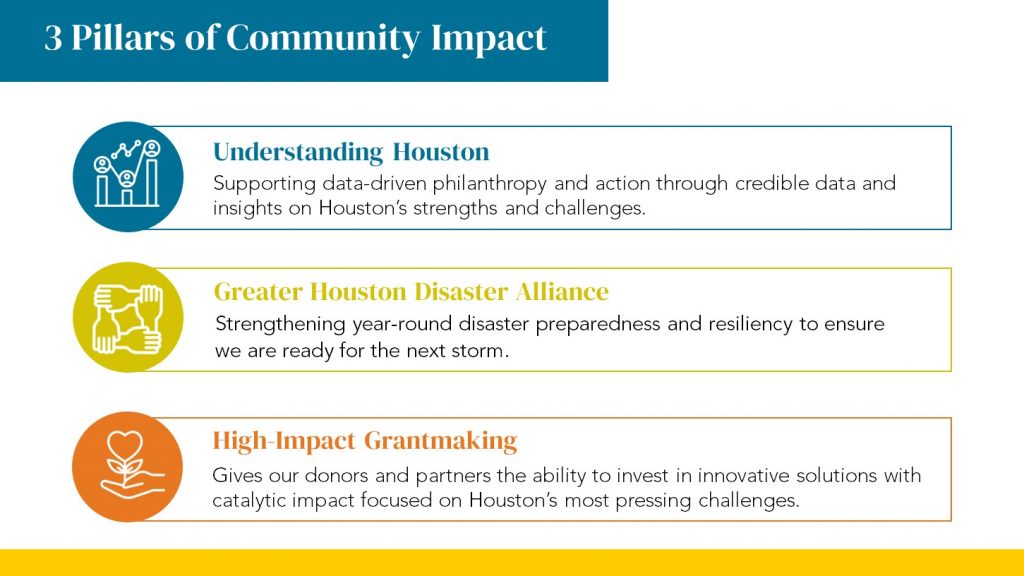
    How did we evolve from Understanding Houston, a data indicators project, to action? Greater Houston Community Foundation’s Community Impact Fund. The Community Impact Fund will be a catalytic force for philanthropic impact – making a meaningful difference in the lives of Houstonians through three pillars of work that speak to data, collaboration, and lasting impact.

    Understanding Houston was the first initiative that started and shaped the Foundation’s Community Impact work. By grounding ourselves in our region’s strengths and challenges through the data and community engagements, we were able to make decisions around how we should deepen our impact and show up for Houston.

    This learning journey, expedited by a global pandemic and a grueling winter storm shortly after, prompted the Foundation to proactively step into a space we had already been leading in reactively. The Greater Houston Disaster Alliance officially launched May 2023 in partnership with United Way of Greater Houston and city and county leadership. This initiative allows us to strengthen our role as philanthropic first responders to support disaster recovery and partner in new ways to increase our region’s resiliency in between times of disaster.

    Finally, our newest initiative, High-Impact Grantmaking where we partner with community to leverage collaborative, catalytic grantmaking to improve economic mobility for our neighbors. Through Understanding Houston data trends and engaging over a hundred community leaders, we solidified economic mobility as a priority and a paramount concern for Houston. Dive into our journey from going to 200+ indicators to one issue area of focus.

    Engage in the Journey

    If you want to stay informed on all our Community Impact initiatives, subscribe to the new, quarterly Insider Update newsletter. For all our data lovers out there, do not worry — while the Understanding Houston newsletter will be switching to a quarterly cadence, it isn’t going anywhere. We will continue to share data insights and trends, articles that dive into relevant and complex issues, and other resources for further learning.

    So please stay with us on this evolving journey as we transition from “Measuring what matters to do what matters” to “Doing what matters by measuring what matters,” because the ride isn’t over!

    As always, we would love to hear from you — please share feedback, suggestions, and success stories here.

  • Honoring Veterans: Shaping Our Future by Remembering Our Heroes

    Honoring Veterans: Shaping Our Future by Remembering Our Heroes

    Every November 11th, cities, towns, and communities across our country come together to pay tribute to the brave men and women who have served in the armed forces. Veterans Day is a solemn occasion, a day when we pause to reflect on the sacrifices made by our military personnel and express our gratitude for their unwavering dedication to protecting our freedoms.

    At its core, Veterans Day is a reminder of the profound debt of gratitude we owe to those who have served in our country’s defense. It’s a day to acknowledge the immense sacrifices that veterans have made for the greater good. These sacrifices extend far beyond the battlefields; they encompass time spent away from loved ones, physical and mental challenges, and the burden of carrying the responsibility for the nation’s security.

    The essence of Veterans Day

    One of the most important aspects of Veterans Day is the opportunity it provides for Americans to connect with veterans and gain a deeper understanding of their experiences. Through conversations, events, and ceremonies, Americans can hear firsthand accounts of the challenges veterans faced and the resilience displayed in the vein of defending the greatest country in the world. These stories remind us that freedom is not free; it has been safeguarded through the courage and valor of our veterans.

    Nearly 220,000 veterans live in Houston’s three-county region. About 7% of Montgomery County’ population are veterans — the largest proportion of veterans in the region, compared to 4% in Fort Bend and Harris counties. On average, men, Black, and white people are most likely to be veterans.

    Veterans Day also serves as a reminder that even after a soldier, marine or airman takes off the uniform there are a litany of ongoing challenges that veterans may encounter upon returning to civilian life. Transitioning from military service to civilian life can be daunting, and many veterans face difficulties such as finding employment, accessing healthcare, or coping with post-traumatic stress.

    According to the Department of Veterans Affairs, 29% of veterans who served in Operation Enduring Freedom or Operation Iraqi Freedom will experience post-traumatic stress disorder (PTSD) at some point in life, though these statistics are likely underreported since many returning veterans may not report PTSD symptoms or may not be screened at all. By recognizing and supporting our veterans, we can work together to address these complex challenges and ensure Veterans receive the care and opportunities they deserve.

    Veterans Day is also an opportunity to extend our gratitude and support to the families who play an integral role in supporting and encouraging our military community. It is important to remember that no veteran serves alone. Spouses, children, and parents of veterans have also made sacrifices — enduring long deployments and the anxiety of worrying about their loved one’s safety — and they often have to endure PTSD or other mental health battles alongside their loved one.

    Yet, despite these challenges, there is also great honor in their sacrifice. Being in the army taught me that a kid from a small town who is willing to raise his hand and take the oath to defend and protect our country would not only learn about military tactics, see the world, and be a part of experiences that are not possible as a civilian, but that anything is possible if you believe in yourself. The leadership, problem-solving skills, resilience, and team-building skills I gained through my service were life-changing. There is no doubt that the military is not for everyone, and the voluntary military system is a great one but, in FY 2022 the Army missed its recruiting goal by 25% (~15,000 active-duty soldiers), and as a society, we should carry some of the responsibility for this staggering number.

    A society united in respect

    Imagine a country in which veterans were put on a pedestal like professional athletes or looked up to and idolized like movie stars and musicians. Imagine what might happen to a 16 or 17-year-old who is trying to figure out what to do when she turns 18, so she looks to Brig. Gen. Smith in the Space Force as a hero and decides on a career as an Intelligence Analyst. Imagine a kid who is about to graduate high school but has no idea what his purpose in life is but decides to don the uniform of this country. Imagine not only what these choices would do for those individuals but also what might happen if the men and women of our armed forces were viewed as “influencers” and how that might re-center our societal priorities to “Be all you can be.”

    While I am an optimist at heart, even I know a complete re-prioritization of values is nothing that can happen overnight, and a societal shift of putting the men and women who bravely defend our way of life in the same day-to-day conversations as celebrities and professional athletes is unlikely.

    But this is H-Town. As the fourth largest city in America, Houston, we may have a problem, but we have influence. We have the ability to make changes so that Veterans Day can extend beyond November 11th.

    This does not mean more parades or showering veterans with gifts or handouts, frankly most veterans (me included) would be adamantly opposed to this type of thing. What I’m talking about is making a conscious effort to learn about what our men and women in uniform do for this country and share that knowledge into normal day-to-day conversations (and social media posts!) with our friends, family members, work colleagues, and children. This is a powerful way in which we can all act individually and collectively to shape the future and honor the sacrifices made by our nation’s veterans and active-duty service members.

    Leading by example

    So, on this Veterans Day, attend the parades, thank those veterans you know for their service, and come together in your community to recognize the courage, sacrifice, and dedication of our veterans. But as Houstonians, let us make a commitment to find our own individual ways to elevate the sacrifices made for this country into the other 364 days of the year. This is Space City — anything is possible.

  • Fort Bend County Health and Human Services’ Journey toward a Community Health Assessment

    Fort Bend County Health and Human Services’ Journey toward a Community Health Assessment

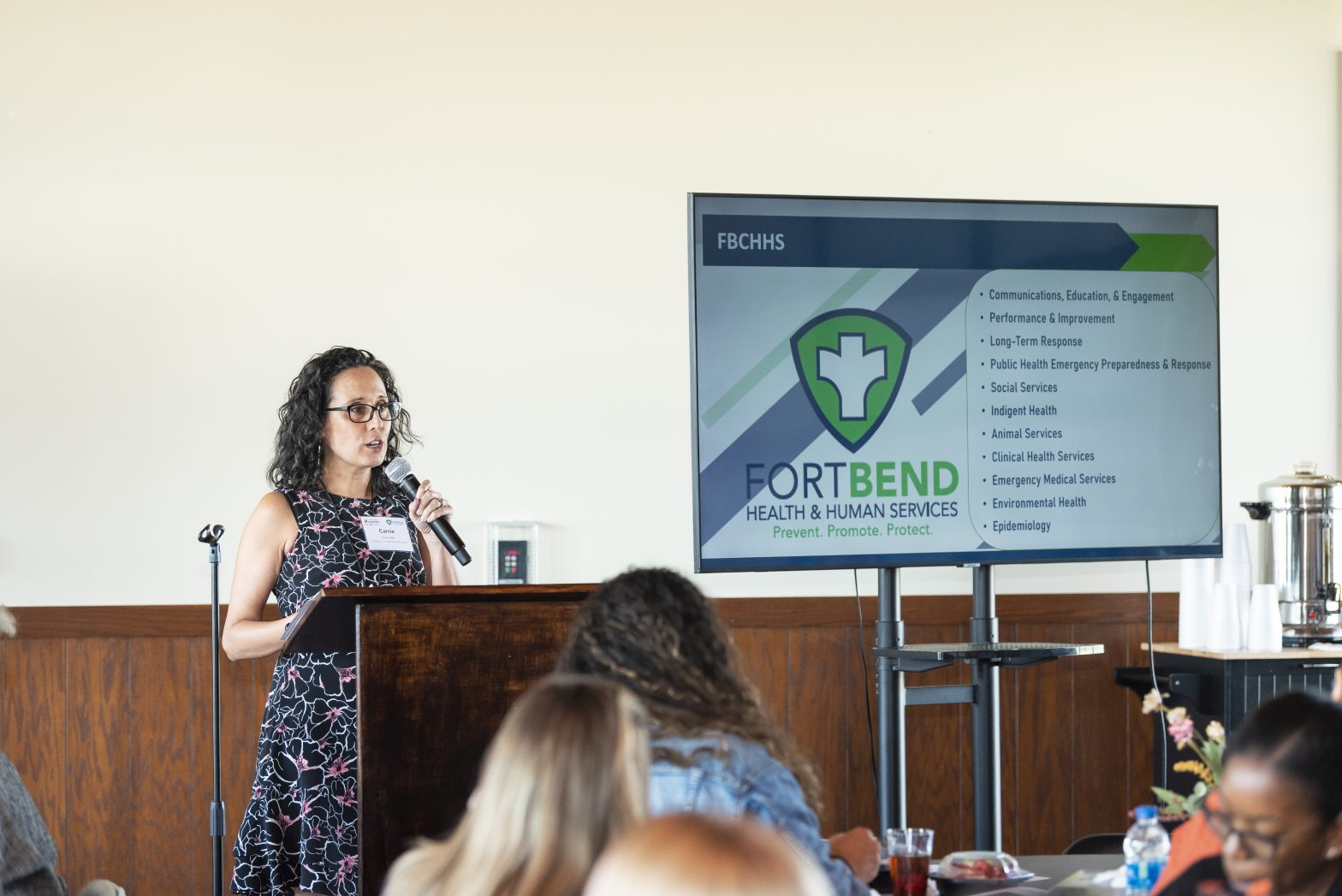
    Banner photo: Carrie Rai, FBCHHS Performance and Innovation Specialist

    This article is the first of a two-part series that describes the community engagement plan and process to create Fort Bend County’s first Community Health Assessment and Health Improvement Plan since 2007.

    In the summer of 2022, Fort Bend County Health & Human Services (FBCHHS) completed its first Community Health Assessment (CHA) in 15 years. The Centers for Diseases Control and Prevention (CDC) defines a CHA as “an assessment that identifies key health needs and issues through systematic, comprehensive data collection and analysis. The ultimate goal of a community health assessment is to develop strategies to address the community’s health needs and identified issues.”  

    The Process

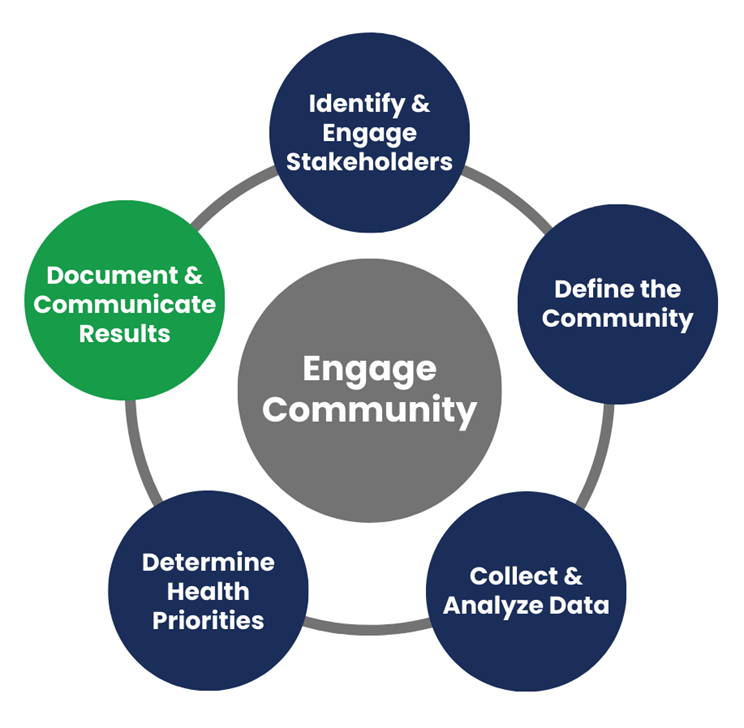
    FBCHHS followed the Association for Community Health Improvement Community Health Assessment Toolkit to guide the CHA process.

    The CHA process was a collaborative effort, led by FBCHHS. The process of collaboration and community engagement began with identifying stakeholders from a variety of sectors within the community and the creation of the CHA Committee.

    The committee was comprised of FBCHHS divisions and leadership and division representatives alongside community stakeholders representing primary health care, mental health, hospitals, private philanthropy, local government, non-profits, the faith community, academia, transportation, and public safety.

    The committee was integral in guiding the process of the CHA, providing input for and reviewing the methodology, data, analysis, as well as determining the types of secondary data to collect, and what questions to ask in the survey and the key informant interviews. The CHA committee also made suggestions about who to interview and how to administer the survey.

    More than 150 Fort Bend County leaders, residents, stakeholders and health champions and over 70 organizations attended the community input sessions throughout the CHA and community health improvement planning process. Additionally, FBCHHS conducted 25 key informant interviews and administered 845 surveys. These activities provided a platform for diverse agencies, community members and perspectives to be shared to generate inclusive, cohesive and attainable health improvement goals.

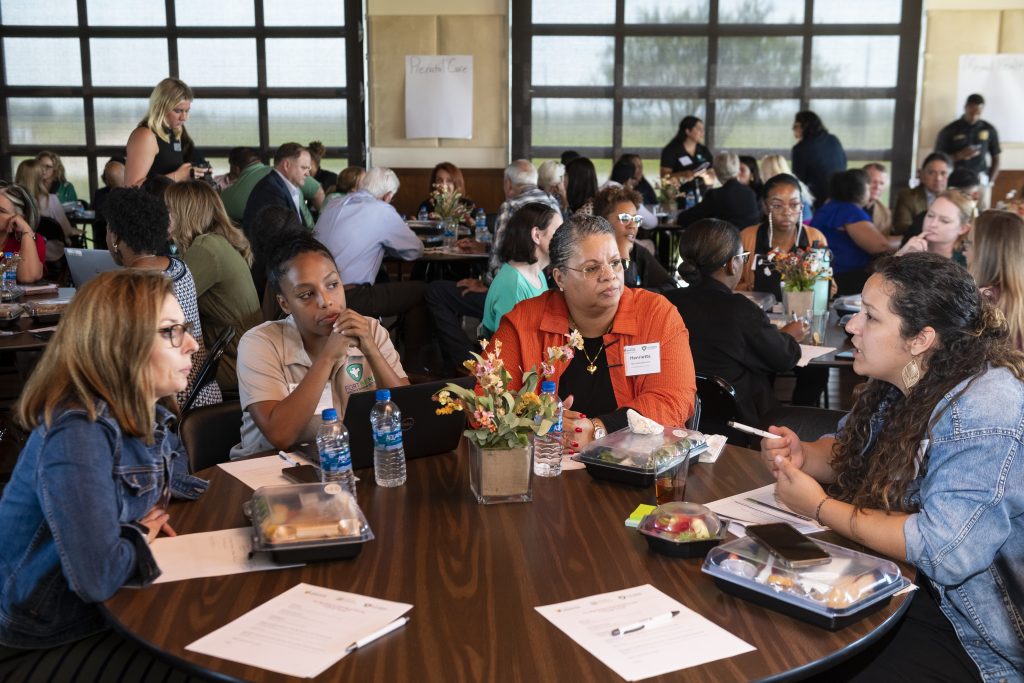
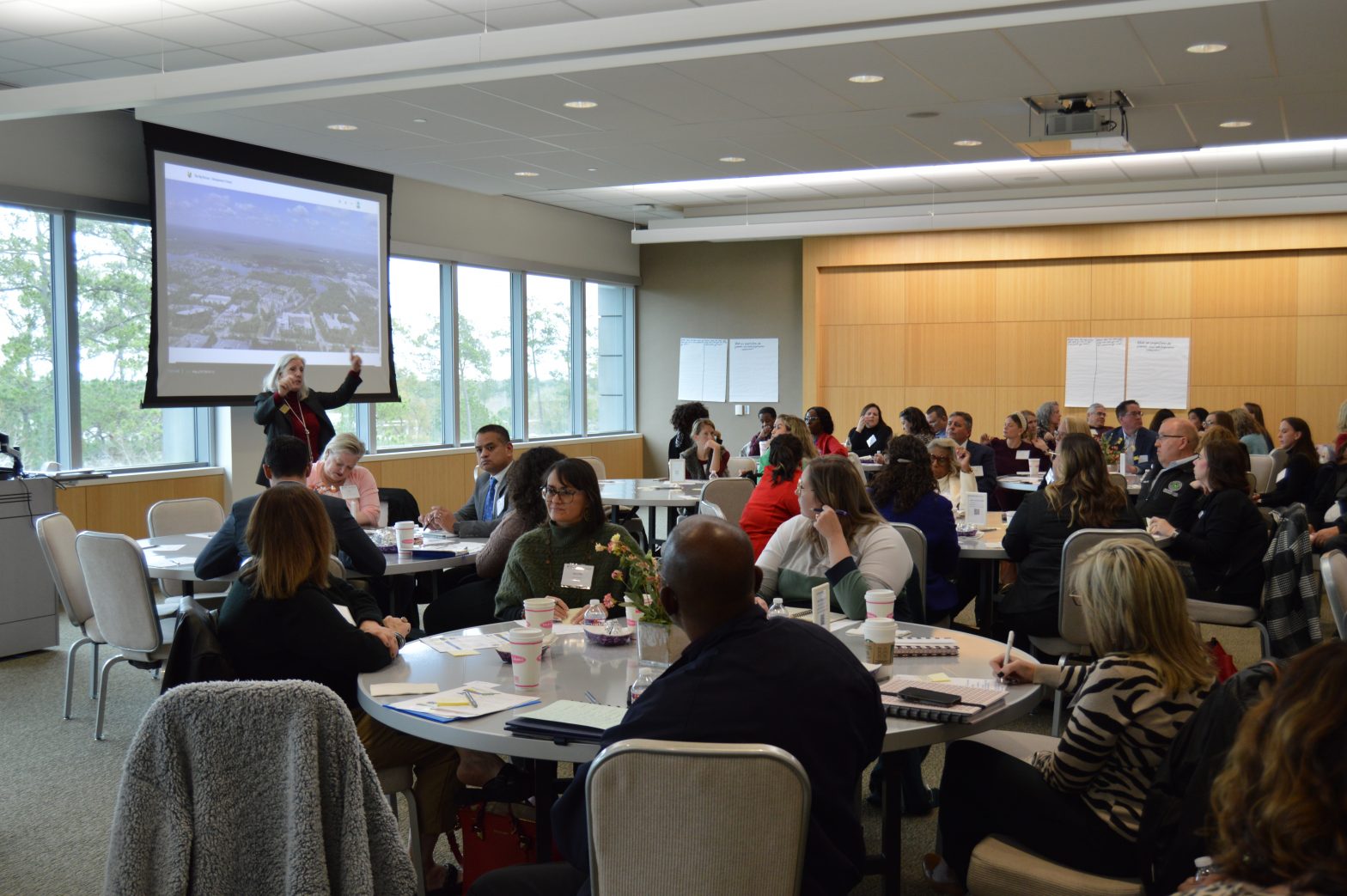
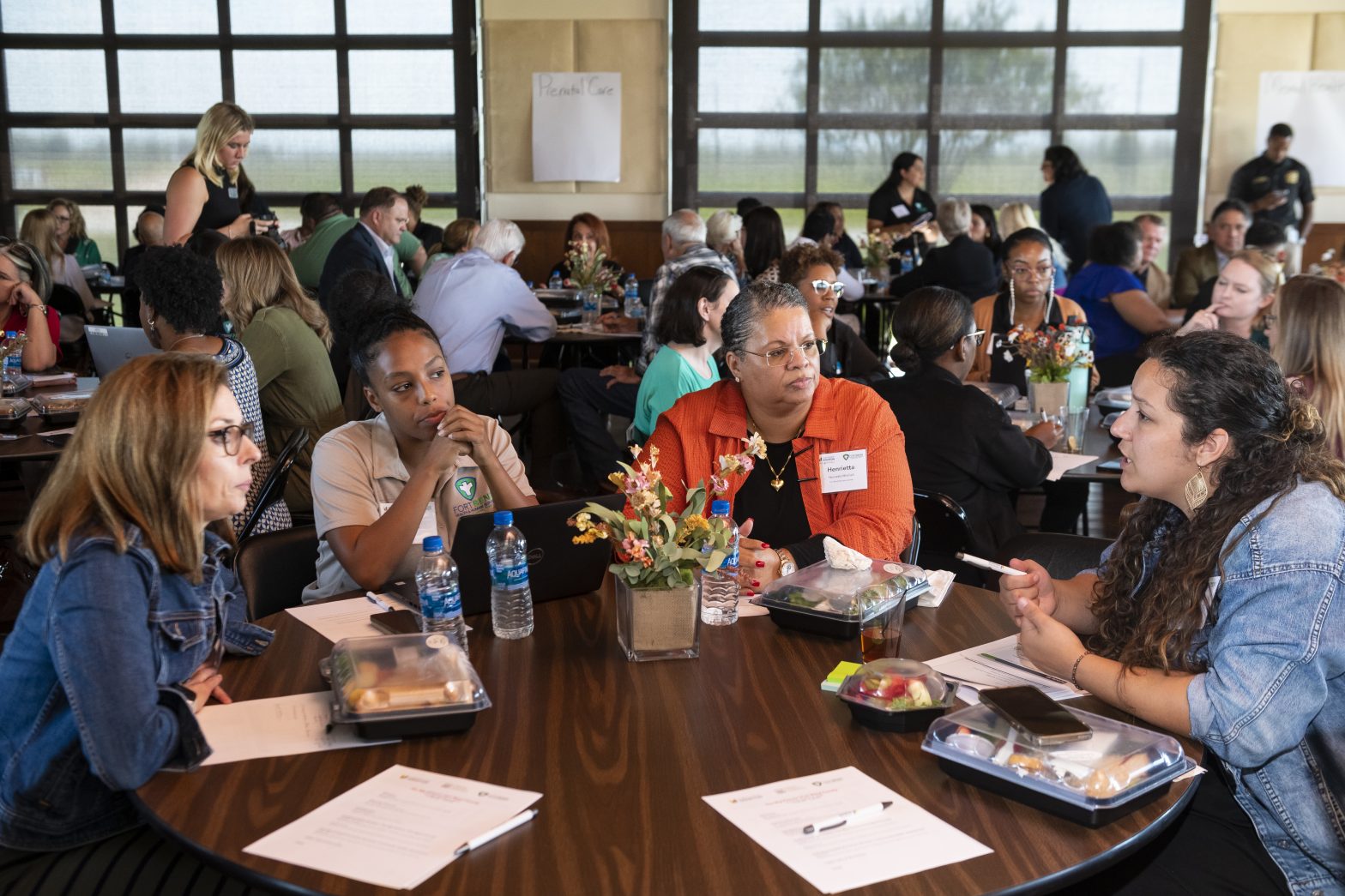
    Image of a room with people around circular tables. The table in focus has four women engaged in conversation.
    Event photo from The Big Picture – Fort Bend County

    Community Health Priorities 

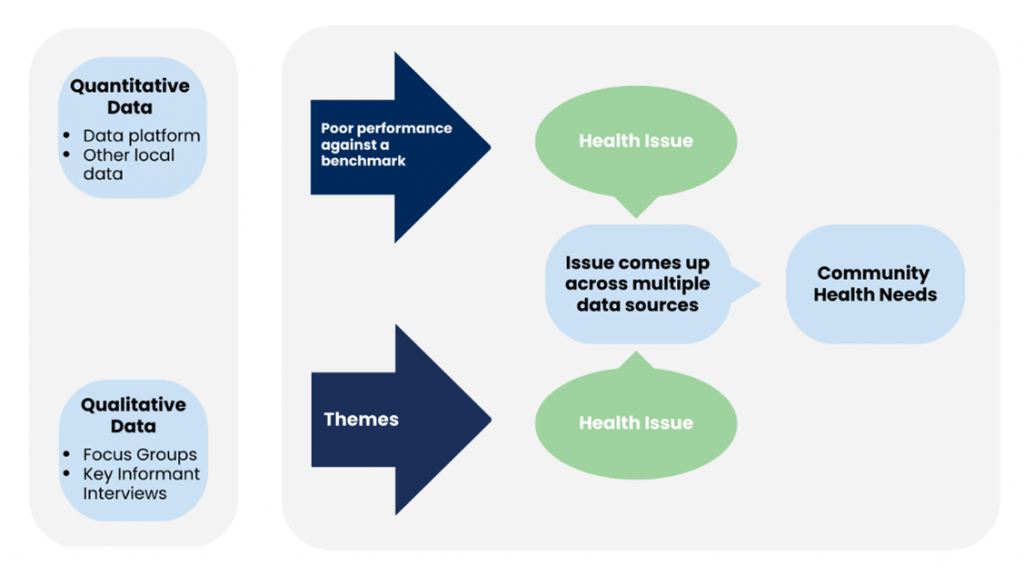
    FBCHHS used the Kaiser Permanente National Community Benefit decision-making criteria for the identification and prioritization of health needs. Quantitative data was compared against the following benchmarks: the state of Texas, U.S. as a whole or the top 10% performing U.S. counties. A health issue was identified when there was poor performance across the comparative benchmarks. Health issues were also identified through thematic analysis of qualitative data from input sessions and Key Informant interviews. Community health need priorities were determined when the same health issue was identified in both the quantitative and qualitative data.

    According to the 2022 County Health Rankings, Fort Bend County ranks fourth in the state for best overall health outcomes. However, the CHA data illustrates areas for improvement among vulnerable populations that have disproportionate health outcomes. Black and Hispanic populations, people without health insurance, and people with low-income have poorer health outcomes. These groups struggle to access services, contributing to health disparities.

    Source: Kaiser Permanente National Community Benefit, August 2015

    While there are several areas where Fort Bend County could see improvement, residents, community leaders and stakeholders identified five top community health priorities.

    Mental Health

    Like physical health, mental health is critical to our overall well-being. Good mental health affects our thoughts and behaviors, helps us maintain fulfilling relationships, enables us to cope with change and adversity, and ultimately supports our contributions to society. Mental health is also closely connected with physical health. Poor mental health may lead to behaviors that harm physical health (e.g., alcohol and other substance use, lack of exercise, etc.), and having poor physical health can negatively affect our mental health. About one in four survey respondents stated that their mental health was not good for one to five days out of the past 30, and 46% said mental health has been a problem in their household.

    About one in seven survey respondents stated that there was a time in the past year that someone in their family needed mental health services but couldn’t receive them — either because they couldn’t afford to pay (34%) or the wait times were too long (27%). Overall, one-third indicated that mental health services are missing in the community. The data from surveys reflect mental health access challenges we see in Fort Bend, specifically. Within Houston’s three-county region, Fort Bend has the highest ratio of residents to mental health care providers, though there has been improvement since 2017.

    Housing

    Affordable, safe, and stable housing is a basic need, and unsafe or unstable housing threatens our health, well-being, and economic security. At the same time, the cost of housing is the single largest expense for most households, and it has become increasingly unaffordable in recent years. The U.S. Department of Housing and Urban Development considers affordable housing as not more than 30% of income. If a household spends 30% or more of their income on housing costs, they are “housing cost burdened.” Households that spend 50% or more of their income on housing costs are “severely cost-burdened.”

    Renters are much more likely to be burdened by housing costs than homeowners. In 2021, more than 45% of renters were cost-burdened compared to 25% of homeowners; and 22% of renters were severely cost-burdened compared to 11% of homeowners. While the share of homeowners who are cost burdened has fallen since 2010, renters are more likely to be cost burdened now than a decade ago. Additionally, a person would need to work 3.2 full-time jobs at minimum wage to afford a two-bedroom rental property at Fair Market Rent in Fort Bend County. Fort Bend County’s population has already increased 41% over the last decade and is expected to increase an additional 15% to nearly 1 million by 2030, according to the Texas Demographic Center’s recent projections. Given these data, it is not surprising that one-third of survey respondents indicated affordable housing is missing in Fort Bend and more than half of Key Informant interviewees cited the issue as their top concern.

    Obesity

    Obesity, defined as having a body mass index (BMI) of 30 or more, is a complex health condition affecting both adults and children. Obesity increases the risk for health conditions such as coronary heart disease, type 2 diabetes, cancer, hypertension, and more. Obesity is found to take more years of life than diabetes, tobacco use, hypertension, or high cholesterol.

    Nearly 30% of adults in Fort Bend County are classified as obese, according to County Health Rankings, and the disease was the top health issue identified among survey respondents. While not the only related triggers, poor eating habits and lack of exercise can contribute to obesity. About 40% of survey respondents are concerned with poor eating habits and 39% are concerned with a lack of exercise.

    Cardiovascular Diseases

    Heart disease was the fifth most-cited health issue by survey respondents and Key Informants with more than one in seven identifying the diseases as a health concern. White and Black residents of Fort Bend die from heart disease at significantly higher rates than Asian and Hispanic residents, according to the Centers for Disease Control and Prevention’s WONDER data tool.

    The National Center for Health Statistics shows that three out of 10 deaths in Fort Bend County are attributed to heart disease and stroke. However, we know that many patients with heart disease also suffer from other chronic conditions, including lower respiratory diseases, diabetes, and kidney diseases, which comprised an additional 6% of deaths in 2020.

    Maternal Health/Prenatal Care

    Babies who are born in good health and who continue to thrive with positive experiences, tend to grow into healthy and productive adults who sustain our population and contribute to our economic vitality. Of course, a newborn’s health depends not only on the mother’s health during gestation but also her state of health before pregnancy. Early prenatal care is defined as pregnancy-related care beginning in the first trimester (1-3 months) and has been viewed as a strategy to improve pregnancy outcomes for more than a century.

    In 2020, the rate of women who receive late (after the first trimester) or no prenatal care in Fort Bend County (30%) is three times that in Texas (10%) and five times the rate in the U.S. overall (6%). Between 2019 and 2020, Fort Bend saw an unprecedented 10-percentage-point decline in the proportion of women who received early prenatal care — a drop we didn’t see in neighboring counties despite the pandemic. Black and Latino women in Fort Bend had the lowest rates of early prenatal care, which is not surprising because a lack of health insurance is the largest contributor to women delaying or not accessing prenatal care, and women in those groups have the lowest rates of health insurance coverage.

    Community Mobilization for Change

    Through the CHA organizations, community members, and other stakeholders are able to evaluate the health of communities, factors that contribute to health challenges in Fort Bend County, existing community assets and resources to improve the community’s health can also be identified. The Community Health Improvement Plan (CHIP) contributes to the advancing of strategies to shorten the gap to accessing services, resources, and disparities faced with the top five community health priorities. The CHIP brings focus to the health issues identified in the CHA and allows communities, municipalities, jurisdictions, and community partners to actively collaborate and create a united plan to improve the health of Fort Bend County.

    Healthy communities do not happen on their own, but through the efforts of community mobilization, local government support and key stakeholder contributions. Key stakeholders include local elected officials, hospital partners, FQHCs, foundations, non-profits, religious organizations, school districts, HOAs and many others. The shared goal is always to increase the quality of health across Fort Bend County. 

    We invite you to join us in reducing the gap for accessing services and or providing resources for the community members to meet the needs identified from the top five health priorities. FBCHHS Office of Communications, Education and Engagement is available to present to your organization or business about the CHIP to bring further awareness on how your organization or business can aid the community members of Fort Bend County.

    Please email hhsoutreach@fbctx.gov to request a presentation.

    Please access the full Community Health Assessment and Community Health Improvement Plan at http://www.fbctx.gov/cha!

  • Key Insights from The Big Picture | Montgomery County

    Key Insights from The Big Picture | Montgomery County

    On January 25, 2023, in partnership with Montgomery County Community Foundation, we hosted our first event of the year: The Big Picture | Montgomery County. The room was full with over 75 leaders across various sectors, including Judge Wayne Mack, Justice of the Peace, Precinct 1, Montgomery County, who assembled the Behavioral Health and Suicide Prevention Task Force in 2020. At this event, Understanding Houston shared key data highlighting Montgomery County’s strengths and challenges, and participants were able to react and respond to the data – the findings of this activity are below.

    Watch the one-minute recap video, view photos from the event, and review the presentation.

    Understanding Montgomery County  

    The program began with Julie Martineau, President & CEO of Montgomery County Community Foundation and member of Understanding Houston’s Advisory Committee. Julie shared how critical it is to use data in decision-making. 

    Data is key to understanding what is happening in our community, where we’ve been, where we are right now, and where we are going. The change makers of Montgomery County are the people who can make an impact and  use data to measure whether it is working or not.

    Julie Martineau, President & CEO, Montgomery County Community Foundation

    Julie explained how Montgomery County Community Foundation works for the present and future well-being of Montgomery County, while Greater Houston Community Foundation works throughout Harris, Montgomery, and Fort Bend counties. Because of this overlap, there is often powerful cross-collaboration between the two foundations. 

    Julie shared how Understanding Houston is a resource for independent and accessible data that organizations, community and civic leaders, and other residents should use to measure progress and effect change. 

    Exploring the Trends and Data 

    Montgomery County has grown significantly, but wages have not kept up

    Montgomery County’s population has grown nearly five times in just 40 years, numbering more than 620,000 according to the 2020 Census. Job growth was double the rate of the state and nearly quadruple the rate of the country, while GDP growth over the last two decades consistently outpaced Fort Bend and Harris counties, the state, and the nation. 

    While GDP grew 82% between 2010 and 2021 in Montgomery County, median household income grew only 7% during the same period. Not only have incomes stagnated, but income inequality has not improved in Montgomery County. 

    Nearly half of all income in Montgomery County went to 20% of the highest-income households, while just 3% of all income went to the bottom 20% of households. While the income gap between white and Hispanic households decreased by 22% between 2010 and 2021, the gender pay gap increased by 41% for the same period, and Hispanic households still earn about two-thirds of what white households earn. 

    Montgomery County’s poverty rate has increased recently, contributing to growing inequality. The percentage of children under five living in poverty increased from a decade-low of 12% in 2017 to 24% in 2021.  

    Nearly 1 in 5 children under the age of five in Montgomery County lives in poverty.

    Households that live above the poverty line but earn less than what it takes to meet basic needs are called ALICE (Asset-Limited, Income-Constrained, Employees) – also known as the working poor. Combining households in poverty and ALICE, nearly two out of every five households in Montgomery County struggle to afford basic necessities like rent, transportation, and food.

    Rent has increased and consumes a larger portion of incomes

    In Montgomery County, rent increased 22% between 2010 and 2021 compared to an 8% decrease in housing costs for homeowners; the percentage of renters that spend at least 30% of their income on housing is double that of homeowners. Some individuals and families will move farther from city centers to access more affordable housing, which can translate into higher transportation costs.

    Montgomery County residents typically spend 53% of their income on housing and transportation alone. On par with L.A. County residents (52%) – a place infamous for its expensive housing market and long commutes.

    While a higher percentage of households in Montgomery County are homeowners (75%) compared to the state (63%) and the nation (65%), the homeownership rate in Montgomery County has not seen any improvement over the last decade.

    Considering rising rents, homeownership appears to be increasingly out of reach for many first-time homebuyers. This is problematic because home ownership is still one of the most effective ways to build wealth and improve economic mobility.

    Where we can afford to live determines more than housing costs

    Where we live determines more than just our housing and transportation costs. It also affects our environment, including the air we breathe and the temperature we feel.

    In Montgomery County, ozone levels were rated “F” by the American Lung Association – the same rating for Harris County. Montgomery County experienced 523 days of extreme heat, defined as 95°F or higher, during the 2010s decade. This extreme heat was a 231-day increase – the equivalent of nearly two-thirds of a year – compared to the previous decade.

    Bad air and extreme heat can lead to premature death and shorter life expectancies as our environment is inextricably linked to our health.

    Poor environment and lack of health care access contribute to poor health

    Over 90,000 Montgomery County residents under the age of 65 do not have health insurance coverage and do not have adequate access to primary care physicians. There is only one primary care physician for every 1,674 residents compared to one for every 1,319 residents in the U.S. overall.

    Clinical guidelines focus on the role of primary healthcare in obesity prevention, and obesity rates in Montgomery County have been up 14 percentage points since 2011. In just a decade, the percentage of residents living with obesity in Montgomery County went from being the lowest in the three-county region to the highest.

    One out of three adults in Montgomery County are living with obesity.

    Adding to healthcare challenges, Montgomery County has less mental healthcare availability than the state, and Texas ranks last across all states in access to mental health treatment. Montgomery County has only one mental health provider for every 1,069 residents.

    Even more concerning, Montgomery County has consistently had the highest suicide rate in the region over the past two decades, and suicidal thoughts for young adults between 18 and 25 in the Houston area have nearly doubled. Research has shown that recent years have been especially difficult for youth and young adults due to social isolation caused by the COVID-19 pandemic and several subsequent traumatic events in recent years.

    Educational outcomes suffered from the impacts of the pandemic

    The pandemic delayed the opportunity to see the full impact of House Bill 3 (HB3), which was signed into law in 2019. HB3 required all pre-K programs to be full-day, which has added benefits over shorter-day programs. Montgomery County saw a 16-percentage point increase in the rate of pre-K students enrolled in full-day programs between 2018 and 2020, despite still having the lowest rate.

    A higher percentage of Montgomery County kindergarteners assessed are considered kinder-ready (57%) compared to Fort Bend (54%) and Harris (45%) counties. However, not all kindergarteners in Texas are assessed equally. Only 31% of Montgomery County kindergarten students were assessed, compared to 96% in Fort Bend County and 90% in Harris County. This rate has been consistently decreasing in Montgomery County compared to a consistent increase in the neighboring counties.

    If we look at a group of Montgomery County eighth graders and their educational journey through higher education, many do not ultimately earn a higher education degree or certificate. For every 100 students enrolled in eighth grade during the 2011-12 school year, 80 graduated from high school, 50 enrolled in a Texas higher education institution, and only 22 earned a credential or degree by the time they turned 25. Among economically-disadvantaged students, only 10% earned a degree or certificate compared to 30% of their wealthier peers.

    Place-based disparate outcomes

    Montgomery County’s economy has grown significantly, but that growth has not translated into growing wealth and prosperity for all residents. Income inequality has not improved, the poverty rate has increased, and nearly two out of five households struggle to afford basic needs. This inequality exacerbates the disparate impacts of rising rents, worsening environment, and low access to healthcare, which play a role in the vastly different outcomes we see for residents. According to research from Opportunity Atlas, one’s childhood zip code can tell a great deal about expected outcomes within each county.

    On average, a child from a low-income family who grew up in Conroe earned a household income of $24,000 as an adult, whereas a low-income child from The Woodlands earned $53,000. About 38% of women who grew up in low-income families in a neighborhood in Conroe became teenage moms compared to 5% of low-income women from a neighborhood in The Woodlands.

    [The] community is not fully informed about what is truly happening in rural parts of [the] county. It’s easy in The Woodlands to be isolated from the poverty.

    Anonymous Participant

    These problems cannot be solved alone. Cross-sector conversation and collaboration are required for Montgomery County to truly be a place where all its residents have the resources and opportunities they need to prosper.

    Results from the Group Discussion

    Given that many often need more time or capacity to converse and collaborate with those outside their organization, attendees were given time to reflect on how the data may align with what they see in the communities they reside, work in, and serve. Attendees reported that:

    • Many Montgomery County households struggle to afford basic needs, and there are disparities between neighborhoods regarding health, access to services, income, and housing.
    • There has been an increase in mental health issues among Montgomery County residents, youth and young adults in particular, and it is difficult to access mental healthcare.
    • Residents are often underinsured or uninsured, and there is a high use of emergency room services in place of primary/preventative care.
    • There is a severe lack of affordable housing.

    Realizing that the county-level averages provided in the presentation can mask differences across various communities, attendees were asked how the data may need to align with what they see in the more granular communities they reside, work in, and serve. Attendees reported that:

    • Even though the data shows more access to mental health providers than primary care physicians in Montgomery County, mental health seems more difficult to access than primary/preventative care.
    • Schools in the south of the County appear to have better student outcomes than the county-level data show.
    • Access to health care is not a pressing issue within specific Montgomery County communities, likely due to new hospital facilities.
    • They do not see a reduction in the income gap between white and Hispanic households through the community they serve.

    Given time limitations, not all quality-of-life indicators from the website were included in the data presented. Some issues attendees noted that were not in the presentation but were pressing challenges in the communities they serve were:

    • The lack of resources available to support individuals with autism spectrum disorder and with intellectual or developmental disabilities.
    • The lack of resources and services for the growing numbers of older adults (age 65+).
    • The income gap between white and Black households.
    • Lack of public transportation.
    • Food insecurity and food deserts.

    Based on the most common themes discussed, mental health and poverty, the rest of the session was dedicated to discussing potential projects and ideas for collaboration around these two issues. Some of the suggestions that came out of the discussion were:

    Mental Health

    • Partnering with local colleges to better prepare and increase the workforce of mental health practitioners.
    • Funding for mental health provider salaries to increase the workforce.
    • Establishing Community peer support groups.
    • Differentiating between mental illness and mental health and collaborating to utilize alternative services to help with mental health, such as community, exercise, animals, nature, etc.
    • Leveraging telehealth to circumvent obstacles such as transportation.

    Poverty

    • Increasing the minimum wage to something that accurately reflects the cost of living.
    • Creating mixed-income communities to ensure affordable housing is available in high-opportunity areas.
    • Providing more mentorship to students, including expanding career and technical education (CTE) opportunities, local trade school resources, and removing barriers for individuals to further their education.
  • Houston is Big

    Houston is Big

    Houston is big. The region’s size and all it encompasses has become an in-joke among residents — “Houston is an hour away from Houston,” the old saying goes. The city is sprawling, populous, industrial and growing. The reasons for the sprawl, rapid population growth and the breadth of successful industries are many and complex. We know that Houston is the 4th largest city in the U.S., but in what ways is Houston big other than in size and population? And how does Houston’s size affect its residents directly and indirectly? 

    Qualifying Houston’s “big-ness”

    Understanding Houston provides data on Houston’s three-county region, but looking at the nine-county Houston-The Woodlands-Sugar Land Metropolitan Statistical Area (MSA) — all of which many people consider “Houston” — can put into perspective the aggregate size of Houston and all of its satellite cities. 

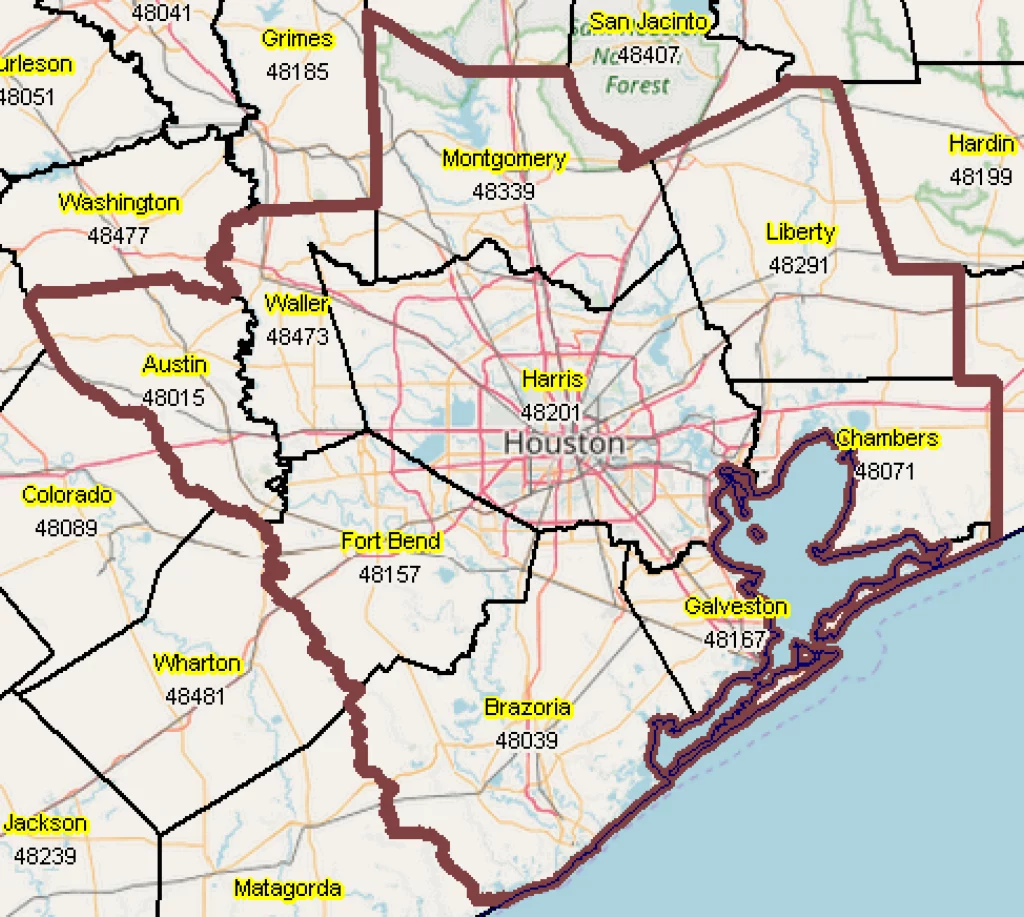
    An MSA is the formal definition of a region linked by social and economic factors — the region where we live and work. The Houston MSA includes Austin, Brazoria, Chambers, Fort Bend, Galveston, Harris, Liberty, Montgomery and Waller counties — an area that spans 9,444 square miles and is larger than the states of Connecticut, Delaware, New Hampshire, New Jersey and Rhode Island. Moreover, more than 100 cities and 40 unincorporated towns are within the Houston MSA boundaries, including Baytown, Fulshear, La Porte and Prairie View. If the Houston MSA were its own state, it would have the 15th largest population in the United States, with  7.2 million residents. 

    Even if one were to only consider Harris County, they would still be dealing with an area larger than many other “big” U.S. cities — its 1,778 square miles are enough to fit the cities of Austin, Boston, Chicago, Dallas, New York City and Seattle and still have room to spare.

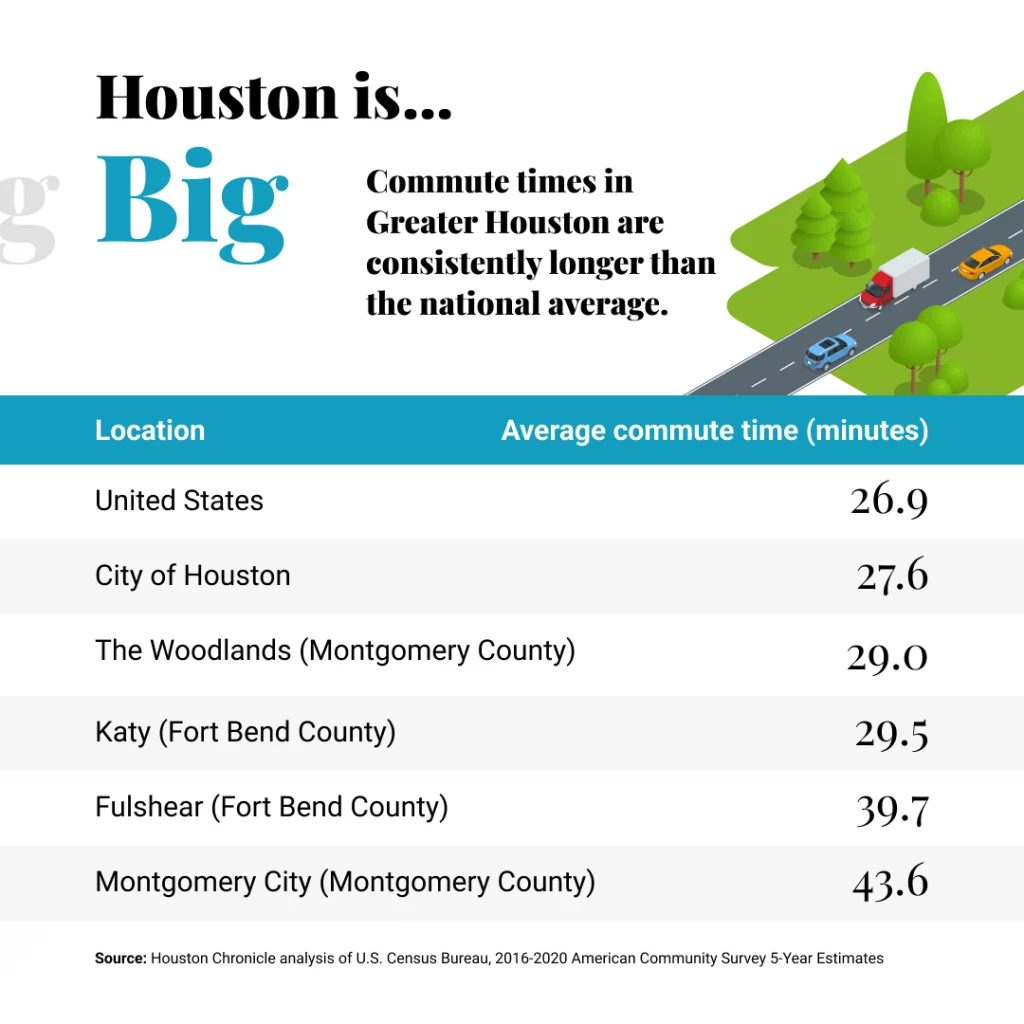
    Sprawl contributes to longer-than-average commute times, food deserts 

    The old joke about Houston being an hour away from Houston largely stems from our many suburbs. Houston’s suburban communities offer many benefits for residents, including access to more affordable housing. However, the prominence of far-flung communities also carries consequences, including longer-than-average commute times and reduced investment in urban centers.

    Commute times are a big challenge throughout Greater Houston. Many Houstonians face complications from urban traffic and congestion, construction, long distances and lack of public transport outside of the 610 Loop — sometimes all of the above.

    Another reason Houston has long commute times is that we are less likely to carpool to work than the average American. Nearly 79% of workers in Houston’s three-county region commuted alone in 2017 compared to the national average of 76%, which helps explain why Houston’s commute times are still higher than the state and national average.

    The emphasis on suburban sprawl can also contribute to the formation of food deserts in some of Houston’s urban areas. Food deserts are areas in which residents have a difficult time finding fresh and affordable food, like fruits and vegetables, due to a lack of grocery stores or a lack of affordable transportation to reach grocery stores with any regularity. Some Houston-area food deserts include Fifth Ward, Third Ward, Sunnyside and Acres Homes. Residents of food deserts without access to reliable and affordable transportation may resort to purchasing their food at nearby gas stations, dollar stores and fast food chains, which can result in higher rates of obesity, heart disease and diabetes.

    Greater Houston’s large and diverse population

    It is a well-known fact that diversity is big in Houston. The city, which years ago was reported to be the most diverse place in America, is what many researchers believe to be an ethnographic snapshot of the future of America. More than two-thirds of the region comprise individuals from nondominant groups, who accounted for 95% of Texas’s population growth over the last decade. 

    Hispanics/Latinos constitute the largest ethnic group in the region. Close to 2.4 million Hispanic residents accounted for nearly 39% of the region’s population in 2020, with 2 million of those residents representing Harris County alone. Among the 100 most populous counties in the nation, only 12 had higher percentages of Hispanic residents than Harris County. And our region’s Latino population continues to grow – increasing by 26% in the region between 2010 and 2020. 

    The three-county area is home to nearly half a million Asian Americans, with the largest two groups being Indian Americans (145,000 in 2020) and Vietnamese Americans (141,400 in 2020). These communities are big not just in the number of residents, but also in cultural and economic import. The Mahatma Gandhi District and Little Saigon are two economic and cultural hubs in which the city’s rich cultural heritage is preserved through community initiatives, small businesses and food. 

    Growing income gaps

    Although Greater Houston’s diversity is often touted as a strength, quality of life in the region is not always equal. Income inequality is also big in Houston. Although counter-intuitive, an increase in average wealth over the last five decades has led to an increase in income inequality. American families in the top 90th percentile have seen their wealth increase five-fold, while the bottom 10% of earners have gone from having no accumulated wealth to being about $1,000 in debt. 

    Income inequality has also increased in the Houston region, where pay gaps are also significant — and some growing — along gender and ethnic/racial lines. Median earnings between different groups are one way to measure pay gaps. Across both the U.S. and Texas in 2017, full-time, year-round male workers made about $10,000 more per year than their female counterparts. While the pay gap in Harris County (at about $7,500) is smaller than in the state and nation, it is significantly larger in Fort Bend and Montgomery Counties, with women earning $15,137 and $20,555 less, respectively.

    The pay gap between Black and white workers has widened since the 1970s in the U.S. Black workers are the only racial group to experience declining median earnings nationally between 2010 and 2017. The Black-white pay gap has remained flat in Texas and grown worse in Montgomery County. The largest racial/ethnic pay gap in Texas is among Hispanic workers, who earned just 60 cents for every dollar a white worker made in 2017. 

    Big institutions

    Physical size aside, Greater Houston has several large institutions that shape life throughout the region. In addition to our beloved food and music cultures, Houston is recognized globally for its expansive arts community and its world-renowned medical center. 

    Greater Houston’s art scene is a staple of the region. Stretching from the echoing halls of major institutions in the Museum and Theater District, to the neighborhood murals and the many festivals and installations. Houston has over 550 nonprofit institutions devoted to the arts and sciences that support the equivalent of 25,817 full-time jobs and generated over $1.1 billion in total economic activity in 2017. Understanding Houston has previously discussed the prolific Houston Theater District spanning 17 city blocks, and the 19 world-class museums available in Houston’s Museum District.

    Houston is also known for the Texas Medical Center, the world’s largest healthcare complex and life sciences destination. In the Med Center are M.D. Anderson Cancer Center, the number one cancer center in the U.S., as well as Texas Children’s Hospital, the second-ranked children’s hospital in the country. 

    Big challenges, big opportunities

    Houston is big, but we are still one community despite our size. Making the most of the qualities that help Houston thrive requires thinking with the big picture in mind. Lack of public transit near Fulshear contributes to longer commutes near Downtown. Pay gaps between workers in Greenway impact small business health in Humble. We may call different counties home, but at the end of the day, we are all Houstonians, and what matters to some of us ultimately matters to all of us.

  • Houston is Diverse

    Houston is Diverse

    Why diversity and inclusion matter and what they truly mean in Greater Houston

    It’s no secret that Houston is diverse. The region was recognized for its multiculturalism long before it was reported to be the most racially/ethnically diverse place in the nation. We typically measure diversity in terms of race or ethnicity, but it is also defined as diversity in backgrounds, perspectives, insights, and lived experiences, and Greater Houston is diverse in many ways that often go unnoticed.

    But why does diversity matter? Research suggests that companies composed of people with diverse experiences — including gender identity, race, ethnicity, and other backgrounds — tend to financially outperform, make better decisions, and are generally more successful. There is a growing movement in pedagogy that children should experience different cultures, languages, and practices to succeed more in our interconnected world. Our exposure to different perspectives and mindsets makes for a richer, more empathetic, interesting world — it can also challenge stereotypes.

    While our population may be diverse — in a variety of ways — our communities can be exclusionary. The very groups which allow us to claim diversity as a strength are the same ones that have been historically marginalized and harmed. Discriminatory policies and practices outlawed decades ago still affect large swathes of the population, who, despite living in the nation’s most diverse region, experience persistent disparities. In many cases, some progress has been made for underserved groups, but for others, the damage has lingered with devastating impacts.

    In this article, Understanding Houston is setting out to celebrate Houston’s diversity by taking a look at the ways in which it underpins our region and the ways in which certain populations remain underserved.

    Disability status

    Over 30 years have passed since the establishment of the Americans with Disabilities Act, and only one significant amendment, the Americans with Disabilities Act Amendments Act of 2008, has been made in accommodation of significant demographic shifts, and to further define what we understand as “disability.” 

    Disability status is often left out of the conversation about diversity. Nearly 10% of Houston’s three-county region is living with one or more disability, according to data from the U.S. Census Bureau. That equates to more than half a million Houstonians, and researchers estimate that one out of five American households will have at least one member with a minimum of one disability by 2050 because of the aging Baby Boomer population.

    While this segment of our population improves our diversity, they have not been fully included in our region’s economic prosperity. In 2020, the rate at which persons with disabilities lived below the poverty line was about double that of folks living without disabilities, according to data from the American Community Survey. People living with disabilities experience significantly lower employment rates, and those who are employed receive significantly lower pay. The National Disability Institute estimates that households containing an adult with a work disability require, on average, 28 percent more income — an additional $17,690 a year for a household at the median income level — to enjoy the same standard of living as a comparable household without a member with a disability. As this population ages and grows, these inequities will only become more acute unless significant changes are made to policy and planning.

    Sexual orientation and gender identity

    Sexual orientation and gender identity are other vital and under-discussed ways in which our region is diverse. While Pride and sexual/gender diversity have become more widely celebrated in recent years, there is still a long way to go.

    Obtaining reliable data on queer populations in Greater Houston is challenging, but we do know that as of 2021, Texas is the state with the second-largest number of LGBTQIA adult residents, estimated to be around 1.7 million people, though this may be an undercount. Attitudes toward the LGBTQIA community have evolved, and support is growing. Both acceptance of same-sex relations and support for same-sex marriage have doubled since the 1990s, jumping from 31% in 1993 to 64% in 2019, according to the Kinder Houston Area Survey.

    LGBTQIA individuals make up our residents, our families, our workers, and our visitors. Houston scored above average on the Human Rights Campaign Foundation’s 2021 Municipal Equity Index, a report that measures how thoroughly LGBTQIA residents, workers and visitors are protected from discrimination across American cities. Houston scored perfectly for “offering equivalent benefits and protections to LGBTQIA employees and awarding contracts to fair-minded businesses” and “city leadership’s commitment to fully include the LGBTQIA community and to advocate for full equality,” which led the city to a total score of 76, above the average of 67. While “above average” is a great start, there is still work to be done. 

    Texas, for instance, still lacks many basic protections against discrimination for LGBTQIA residents. As of 2020, Texas had no official protection for LGBTQIA population from discrimination in housing, public accommodations, credit and lending or anti-bullying for students. As of 2019, LGBTQIA folks in Texas live in poverty at a rate higher than that for cisgender straight people.

    Racial, ethnic and linguistic diversity

    Greater Houston’s reputation for diversity is often rooted in its extraordinary ethnic/racial diversity. Over two-thirds of Houston’s three-county region is comprised of people of color, who made up 95% of Texas’ population growth over the last decade. This trend toward increasing diversity will undoubtedly continue as the racial/ethnic composition of children under five in the three-county area is even more diverse than our overall population.

    The region is made richer by multiculturalism in incalculable ways. Still, many of the diverse populations who contribute to the economy and vibrancy of the region continue to face disproportionate challenges and disparities. Historically underrepresented communities, the majority of our region’s population, have on average poorer health, lower household incomes, lower access to quality housing, among other disparities. Why is this? 

    That question has many answers, often related to outdated, discriminatory public policy put in place with the intention of keeping American metros racially segregated. Policies that, despite being outlawed today, have done irreparable harm to the quality of life and access to opportunities for entire communities across generations. One of the many discriminatory practices employed in our nation’s history, including the Houston area, was called redlining. Redlining maps were used in the early-to-mid 20th century to determine which neighborhoods would receive public investment and access to home loans. The result of which legally prevented nearly all Black and Mexican Americans from being able to purchase homes. 

    Homeownership is the most common avenue to building generational wealth. The exclusion of the single most important American investment opportunity does not, however, scratch the surface of how damaging these policies really were to Black Americans.

    Home Owners’ Loan Corporation (HOLC) maps. Source: Mapping Inequality; Opportunity Atlas.

    Redlining maps and other discriminatory housing policies not only prevented Black families from building meaningful wealth, but also ensured that Black neighborhoods would be isolated from access to safe affordable housing, good jobs, and proper infrastructures like parks, roads or stormwater drainage. The result is what we see today — communities that have worse air quality, higher temperatures, limited fresh food options and lower rated schools. 

    Despite these disparities, segregation levels in the region have ticked down, according to the fractionalization index, which measures the likelihood that two random people in a given area will be of different races or ethnicities. A score of one on this index represents a 100% chance that two random people will be of different racial/ethnic backgrounds, with a score of zero representing that it would be impossible. Fort Bend County (0.75 in 2017) has the highest level of diversity among the three counties, although Harris is right behind it (0.69 in 2017). In Montgomery County, the odds are a little lower at 0.50. 

    Another way to measure diversity as it relates to segregation is the entropy index, which measures the degree to which racial/ethnic groups are concentrated in specific areas. An entropy index score of one would mean that only one ethnic group was represented in the area, indicating complete segregation, while a score of zero would indicate complete integration. This measure suggests Harris County is more segregated than Fort Bend or Montgomery counties. Although Montgomery County is less segregated than both Fort Bend and Harris counties, it is also the least diverse.

    The greater Houston region is also home to exceptional linguistic diversity thanks to its residents who originate from all over the world. Of all three Houston-area counties, Fort Bend County has the greatest linguistic diversity, while Harris County has the most non-English speakers. About 28% of residents in Harris County are limited English speakers who either speak English “not well” or “not at all.” Spanish is the most common non-English language spoken in homes in the three-county region, followed by other Indo-European languages (such as Greek, Hindi, Italian and Persian), Vietnamese and Chinese. 

    Houston is enriched by diversity

    Diversity enriches Greater Houston in innumerable ways, but the population groups that contribute to our diversity have historically faced a disproportionate number of barriers to economic stability, high-quality education, and environmentally safe and healthy neighborhoods. Specific neighborhoods in our region have long been intentionally segregated, resulting in disinvestment and poor quality infrastructure. For our entire region to thrive we need not just diversity or the championing of diversity, but for all of our region’s residents to be able to prosper and benefit from our thriving economy. 

    Changing attitudes can only bring us so far, but local organizations work every day to both celebrate diversity and to ensure that all residents, regardless of ability, sexuality, gender identity or racial/ethnic background have access to the resources that enable them to thrive. Here are just a few:

    DiverseWorks logo

    DiverseWorks is a nonprofit arts program committed to bringing people from different backgrounds together, presenting art in all forms through collaborations that honor individual artistic vision. They foster civic participation and cross-cultural understanding by taking risks and showing work that might otherwise go unseen.

    Houston Coalition Against Hate logo

    Houston Coalition Against Hate (HCAH) is a network of community-based organizations, institutions, and leaders who come together to reduce hate and encourage belonging. HCAH does this through education, research, relationship building and prevention initiatives, as well as partnering with organizations to host events that celebrate the diversity that makes Houston strong.

    Diversity is less a characteristic of Greater Houston than it is the foundation on which it was built. Greater Houston’s diversity directly informs many other aspects of the region.

    Understanding Houston has already paid service to its entrepreneurial spirit, resilience and vibrance — all of which are directly shaped by the diversity of Houston’s residents. The more we meaningfully engage with and work to include all members of our increasingly diverse region, the stronger that foundation — and our region — grows.

  • Houston’s three-county region accounts for a quarter of Texas’ population growth

    Houston’s three-county region accounts for a quarter of Texas’ population growth

    2020 Census data shows how the Houston region has evolved over the last decade

    The U.S. Census Bureau has released data from the 2020 Census; however, collecting this data did not come without its challenges. In March 2020, right as households began receiving invitations to participate in the 2020 Census, the COVID-19 pandemic forced the U.S. Census Bureau to cease all in-person operations. Not only did social distancing make it challenging to go door-to-door to follow-up with folks who hadn’t completed the census, but the virus (along with uncertainty around the existence of citizenship-status questions) also hindered Houston’s response rates to the 2020 Census

    In an article with Understanding Houston, Frances Valdez, the Executive Director of Houston in Action, wrote, “The census affects how billions of our tax dollars will come back into our communities through federal budgeting allocations over the next decade.” The lower the response rate, the smaller the budgets for services and programs like public education, public transit, housing, and more. Decennial census data allows us to look at the present to understand what the Houston region may need in the future. This data informs redistricting efforts, alerts county officials to which groups are growing or declining, and helps policymakers’ plans to strengthen our region for the road ahead. 

    Houston’s three-county region adds one million residents in past decade

    The past decade has been a time of growth for both the state of Texas and the Greater Houston region. The population of Texas grew to 29.1 million in 2020 by adding nearly 4 million residents since 2010. Three Houston-area counties — Fort Bend, Harris, Montgomery — accounted for one-fourth of Texas’ population growth.

    As for the population in Houston, each one of our three largest counties has also experienced population growth. The population of Harris County — the most populous county in the state — increased to 6.2 million (15.6%) between 2010 and 2020. Fort Bend County is home to 822,800 people and grew 40.6% in the last decade — the fastest growth rate in our three-county region. Montgomery County’s population grew 36.1% since 2010 to 620,400 in 2020.

    Population growth consists of two main components: natural increase and net migration. Natural increase refers to the number of births minus deaths in a population, and tends to remain relatively steady over time. Whereas, net migration — the total of the number of individuals who moved into an area minus those who moved out — can have more frequent fluctuations. 

    Domestic and international migration drives Houston’s population growth

    The U.S. Census Bureau distinguishes between domestic and international migration in its migration estimates — domestic migration is any movement within the nation while international migration refers to movement across international borders.

    For example, between 2010 and 2020, about 81,900 more residents left Harris County to live somewhere else in the U.S. than moved into Harris County from another U.S. county. (This is the second consecutive decade in which Harris County had negative net domestic migration. Between 2000 and 2010, 72,100 more residents left Harris County to live somewhere else in the country.) 

    If Harris County is losing people domestically, why is Houston growing so fast? Because Harris County net-gained 289,400 residents to its population between 2010 and 2020 from more people from overseas moving into the area than leaving it for another country. Much of Fort Bend and Montgomery counties’ population growth comes from domestic migration — historically, people from Harris County moving to a neighboring one.

    Projections for Houston’s population hit the mark

    In 2014, the Texas Demographic Center (previously known as State Data Center) made population projections for three different migration scenarios: one, assuming zero net migration (the number of people who move in equals the number of people moving out), another assuming a net migration rate equal to one-half of the rate seen between 2000 and 2010 (0.5 Scenario), and a final scenario assuming the net migration rate will be equal to the rate seen between 2000 and 2010 (1.0 Scenario). 

    The 2020 population of Texas is not very different from the projections the Texas Demographic Center made in 2014. Under the 0.5 scenario, they projected that the population of Texas would reach 28.8 million by 2020. Under the 1.0 Scenario, they projected Fort Bend’s population would reach 888,600; under the 0.5 Scenario, they projected Harris County’s population would reach 4,683,874; and Montgomery’s 2020 population is closest to the 1.0 Scenario estimate. 

    What is the expected population growth in Houston? According to their most recent Houston population growth projections made in 2018, the Texas Demographic Center estimates that by 2030, Fort Bend’s population will nearly double to 1.2 million, Harris County’s will exceed 5.9 million, and Montgomery County’s will reach 831,450.

    More than two-thirds of Houston’s three-county region is non-white

    The past 40 years has been one of transformative change for the three-county Houston region. Not only has our region grown to one of the most populous in the nation, but also the racial/ethnic composition of our already diverse population has further diversified. Between 1980 and 2020, each of the four largest racial/ethnic groups increased, however the growth rate of Hispanics and Asian Americans outpaced that of non-Hispanic whites and Black Houstonians, creating a shift in Houston’s demographics from being majority-white to majority-non-white. While this mirrors a similar trend happening across the nation and the state of Texas, no other major metropolitan area has witnessed this change more acutely and quickly as Houston, according to Stephen Klineberg, principal investigator of the Houston Area Survey and sociologist at Rice University. Interact with the chart below to see how racial/ethnic composition has changed in our region and Texas by selecting different geographies in the drop-down menu.

    In 2020, there were nearly 2.4 million Hispanics/Latinos in Houston’s three-county region (nearly 39% of the region), with 2 million in Harris County alone. In 1980, just 40 years ago, Hispanics comprised 15% of the population of Houston’s three-county region. The weight of these figures typically does not faze most Houstonians who have witnessed this significant shift, but to most Americans, these changes are unique. For example, among the 100 most populous counties in the nation, only 12 have a higher percentage of Hispanics than Harris County. More recently, Houston’s Hispanic/Latino community has grown considerably in the last decade. Between 2010 and 2020, the Hispanic population in Houston’s three-county region grew by 26% alone. The number of Latinos grew by 43% in Fort Bend County, 22% in Harris County, and 73% in Montgomery County during the same time period.

    More broadly, in Texas, the Hispanic/Latino population grew by nearly 2 million people between 2010 and 2020, increasing its share of the state population from 37.6% to 39.3%. In fact, non-white people made up 95% of all of Texas’ growth in the past 10 years –– and Hispanics alone accounted for half of that growth.

    According to recent Census data, the three-county region’s Asian-American population grew by 53% — from 358,000 in 2010 to 548,000 in 2020 — the fastest growth rate in our region. In 2020, Asian Americans comprised 8.9% of the population of Houston’s three-county region compared to 7.0% in 2010 and only 1.8% in 1980. Between 2010 and 2020, the number of Asian Americans grew 84% in Fort Bend County, 38% in Harris County, and 129% in Montgomery County — though Asian Americans comprise less than 4% of Montgomery’s total population.

    Fort Bend County has the highest proportion of Asian-American residents in Texas (22%). In Sugar Land, nearly 39% of the population identifies as Asian American. Asian Indians comprise 41% of the Asian-American population in Fort Bend, while Vietnamese Americans account for the largest share in the rest of our region. Read more about the fastest-growing ethnic group in our region here.

    Of course, it is difficult to talk about Houston’s population growth without considering how certain groups are typically displaced from their communities due to changing economic and demographic conditions. For example, the Houston Chronicle reports that historically Black Third Ward has changed significantly in the last decade. In 2020, Black people comprised 45% of the neighborhood — a decline from 71% in 2010. Acres Homes in North Houston saw its Black population fall 12% and its Latino population grow by 65%. Second Ward saw its Latino population decline by 25% while its white population increased 50%. Learn more about the history of these communities in the Chronicle’s report.

    Continue reading about the diversity of Houston

    Trends today inform Houston’s future

    Census data allows us to recognize the trends of the past and plan for the population of the future. The data also represents an opportunity for us to strengthen our region in the places where change and evolution will be necessary. These shifts in the Houston population have implications for our community context, economic opportunity in our region, our education system, and much more, including the process of adding a congressional district to our region and redistricting, which is currently underway. 

    As Houston’s three-county region continues to grow, we will continue to analyze and report on the data that affects our communities. Given the pandemic, the Census Bureau is expected to release its first-that-we-know of “experimental” data set that will allow us to delve deeper into the latest trends on a broader range of quality of life issues. Stay tuned for data updates coming in November and early 2022! We invite you to get to know the data, keep up with our mission on social media and discover how you can get involved to help Understanding Houston continue exploring what matters to the Houston area.

    Helpful Articles by Understanding Houston:

  • The Human Cost of Cash Bail in Texas

    The Human Cost of Cash Bail in Texas

    The COVID-19 pandemic has exacerbated many pre-existing disparities in access to healthcare, housing, and other life-dependent measures. These disparities often intersect with more severe outcomes in our criminal justice system, and are then met with a broken cash bail system. The outcomes dictated by these disparities can be dire. A study by the University of Texas found that of the 297 incarcerated individuals in Texas correctional facilities who died of COVID-19 between May and September 2020, 80% had not yet been convicted of a crime.1 This crisis within a crisis has further reinforced calls for pretrial justice reform in Texas and around the country.

    In most of the state, pretrial justice programs are entirely dependent on cash bail, which favors wealthier defendants over poorer ones, violating the Equal Protection Clause of the Fourteenth Amendment of the United States Constitution.2 This system not only detains non-violent offenders simply because they cannot afford bail, but also allows violent offenders the chance of release if they can afford it. This unconstitutional system transfers approximately $15 billion in the United States each year from the poorest, most vulnerable communities to privately-held bail bond corporations in the process.3

    What pretrial reforms have taken place across the country?

    Proponents of cash bail systems argue that releasing or offering bond assistance to pretrial offenders increases the likelihood of bail jumping, repeat offenses and crime in general.4 But a recent study conducted by researchers at Loyola University found that 2017 Cook County bail reform measures increased the number of people released pretrial without causing significant changes in the level of new criminal activity. The reforms also saved the Chicago-area community approximately $31.4 million that would have been used on bail funds in only the first six months after initiating the program. This program even included alleged felony defendants.

    Data-driven insights gleaned from studies such as this have assisted lawmakers across the country in crafting evidence-based policymaking in regards to cash-based pretrial reform. On February 22, 2021, Illinois Governor J.B. Pritzker signed the Pretrial Fairness Act (HB 3653 SFA2) into law, making Illinois the first state in the U.S. to effectively eliminate cash bail. While the bill eliminates cash bail for many defendants, it still permits judges to detain individuals if they’ve been charged with felonies such as murder or domestic battery. The only misdemeanor charges that permit the use of pre-trial detention are domestic or family violence, in order to ensure the safety of the victims. In addition to reforming cash bail practices, the 764 page bill also includes provisions for the creation of a Pretrial Practices Data Oversight Board, a Domestic Violence Pretrial Practices Working Group, establishes a “civil right of action,”5 bans outright chokeholds, and even creates a confidential mental health program for law enforcement officers. While this is the most progressive pretrial justice program passed in the United States to date, even conservative thinkers find value in certain aspects of bail reform efforts such as this.

    What is Harris County doing to mitigate harm caused by cash bail?

    While Illinois is leading the country in progressive pretrial reforms, lawyers and policy makers in Harris County have also been working to eliminate wealth-based descrimination in pre-trial populations. In 2016, defendants in Harris County filed a class action lawsuit arguing the unconstitutionality of bail practices, resulting in the creation of the ODonnell v. Harris County Consent Decree. The resultant measures allow Class A and B misdemeanor arrestees the chance to apply for swift release or to receive bail assistance in the form of personal or general order bonds.6 Those who are not eligible for swift release or personal bonds include those arrested:

    • and charged with domestic violence, violating a protective order in a domestic violence case, or making a terroristic threat against a family or household member;
    • and charged with assault;
    • and charged with a second or subsequent driving-under-the-influence (DUI) offence;
    • and charged with a new offense while on pretrial release;
    • on a warrant issued after a bond revocation or bond forfeiture7; or
    • individuals arrested while on any type of community supervision for a Class A or B misdemeanor or a felony.8

    Led by Brandon Garrett of Duke University, Sandra Guerra Thompson of the Criminal Justice Institute at the University of Houston Law Center, and Dr. Dottie Carmichael of the Public Policy Research Institute at Texas A&M, the Independent Monitor for the ODonnell v. Harris County Consent Decree recently released their first six-month report, showing promising signs of progress. “Gone are the days when a poor person would be locked up solely due to an inability to pay,” Garrett said in response to the findings.

    Some key metrics featured in the report include a large increase in releases of misdemeanor arrestees, a large reduction in the use of cash bail in misdemeanor cases, a reduction in race disparities in the use of cash bail and an overall decline in pretrial jail days (from an average of five days or more to two days or fewer) without resulting in an increase of reoffenders. In fact, the report found a slight decline in the number of reoffenders (shown below).9

    How much money is the Consent Decree saving the Harris County community?

    In the Independent Monitor’s second six month report (published March 3, 2021), Dr. Carmichael and researchers at Texas A&M University found significant decreases in the cost of bail incurred by Harris County communities. In 2016, the actual cost of bonds to individuals and their families in Harris County totaled $4.4 million. Just three years later, the actual cost of bonds incurred by local communities was just over $500,000, an 89% decrease from 2016.10

    89% decrease in bail spend

    In the three years since enacting bail reform, annual costs to the community dropped from $4.4 million in 2016 to $500,000 in 2019.

    What other improvements can be attributed to the Consent Decree?

    The Consent Decree has also vastly improved the quality and administration of due process for those awaiting trial. A few key improvements detailed in the Decree are that every defendant must now receive a bail hearing within 48 hours of their arrest, defendants must be represented by a lawyer in bail hearings, forms are now translated in the defendant’s native language, and translators are available at all hearings.11 Email and phone reminders are also now in place, which helps increase the likelihood that defendants show up to trial. In a recent Understanding Houston webinar, Sybil Sybille, a Fellow at Pure Justice and member of the Community Working Group for the independent monitor of the Consent Decree, shared her thoughts regarding the efficacy of the program saying, “It’s working. People have access to bonds … as long as you haven’t violated a bond in the past.”

    “An important part of the success of the Consent Decree is due to our team’s ‘Community Working Group,’” said deputy monitor Sandra Guerra Thompson. “The group is comprised of community leaders with experience in providing services for the homeless, survivors of domestic violence and sex trafficking, foster kids, immigrants and others.”12 The inclusion of independent, community-led oversight in Harris County’s recent bail reforms has set the county apart from other bail reform measures across the country, but still fails to address the population of felony defendants.

    According to Dr. Howard Henderson of the Center for Justice Research at Texas Southern University, pretrial justice reforms must be accompanied by programs that address the underlying “societal pre-existing conditions” that prevent fair access to mental healthcare, quality education and economic opportunity. The truth of this wisdom can be seen in the aforementioned research conducted by Loyola University in response to Cook County’s recent bail reforms. The researchers found that the most common new charge for alleged reoffenders was misdemeanor drug possession, followed by retail theft and drug dealing. The impetus of each of these offenses could be suppressed if historically neglected communities were given greater access to quality employment, mental healthcare and substance abuse counseling. Taking a glimpse at the mental health breakdown of the Harris County Jail population further supports these claims.

    Has the Consent Decree improved outcomes for those with mental health indicators?

    According to the continuously updated Harris County Jail dashboard, nearly three quarters of the Harris County Jail population have mental health indicators. According to the Bureau of Justice Statistics, mental health indicators are defined as “serious psychological distress in the 30 days prior to the interview or having a history of a mental health problem.”13

    In the second six-month report created by the Independent Monitor for the Consent Decree, the data show that misdemeanor defendants with mental health problems are being arrested at roughly the same rate as prior to the Consent Decree (30% of all misdemeanor arrestees have mental health issues). However, the Independent Monitor team did find that recidivism rates in those with mental health indicators have decreased slightly in recent years, from about 45% in 2015 to about 38% in 2019. These data illustrate that while the Consent Decree has resulted in slight improvements in outcomes for those with mental health needs, additional diversion and affordable mental health care programs are needed. Local organizations such as the Harris Center for Mental Health, Intellectual and Developmental Disabilities are working to fill this gap in equal access to mental health services.

    Has the Consent Decree minimized the COVID risk in Harris County Jail?

    Despite Harris County’s proactive measures in enacting the Consent Decree prior to the onset of the COVID-19 pandemic, a large share of people who died of COVID-19 in Harris County correctional facilities had not been convicted of a crime. According to the Texas Justice Initiative’s dataset on COVID-19 fatalities in Texas correctional facilities, all ten people who died (with Custodial Death Reports14 available) from COVID-19 in Harris County Jail had been awaiting trial.

    100% of people who died from COVID in Harris County Jail had not been convicted of a crime.

    Of the ten who died while awaiting trial, five were charged with a violent crime against persons, likely making them  ineligible for swift release. Two were charged with Possession of a Controlled Substance, and at least two individuals who were on staff in Harris County correctional facilities have also died from COVID-19.

    While one may be quick to equate these deaths as failures of the Consent Decree, the avoidable tragedy of these deaths cannot be attributed to the program, because most of these people were not eligible for swift release under current requirements. Instead, their deaths can be attributed to the lack of a program that addresses felony defendants.

    What does Harris County Jail look like now, without a pretrial diversion program that addresses felony defendants?

    As of January 28, 2021, Harris County Jail was at 97% capacity, with 87% of the population awaiting trial.15 Despite efforts of local nonprofits like the collaborative leading the Community Bail Fund, Harris County Jail is reaching a breaking point. “Almost all of these individuals have bail that is set at amounts that are beyond their or their families’ financial means,” Amrutha Jindal, an attorney with Restoring Justice, stated to CBS. “As a result, they are stuck in jail – where the virus is rampant, social distancing is impossible and PPE is limited — merely due to their poverty.”

    These data show that while the Consent Decree has vastly improved the efficacy of the pretrial process, the program can only do so much. As you can see in the figure below, a vast majority of those in Harris County Jail are alleged felony offenders, and therefore are not eligible for swift release or general order bonds.

    This means they are forced to stay in jail for an indefinite period of time, subjecting them to life-threatening and torturous conditions, often without being convicted of a crime due to the COVID-caused delays in the courts. In an interview with the Texas Criminal Justice Coalition, one incarcerated man described his experience in quarantine saying, “We had to go to the single-man cells (solitary confinement) for fifteen days, eating bologna sandwiches for lunch and dinner.” Another incarcerated person described his experience, “Sometimes, we didn’t even come out for like 30, 40 hours. We’d just be locked in the cell, the one-man cell, for like 40 hours… It’s not fair. It’s not right.”

    While the Harris County Consent Decree has made great progress in reducing wealth-based discrimination and upholding due process in pretrial misdemeaner populations, additional reforms that address alleged felony offenders and the inhumane treatment that incarcerated people are being subjected to are needed. The story of Preston Chaney illustrates the urgent need for such reforms. Chaney was arrested for allegedly stealing lawn equipment and frozen meat. Despite the pettiness of these charges, burglary is a felony offense in Harris County, making him ineligible for swift release under the current Consent Decree requirements. A judge set a relatively modest $100 bail but Chaney was unable to pay. After spending three months awaiting trial in Harris County Jail, Chaney contracted COVID-19 and tragically died shortly thereafter. This entirely avoidable death was purely due to Chaney’s inability to pay bail, undoubtedly caused by “societal pre-existing conditions” alluded to by Dr. Henderson earlier.

    While the Consent Decree has vastly improved the efficacy of the pretrial process, the program can only do so much.”

    What can be done to improve the pretrial process?

    Although Harris County is leading Texas in amending unconstitutional bail practices, there is clearly much work to be done. Engaged citizens who would like to take part in building a fairer pretrial justice system can do so by educating themselves and/or providing material assistance to the organizations mentioned in the piece and supplied below. If you would like to stay updated on the research into the efficacy of the Consent Decree, the Independent Monitor team released their second six-month report on March 3, 2021, which provides clearer insights into the efficacy of the program. Future reports and updates can be found here. Future pretrial reforms that address alleged felony defendants may be on the horizon. According to the Civil Rights Corps, an additional lawsuit against felony cash bail practices is ongoing.

    End Notes:

    1Data used in this study were collected from early March 22, 2020 to October 4, 2020.

    2Wydra, E.B. (October, 2017) When cash bail violates the Constitution. Constitutional Accountability Center

    3ACLU (2017) Selling Off Our Freedom: How insurance corporations have taken over our bail system. Report can be found here: https://www.aclu.org/sites/default/files/field_document/059_bail_report_2_1.pdf

    4Bail jumping is the defined as the act of failing to appear to a court-mandated trial for a crime.

    5A civil right of action can be defined as an individual’s legal right to sue.

    6General order bonds are judicial release orders, pre-approved by Presiding Judges, that require the release of the arrestee. (Source)

    7This can occur when a defendant fails to show up to court for previous offense, forfeiting their opportunity to receive bonds for future offenses. 

    8United States District Court For the Southern District of Texas, Houston Division. Full decree can be found here: http://www2.harriscountytx.gov/cmpdocuments/caoimages/Ex1ConsentDecree.pdf

    9Monitoring Pretrial Reform in Harris County: Second Report of the Court-Appointed Monitor (March 3, 2021)

    10Garrett, B.L. , Thompson, S.G. (September 2020) Monitoring Pretrial Reform in Harris County. Report can be found here: https://www.scribd.com/document/474748071/ODonnell-Monitor-Report-Six-Months-Final#fullscreen&from_embed

     11Docket Entry No. 701-2 at 17–18, citing sections of the Texas Penal Code

    12Garrett, B.L. , Thompson, S.G. (September, 2020) Monitoring Pretrial Reform in Harris County. Report can be found here: https://www.scribd.com/document/474748071/ODonnell-Monitor-Report-Six-Months-Final#fullscreen&from_embed

    13Berzofsky, M., Bronson, J. (June, 2017) Indicators Of Mental Health Problems Reported By Prisoners And Jail Inmates, 2011-2012. Bureau of Justice Statistics.

    14Custodial Death Reports are created for every person that dies while in custody of a Texas correctional facility. These reports include information pertaining to the individual’s cause of death, detention charges, and location. 

    15“The largest jail in Texas is nearing capacity. Experts warn it could become a hotbed for COVID-19.” CBS News, 2021. Accessed online.

    Additional Resources

    Local Organizations:

    Regional Organizations: