
Evictions are on the rise in Houston. As the Covid-19 pandemic and economic downturn continues to batter Texas and the Greater Houston region, millions of families are wondering how they’re going to be able to pay the bills. According to a recent Census Bureau survey, 37% of adults in the Houston metropolitan area either missed last month’s rent or mortgage payment, or have slight or no confidence that their household can pay next month’s rent or mortgage on time.
Back in March, the Texas Supreme Court provided some initial relief to renters with a statewide moratorium halting all evictions. That moratorium expired in late May, however, and eviction filings are ramping back up, even at properties with federally backed mortgages covered by the CARES Act’s eviction moratorium, which ended on Friday. Public and philanthropic dollars are trying to fill in the gaps but the need is big and time is running out.
Data can help us better understand and respond to this looming eviction crisis. January Advisors has been collecting data on eviction cases in Harris County for some time. We recently partnered with Princeton University’s Eviction Lab to collect data on eviction case filings each week in cities across the country for their COVID-19 Eviction Tracking System.
In this post, I track eviction filings since January 2020 across Harris, Fort Bend, Galveston and Montgomery (partial data) counties to uncover how many evictions have been filed, where they’ve been filed, and which communities are bearing the brunt of eviction during COVID-19.
How many evictions have been filed?
Since March 19, 2020, when the Texas Supreme Court’s eviction moratorium went into effect, landlords have filed over 6,500 evictions across Greater Houston (Harris, Fort Bend, Galveston and Montgomery counties). This data comes from public court records collected by January Advisors through public-facing websites in each county. In Montgomery County, data is only made available for the Justice of the Peace Court Precinct 3 (Judge Matt Beasley).
The bulk of COVID-19 evictions have been filed in Harris County — 6,153 evictions — followed by Galveston (454) and Fort Bend (383) counties. Adjusted for the number of renters, however, Galveston County landlords emerge as the top evictors during this period: Since April, there have been 11.3 eviction cases filed for every 1,000 renter-occupied households in Galveston County compared with 8.6 in Harris County, 7.5 in Fort Bend County, and 3.5 in Montgomery County JP3.
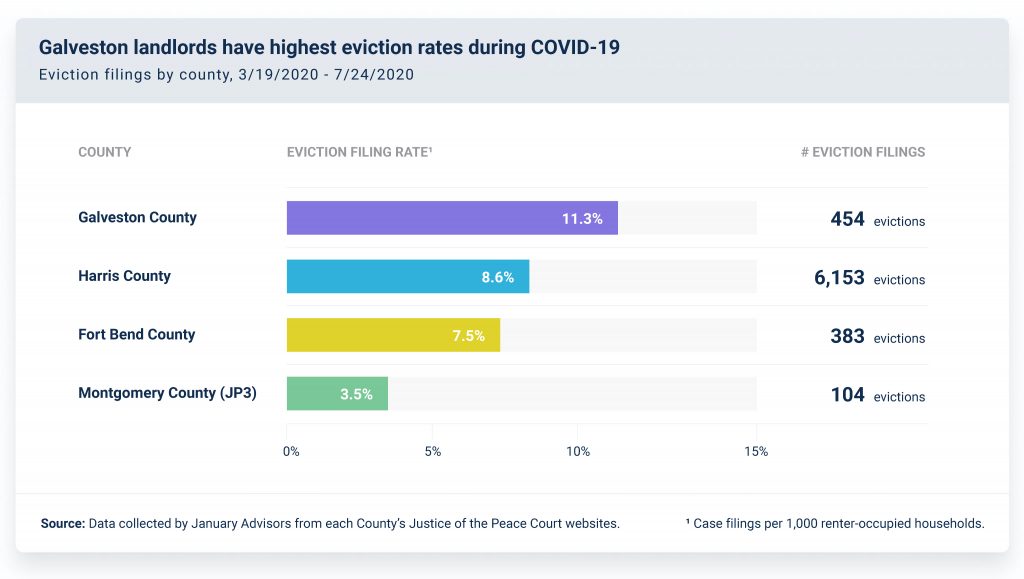
A higher eviction filing rate in Galveston reflects, in part, the differences in housing patterns and costs. Compared with Harris County, Galveston County is less urbanized, has fewer renters, and more homeowners. Residents who do rent in Galveston are more economically vulnerable and pay more of their incomes on rent, according to the latest American Community Survey estimates.
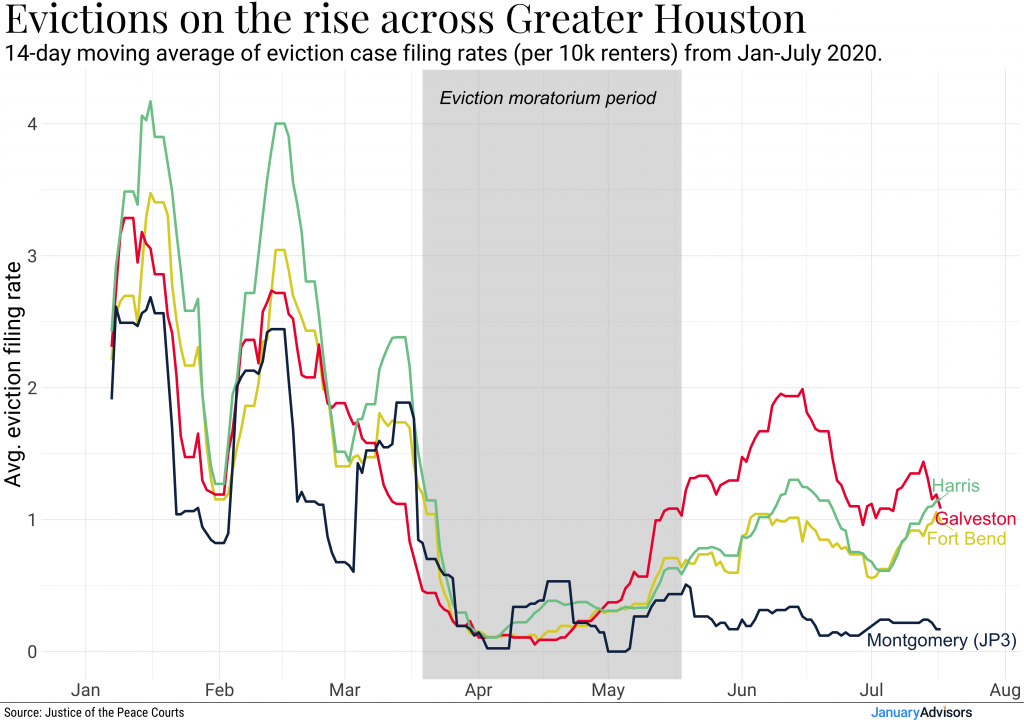
Looking over time, the impact of the Texas Supreme Court’s eviction moratorium is striking. The chart below shows the eviction filing rate for each county since January 2020. Starting in late March, when the moratorium went into effect, the number of eviction cases dropped to near zero across the region within a week.
The moratorium, however, did not prevent landlords from filing evictions — it only prevented courts from hearing these cases and kicking families out of their homes. In fact, many landlords continued to file eviction cases during April and May. During the two-month moratorium period, there were 1,650 eviction cases filed across the region.
Eviction filings have picked back up since the moratorium was lifted on May 18, although they remain below where they were before the pandemic. Across Greater Houston, over 5,400 eviction cases have been filed by landlords since the moratorium ended. For more information on the top evictors in Harris County, check out this daily eviction tracker.
Where are evictions being filed?
In Texas, eviction cases are heard by the Justice of the Peace Courts (JP Courts) in each county. These local judges have the power and discretion to postpone eviction cases if they choose. In Dallas, for example, JPs have agreed to halt evictions through the summer as families and businesses try to make ends meet. Harris County Judge Lina Hidalgo and Houston Mayor Sylvester Turner have urged Harris County JPs to do the same, and some have followed suit, but so far there is no countywide or regional agreement among Justices of the Peace.
To get a better sense of the geography of eviction filings and the growing case load, the map below breaks down eviction case filing rates by JP precincts in all four counties (note: each precinct in Harris County has two judges). To overlay the unadjusted filing counts, click the box in the top right corner.
Overall, the top three JP precincts with the highest rate of eviction case filings are Harris County JP 4 and 7 (10.3 and 10 filings per 1,000 renter households), and Galveston County JP 1 (9.6), followed by JP 3 in Harris County (9.1) and JP 2 in Fort Bend (9/1).
In Harris County, JP 5 has the highest raw number of eviction filings of any precinct – but it also has the highest number of renters (over 230,000). Still, housing advocates tracking hearings have noted that Judge Russ Ridgway and Judge Jeff Williams are also hearing more eviction cases than any other JP in Harris County — at the same time, some of their colleagues are suspending hearings. Precinct #5 — which covers neighborhoods in Southwest Houston — is also being hit hard by Covid-19.
Who is at risk of eviction in Greater Houston?
Black/African American renters in Greater Houston have been more likely to receive an eviction than other race-ethnic groups during this period. Since March 19, more than a third (36%) of eviction cases are estimated to be filed against Black leaseholders, despite the fact that Black householders only make up 28% of all renter households in the region.
By contrast, White renters make up an estimated 29% of eviction cases (on par with their share of renter households) while Latino/Hispanic and Asian-American leaseholders are underrepresented in eviction filings relative to their share of renter households.
Race-ethnicity estimates of leaseholders were generated using a statistical model that takes into account the leaseholders’ last name (comparing it to the Census Bureau’s surname list) and the race-ethnicity of their census tract of residence (Read more about the methodology here).
Higher rate of evictions among Black residents is not unique to Houston nor to the current crisis. This pattern reflects a long history of discriminatory housing and employment policies in the United States that have left many Black residents with substandard housing in segregated neighborhoods, less wealth and access to financial resources, and greater economic vulnerability during economic downturns (See here, here, and here for more in-depth discussions).
It is also important to remember that these data only reflect eviction cases that have been filed in court. An unknown number of informal evictions are likely taking place during this period in which landlords are threatening eviction and renters leave. Foreign-born and undocumented residents, who are more likely to be from Latino and Asian American communities, may be more vulnerable to these types of evictions.
In fact, recent data collected by the Census Bureau finds that Hispanic/Latino renters in Houston are twice as likely to report slight or no confidence in their ability to pay next month’s rent — 67% among Hispanic/Latino renters compared with 34% and 33% among White and Black renters.
What can be done to limit evictions?
If we hope to contain the spread of the virus and keep our community healthy, throwing families who cannot pay rent out on the street will only make things worse. Moreover, the high levels of eviction filings we see in Houston are not inevitable: Harris and Galveston counties saw more evictions the week of July 12–18 than Austin, Boston, Cleveland, Jacksonville, Kansas City, St. Louis, Milwaukee and Richmond combined.
Although evictions are just one of the many pressing concerns Houston faces at this moment, it is one that is preventable if local, state, and federal officials act quickly. Here are just a few ideas about what can be done:
- Extend (and enforce) the CARES Act moratorium: There is mounting evidence that the CARES Act eviction moratorium, which prevented landlords with federally backed mortgages from filing evictions, helped reduce the number of evictions filed, even if some landlords, out of ignorance or indifference, violated the ban. The federal moratorium ended on Friday (7/24), however, paving the way for a flood of evictions in the coming weeks. Congress needs to renew the moratorium, expand it to cover ALL renters, and ensure there are consequences for landlords who violate the eviction ban.
- Delay eviction proceedings: Local city councils and county Justices of the Peace can enact their own ordinances and agreements to delay eviction hearings and prevent tenants from being evicted. Dallas JP’s are refusing to hear eviction cases. Austin’s city council decided to extend its eviction moratorium. Why can’t local officials in the Houston area do the same thing?
- Give tenants more time: Even if some judges refuse to hear cases during this period, these cases do not simply go away. Landlords can and will continue to file eviction cases through the summer, and renters who are behind on rent will be at risk of eviction. Given the scale of job losses, it is unlikely that most renters will be able to catch up on back rent in the near future. Austin and Dallas passed grace period ordinances, which give renters more time to catch up on late rent payments before being evicted. Counties in the Houston region should follow suit.
- Tenant’s right to counsel: Most tenants, if they attend their eviction trials at all, do not have legal representation. In Harris County, tenants were assisted by attorneys in only 4% of eviction cases since March 19, 2020. A right to counsel would ensure that renters are better protected from predatory landlords, especially those who are openly violating the CARES Act eviction ban (and its possible extension).
- More income and rental assistance is needed: As Congress debates the details of the next pandemic bill, the millions of families at risk of eviction should be at top of mind. Bans and delays in eviction cases do not solve the larger problem: If tenants can’t make rent, many landlords can’t pay their mortgages or their employees. If we do not do more to support renters, the entire housing system is at risk of collapse.