Month: June 2020

  • COVID-19 Recovery and the Ongoing Challenges Facing Houston Entrepreneurs

    COVID-19 Recovery and the Ongoing Challenges Facing Houston Entrepreneurs

    The ongoing COVID-19 pandemic has impacted Houston’s business community so drastically that no company is too big — or too small — to feel its effects. Even the healthiest businesses have found themselves in need of emergency assistance to stave off layoffs or permanent closure as a result of plummeting levels of consumer spending, stay-home orders, and fear of catching and spreading the virus to loved ones. And while programs like the Small Business Administration’s (SBA) Paycheck Protection Program (PPP) have provided valuable assistance to a number of employers, many of Houston’s small business entrepreneurs who most need these funds to survive have been unable to access them — particularly female entrepreneurs and entrepreneurs of color.

    The state of minority and female-owned small businesses in Houston 

    Houston is nationally recognized for its racial/ethnic diversity as people of color make up two-thirds of residents living in Houston’s three most populous counties. This reputation carries over to our small business community. According to a national analysis, Houston ranks first in the United States for minority entrepreneurs, based on criteria such as startup density, rate of new entrepreneurs, percentage of companies owned by minorities, and access to financial resources.
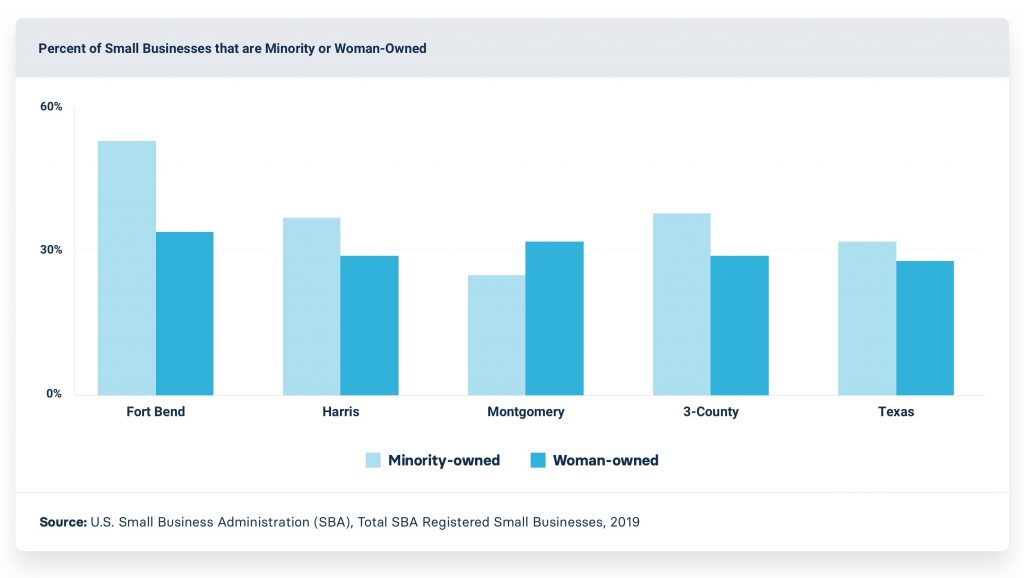

    Despite Houston ranking first in the U.S. for minority entrepreneurs, business owners of color are still underrepresented in the Houston area and face unique challenges.

    About 38% of Houston’s small businesses are minority-owned, higher than the rate for the state. In Fort Bend County, 53% of small businesses are minority-owned.  Woman-owned businesses are underrepresented in our regional economy —  just 29% of small businesses in Houston are women-owned.

    These businesses reflect the entrepreneurial spirit of Houstonians — forging their own economic path with talent and persistence — sometimes as a necessity to overcome employment barriers, challenges in building personal wealth, and discrimination.

    The importance of small businesses and Paycheck Protection Program loans 

    Both in Houston and across the nation, small businesses are vital to the financial and economic health of our communities. About 63% (68,500) of firms in the Houston Metro area are small businesses with fewer than 10 employees, according to the 2018 Annual Business Survey from the Census Bureau. Across the three-county region, 559,000 establishments with no paid employees (representing self-employed entrepreneurs) — generated $28 billion in receipts in 2017, according to the Census Bureau’s Nonemployer Statistics. 

    As a means of helping these businesses weather the economic storm accompanying the COVID-19 pandemic, the federal Paycheck Protection Program (PPP) loan began to deploy $349 billion to provide “small businesses” with up to $10 million in forgivable loans as long as certain requirements are met. The program allowed all businesses — including nonprofits, veterans organizations, tribal businesses, sole proprietorships, self-employed individuals and independent contractors — with 500 or fewer employees to apply.1

    Issues with the Paycheck Protection Program loans

    While the broad eligibility criteria allowed many small businesses to apply for relief, the exceedingly fast process and unclear guidance for borrowers and lenders had a narrowing effect, as businesses with significant capacity and legal/financial expertise were best positioned to apply. Furthermore, the 7(a) loan was quickly administered by banks that were existing SBA-certified lenders, a pool of lenders that has been criticized as having an insufficient track record of providing access to capital to underserved businesses owned by women and people of color.

    In less than 14 days, all PPP funds were exhausted due to high demand, with more than 1.6 million loans processed by about 5,000 lenders.2 It’s estimated that as of April 17, approximately 80% of small businesses that applied for a loan were still waiting for answers the day after the program ran out of funds.  

    Why minority- and woman-owned businesses in Houston are struggling

    Even before COVID-19, many Houston-area small businesses, microbusinesses, and sole proprietorships led by historically marginalized communities and women faced financial challenges at disproportionate levels relative to White small business owners in our region. On average, minority-owned businesses in Houston are denied loans at three times the rate of non-minority-owned firms. The COVID-19 pandemic has only exacerbated these challenges in Houston. Many small businesses owned by minorities historically have lacked access to established accounting infrastructure and banking relationships that would allow them to access substantive capital such as the federal PPP loan. 

    Some issues that prevent small businesses from accessing capital through PPP loans include: 

    • Low employee count: The financial incentives associated with PPP loans encouraged lenders to serve clients with larger loan sizes, meaning larger “small businesses” were more likely to have their requests approved than those with fewer employees. For context, 90% of businesses owned by a woman or minority in Metro Houston have fewer than 100 employees, according to the Annual Survey of Entrepreneurs. In response, some large banks have donated their fees totalling millions of dollars to nonprofit organizations. 
    • Smaller operations: Given that microbusinesses, sole proprietors, and contractors often have very low fixed costs (e.g., payroll, rent, utilities), the PPP loan rules and forgiveness conditions often do not truly apply to many small/micro minority- and/or woman-owned businesses as they are more likely than other groups to not have employees and significant overhead costs.

    Major local efforts in Houston to support small businesses have faced challenges, despite good intentions. For example, a $10 million loan fund in Harris County was depleted in less than 48 hours, with broad eligibility criteria and credit requirements that made it difficult for small/microbusinesses led by people of color to access these funds.

    Understanding Houston’s needs on the long road to recovery

    Small businesses are critical to our region’s economic success. When small/micro-business owners and self-employed entrepreneurs are unable to provide for themselves, their employees and their families, entire communities suffer. And when the safety nets in place are unable to accommodate the needs of the most vulnerable small business owners, the economic inequalities affecting our region will only intensify.

    As our region continues to work toward a long recovery process, thoughtful and direct action on behalf of minority- and woman-owned businesses will be needed to help these valuable institutions survive. Access to the right information is vital to making these important decisions. As we research and work toward a plan for our region, we invite you to explore the data, get involved and use Understanding Houston to learn more about what matters in our communities. 

    End Notes:

    1 Businesses in certain industries can have more than 500 employees if they meet applicable SBA employee-based size standards for those industries.
    2 “The SBA has processed more than 14 years’ worth of loans in less than 14 days,” said U.S. Treasury Secretary Steven T. Mnuchin and SBA Administrator Jovita Carranza in a joint statement.

  • Words of Unity: 14 Texas Voices Inspiring Hope in Our Region

    Words of Unity: 14 Texas Voices Inspiring Hope in Our Region

    The strength and substance of our communities at their best are defined by what we do during times of turmoil. Houston is a do community. In times of peace and crisis, we work together and strive to make Houston a more vibrant place.

    Our strength is also defined by the words and perspectives we offer to help those around us find unity in the face of adversity. Challenges like Hurricane Harvey and the ongoing COVID-19 pandemic have showcased our region’s undeniable ability to help and inspire one another in crises. And now as we collectively mourn and reflect upon the death of Houstonian George Floyd while in police custody, and others who have died senselessly in recent months, we once again turn to the voices that aim to inspire and heal our communities in this time of meaningful action.

    While no quote can repair the wounds left and exposed by George Floyd’s death, these words from community leaders across the private and public sectors have helped to drive the conversation and shape progress — in the Greater Houston region and beyond.

    Greg Abbott, Governor of Texas

    “Texas has a legacy of success, whether it be the Timothy Cole Act, the Sandra Bland Act, and now maybe the George Floyd Act to make sure that we prevent police brutality like this from happening in the future in Texas…George Floyd is going to change the arc of the future of the United States. George Floyd has not died in vain. His life will be a living legacy about the way that America and Texas responds to this tragedy.

    George W. Bush, Former Governor of Texas and Former President of the United States

    “It is time for America to examine our tragic failures — and as we do, we will also see some of our redeeming strengths … America’s greatest challenge has long been to unite people of very different backgrounds into a single nation of justice and opportunity. The doctrine and habits of racial superiority, which once nearly split our country, still threaten our Union. The answers to American problems are found by living up to American ideals — to the fundamental truth that all human beings are created equal and endowed by God with certain rights.

    Rev. Marcus D. Cosby, of Wheeler Avenue Baptist Church

    It is perfectly OK to be angry. As a matter of fact, if you’re not angry something is not right. You should be angry. You should be infuriated by what we have seen. Experience the anger. Process that anger so it can move to positive action so we can make sure that something changes. It’s how we channel our anger, so it does not become vengeful but at the same time it has to be an anger that leads to difference, leads to change. Until we change that notion and understand that we’re all God’s children, we’re one family, we’re one future.”

    Commissioner Rodney Ellis, Harris County Precinct 1

    “The solutions we need right now — both to protect our safety and to rescue our democracy — are ones that meet the scale of the problem. To respond to George Floyd’s killing, or Breonna Taylor’s killing, we must replace the questions about how to reform policing with questions about what role a discriminatory system of mass incarceration should play in a broader vision for safety and justice in America.

    As elected leaders, we can do better — and our communities deserve better. As your Commissioner, I pledge to do my part. In doing so, we will all be safer and healthier. Change is long overdue, but transformation is possible.”

    Commissioner Adrian Garcia, Harris County Precinct 2

    “As we mourn the loss of George Floyd, we must remember that the problems exhibited in that horrendous video are a reflection of the societal problems that still exist in our country today. George’s family needs to know that their loss will not be in vain. Loss of life by police action, no matter how it happened, is something that creates a tear in the fabric of our society. I believe we have the capacity to come together to address the prejudices, misunderstanding and lack of respect that may have led to George’s death… We can and must do better, because when tragedy has knocked on our doors, we have responded as a united community. We are known around the world for our capacity to unite under the most difficult times and the nation needs our example more than ever today. The Floyd family needs us to unite around them and lift them up in this darkest hour.”

    Rep. Al Green, Texas 9th Congressional District

    “I am not here today as a Democrat. We are not here as Republicans. We are not here today because we are rich or poor and we are not here because we are conservative or liberal. We are here because… we have no expendables in our community. George Floyd was not expendable… we are going to make sure that those who look through time, that they will know that he made a difference in his time because he changed not only this country, not only the United States — he changed the world. George Floyd changed the world.”

    Bob Harvey, President and CEO of Greater Houston Partnership

    “While the issues of racial inequity and systemic racism are not unique to Houston, we have an opportunity as Houstonians to lead the way in reforming broken systems, building up communities, offering support and removing barriers. We often speak with pride of Houston being ‘America’s most diverse city.’ This is our moment to make Houston ‘America’s most inclusive and open city’, one that does truly offer ‘opportunity for all.’”

    Lina Hidalgo, Harris County Judge

    “We must never forget the name George Floyd or the global movement he has inspired. George Floyd’s death, and the deaths of Breonna Taylor, Sandra Bland, Tamir Rice, Ahmaud Arbery, and too many others have sparked a national conversation about race and police brutality. It has taken far too long for us to get here, but we must lean forward and work to make meaningful change in our nation. No family should lose another loved one in such a senseless way. Systemic racism has no place in Harris County.

    Beyoncé Knowles

    “No more senseless killings of human beings. No more seeing people of color as less than human. We can no longer look away. George is all of our family and humanity. He is our family because he is a fellow American… justice is far from being achieved. Continue to pray for peace and compassion and healing for our country.”

    Dr. Ruth J. Simmons, President, Prairie View A&M on the launch of the Center for Race and Justice

    “Today’s events call upon us to take action. Not one-time action but action that can have an impact on our community over time. For too long, we have been content to have others dictate the limits of our ability to act: individuals who call for a different course of action, those who are concerned about controversy, those who advocate “staying in our lane.”… Fighting racism and discrimination and upholding justice must always be among our highest callings.”

    Sylvester Turner, Mayor of the City of Houston

    “We recognize in this city that there are many communities and neighborhoods that have been underserved and under-resourced for decades…. We see you and we choose not to ignore you and we want to do everything we can to treat you with the respect and the decency that you rightfully deserve…We are taking an internal look in our own city to improve those inequities to make things better. We recognize our diversity, and we recognize that we must constantly assess and evaluate the things that we are doing such that our city works for everyone at every level of operation.”

    Frances Valdez, with Houston in Action partners

    Avenue, BakerRipley, Children’s Defense Fund-Texas, Emgage, Empowering Communities Initiative, Grassroots Leadership, Houston Endowment, Houston Justice, Jolt, Korean American Voters League, League of Women Voters Houston, Mi Familia Vota Education Fund, MOVE Texas Action Fund, Movement Voter Project, OCA-Greater Houston, Texans Against Gerrymandering, Texas Advocates for Justice, The Montrose Center, Workers Defense Project, Young Invincibles in an email to Houston in Action members and partners dated June 12, 2020.

    “What recent protests have shown is that there is a role for each of us to play in ending violence against the Black community… it’s incumbent upon us to know this history, to do our part to reverse its effects on the people of our communities, and to break-down the barriers, especially those rooted in a history of oppression, that have been put in the path of marginalized communities…. Marching in the streets, protests at institutions of power, speaking out against racism, fighting for justice, organizing community members, giving of one’s time, contributing financially, educating others, volunteering, making art, caring for one’s self, caring for loved ones, caring for community, donating your expertise, getting everyone counted in the Census, voting, registering others to vote, living with dignity, and speaking truth to power are all ways in which Houston-area residents participate in shaping systems that govern and work for the change in their community—and [we] will never stop working for their ability to do so.”

    JJ Watt, Community Activist, Houston Texans Defensive End

    I have never had to feel that fear for my life. I have never had to experience a situation where I felt threatened because of the color of my skin. I can’t sit here and pretend to know what that feels like. But I can understand and acknowledge that it’s wrong and that nobody should ever feel discriminated against because of the color of their skin. Racism is a problem and silence won’t solve it. I certainly don’t have the answers, nor do I pretend to. But I do intend to listen, learn, understand and ask how I can help.”

    100 Black Men Metropolitan Houston

    “The Declaration of Independence proclaimed: ‘We hold these truths to be self-evident, that all Men are created equal, that they are endowed by their Creator with certain unalienable Rights, that among these are Life, Liberty and the Pursuit of Happiness.’ Unfortunately, none of those words applied to Black people when they were written. Though the journey was never easy, our communities have united throughout American history to effectuate change and give those words purpose, effect and meaning.

    We are at another historical inflection point, our communities are uniting and we are again marching toward change. We are united by an undeniable fact that racism exists. Some people will never appreciate the effects of racism; the fear, the stigma, and the oppression that it creates… The 100 Black Men of Metropolitan Houston will always fight racism and racial inequality. We will always support peaceful protests. We will always seek to be the change our community seeks. We will never forget the sacrifices of Breonna Taylor, Ahmaud Arbery, George Floyd or the countless other Black lives that have been wrongfully taken. And we celebrate the 60,000 Houstonians from all ethnicities and backgrounds who peacefully protested and paid homage to Mr. Floyd’s memory.”

    Inspired by the cause, driven by the facts

    As our region works to enact meaningful change in our communities, seeing the full picture and working with accurate and meaningful data will be critical in directing future philanthropy and activism. Understanding Houston is committed to making such vital data and information accessible to illuminate where our region’s challenges lie, so that our communities can take action to do the work that matters most, where it matters most.

    Help us spread the knowledge by exploring the data, getting involved and using Understanding Houston to learn more about what matters in our communities.