Month: September 2021

  • A Path Forward: How Arts Education Helps Student Learning and Well-Being

    A Path Forward: How Arts Education Helps Student Learning and Well-Being

    The 2021–22 school year has reamplified public concerns regarding COVID-19’s continued impact on our children, including its toll on their mental and emotional wellbeing as well as lost learning opportunities. Addressing these needs will necessitate holistic, comprehensive approaches that require our community to reexamine children’s educational priorities, needs and resources. While many of these strategies will require further investigation and experimentation, the arts have proven to be remarkably valuable in addressing and strengthening students’ social and emotional learning needs.

    As a region with remarkable wealth and an abundance of arts resources, we believe that Houston-area schools should work together with arts organizations and institutions to utilize the arts and address our students’ pressing needs.  

    What is Social Emotional Learning?

    Defining Social Emotional Learning (SEL) is complicated because the phrase is often employed differently by various stakeholder groups. A classroom teacher may use SEL to refer to social emotional skills like empathy and perseverance. Meanwhile, a parent may think of SEL as a means for promoting positive relationships amongst their children’s peers.

    The Collaborative for Academic, Social, and Emotional Learning (CASEL) defines SEL as the process through which people (both young and old) acquire knowledge and skills to manage their emotions and feelings, achieve goals, display compassion and empathy for others, cultivate and maintain relationships, make better decisions, and ultimately develop a healthy self-image.

    Policymakers have come to recognize the importance of SEL in schools. In the reauthorization of the Elementary and Secondary Education Act, i.e., The Every Student Succeeds Act (ESSA), Congress added legislation requiring states to broaden their measures of school quality and effectiveness. The vast majority of states have since responded by adopting measures that assess students’ school engagement, school culture and climate, and SEL. While the emphasis on SEL had been gaining steam, the COVID-19 pandemic made its importance all the more apparent.

    About one-third of adults in the Houston Metro Area have reported feeling nervous, anxious, or on edge for at least more than half the days of a week since the start of the pandemic, with some groups faring worse than others. As students across Houston continue to experience high rates of anxiety, trauma and depression in light of the pandemic, it is important to address these mental health challenges directly. Latinos for Education recently shared that 46% of Spanish-speaking parents in Houston have seen their children experience mental health struggles and decreased socialization. 

    SEL development combats these issues head on. A 2017 study showed that students who received SEL programming tended to handle emotional distress better and experienced less drug usage. Research also shows strong correlations between mental health and academic performance — the same study found that students who received SEL programming averaged 13 percentage points higher than non-SEL peers on academic performance metrics.

    These benefits go beyond the individual. A separate 2015 cost-benefit analysis on SEL interventions reported an average of an $11 return on investment for every dollar spent on SEL programming. This type of return on investment can be utilized by the Houston community-at-large to increase economic opportunities, reduce poverty, and improve other outcomes for students.

    The Arts Opportunity

    There is little consistency in how schools approach teaching SEL concepts to their students. Some campuses integrate SEL into their school improvement and/or strategic plans directly and encourage their teachers to incorporate SEL concepts into existing lesson plans, while others teach SEL concepts entirely separate. Regardless of what approach an individual campus may choose, there is one scientifically proven, yet historically overlooked (and underfunded) avenue for increasing these skills: arts education.

    Children grow their skills and behaviors through developmental experiences that allow them to participate in daily life and reflect on how their participation impacts them. These experiences also tend to be the most impactful when they occur in “strong, supportive, and sustained developmental relationships with important adults and peers.” Put another way, students develop skills, habits and behaviors most effectively when they are actively involved in the “doing” of learning, and when they are surrounded by people they care about, like teachers and classmates. 

    Communal active learning is at the core of arts education. Any art form, whether it be music, theatre, visual arts, dance, etc., provides students the chance to actively explore new concepts, new skills and new behaviors with their peers. Arts education programming affords students an opportunity to mimic or interpret experts and leaders in an art form, participate as much or as little as they feel comfortable, develop self-discipline through practice and contribute to a collective effort. For instance, a classroom of third graders may mimic their art teacher’s still-life painting and attempt to produce something similar. This act forces the student to think critically about how to produce a similar piece, what materials they may need, and how to move their hands. They may look around and engage nearby students for advice or learn by what others are doing. The process of creating art builds focus and endured concentration, while empowering students to express themselves in ways they normally would not be able to articulate.

    A 2019 Rice University study examined the impacts of arts educational experiences on Houston students and also found considerable impacts on their social and emotional outcomes. Students who received access to these arts educational experiences saw substantial increases in their writing achievement, compassion for others, and a reduction in school disciplinary issues. Among elementary school students, this same study saw significant increases in school engagement levels, aspirations for college, and empathy.

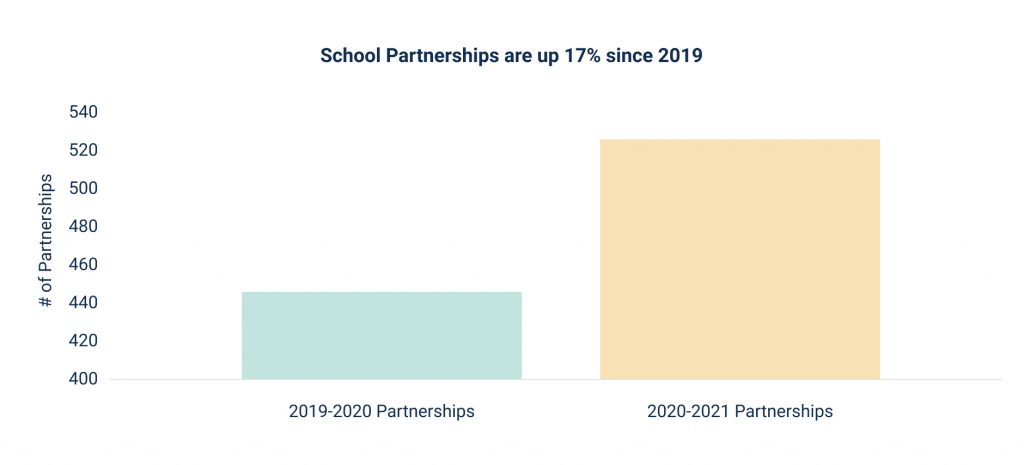
    Funders and decision-makers often point to a lack of empirical evidence as the reasoning behind not investing in the arts. This study is tangible proof that right here in Houston, arts education is a lever for improving SEL outcomes. Our region has already developed a strong, vibrant and growing infrastructure for supporting this work. The creation of the Houston ISD Fine Arts Department in 2017 has seen the Fine Arts student-teacher ratio drop by over 100 students per teacher and has eliminated 30 Fine Arts deserts at elementary schools across the city. Arts Connect Houston, a collective-impact organization of over 80 partners, including arts and cultural organizations, Houston ISD, funders, and city/government leaders exists to increase equal access to the arts  in schools across Houston. Since 2019, we have seen partnerships between schools and cultural organizations grow 17% — demonstrating an increase in understanding the impact the arts can have in supporting students, particularly amid an ongoing pandemic. Imagine what that growth could look like, and the subsequent SEL outcomes, if the arts were sufficiently supported.
    An arts-rich education in Houston

    Margo Hickman, a theatre teacher in Houston noted that when she looks at her students, “so many of them are frustrated. They are angry. The arts allow them to release those feelings.” Margo incorporates Social Emotional Learning through theatre games and meditation. When asked how the arts have impacted her student’s social-emotional learning, she simply added, “The arts have saved people’s lives.”

    “So many of the [students] are frustrated. They are angry. The arts allow them to release those feelings.”

    – Margo Hickman, Theatre Teacher in Houston

    Social Emotional Learning is an important aspect of a child’s development, and the arts provide a proven pathway to grow those skills, but students lack equal access to these valuable educational experiences. As of 2021, it is estimated that nearly 9,000 elementary school students within Houston ISD do not have access to a full-time certified fine arts teacher at their school. Last year, nearly 40 schools reported no partnerships with any arts and cultural organizations, while others worked with as many as six. Moreover, past studies have shown that students from historically underserved communities are much less likely to engage in arts learning experiences outside of school (while affluent students are twice as likely!), meaning that investments from schools and districts are critical for ensuring that these students have these opportunities. Shaela Sageth, a Houston ISD student planning on pursuing an arts-related degree next fall highlights the disparity in access saying  “Being low-income, school was my only chance to access arts classes and creative tools while growing up. I would have liked to have had these kinds of diverse arts opportunities in my schools.” 

    Looking ahead

    As our community continues to discuss the best way forward, administrators will face incredible challenges for determining how best to spend scarce resources. As a community, we need to consider holistic, comprehensive approaches that employ the vast resources available in our city to provide all students no matter their neighborhood or school, with the tools they need to successfully navigate the trauma of a global health crisis and prepare them for lifelong success. Arts education is a tried-and-true means for addressing these challenges.

    It is up to all of us, now more than ever, to ensure that every child has access to the benefits of an arts-rich education. Our city has already cultivated the necessary tools to implement meaningful change. Despite the horrible crisis we have found ourselves in for the past year and a half, we have also been afforded an incredible opportunity to reevaluate how we educate our students. It is time to invest in the “arts opportunity” and grow and nurture our children’s humanity, sense of community, and perseverance. Doing so will ensure that Houston remains a vibrant and thriving community for years to come.  

     By Michael Sheehy, Deborah Lugo, and Daniel H. Bowen, PhD

    Michael Sheehy is the Data + Advocacy manager for Arts Connect Houston. He holds a degree in theatre from the University of Kentucky and an M.P.P. from the Sanford School of Public Policy at Duke University. Before coming to Houston, Michael worked as a researcher measuring audience response to COVID-19 and social impact for WolfBrown and El Sistema USA respectively.
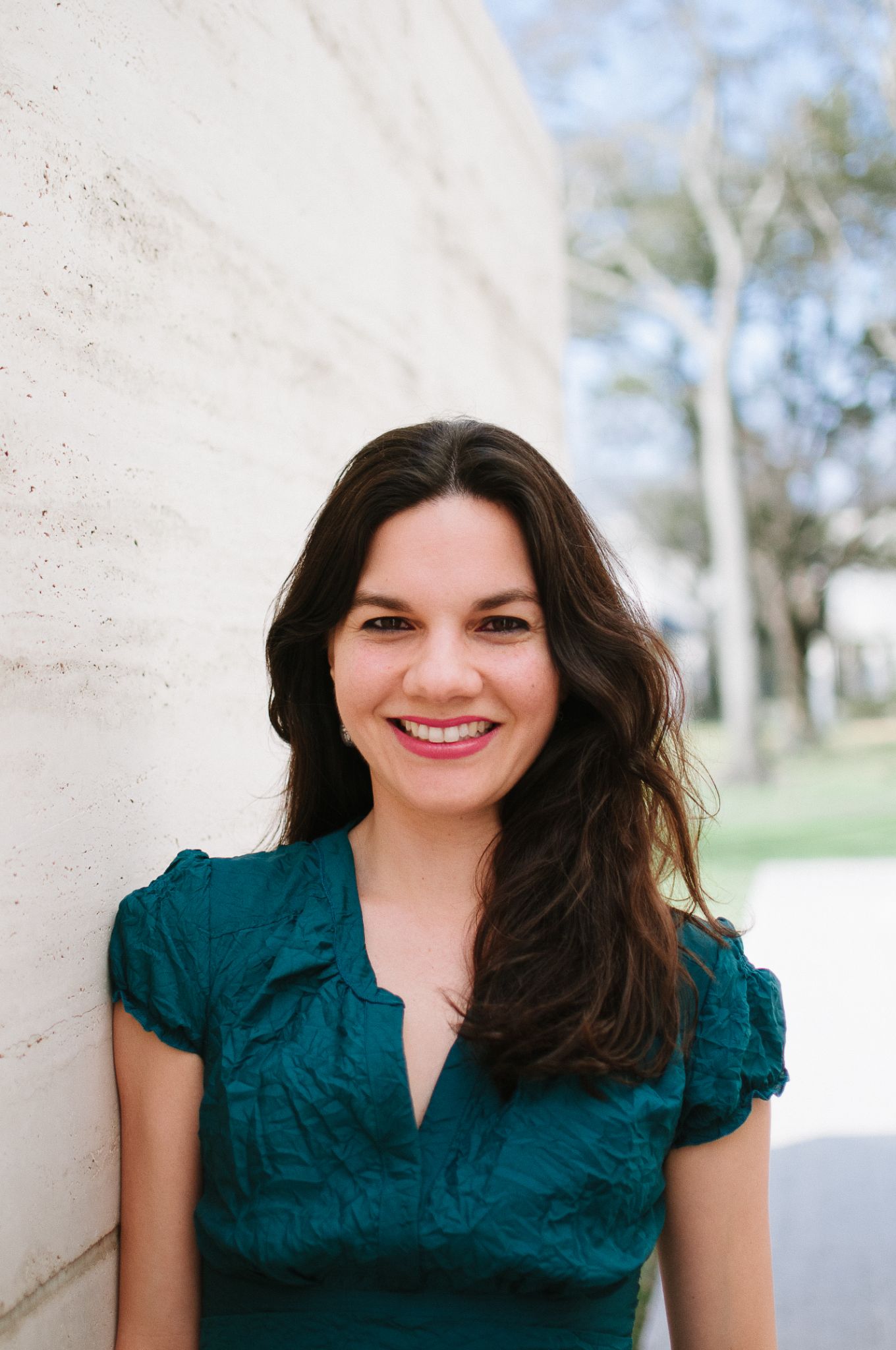
    Deborah Lugo is the Executive Director for Arts Connect Houston. Through her work, she facilitates strategic alignments and opportunities in order to expand access to arts education for students throughout the Houston ISD. Deborah, originally from Puerto Rico, holds a Master in Public Policy from Princeton University and a Bachelor in Violin Performance from Florida International University. Before her time at Arts Connect, she was the Executive Director of Mercury Chamber Orchestra.
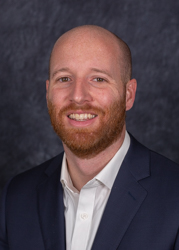
    Daniel Bowen, Ph.D. is an associate professor with Texas A&M University’s Department of Educational Administration and Human Resource Development, a research affiliate of Rice University’s Houston Education Research Consortium (HERC), and the co-director of the National Endowment for the Arts-sponsored Arts, Humanities, and Civic Engagement Lab. Dr. Bowen primarily investigates the educational impacts of arts, humanities, and civic engagement learning experiences through experimental and quasi-experimental research methods. 
  • Hispanic Heritage Month: Celebrating the Hispanic Population in Houston

    Hispanic Heritage Month: Celebrating the Hispanic Population in Houston

    As the largest ethnic group in the region, Houston’s Hispanic community has left an indelible impression in our communities — both past and present. From indigenous roots spanning the Americas and those with African ancestry, to early Spanish-speaking settlers and present-day community pillars, Houstonians who identify as Hispanic/Latino have shaped our region in fundamental and invaluable ways.

    In honor of Hispanic Heritage Month, we’ll explore the multifaceted Hispanic population in Houston through data, history and what current leaders are doing to keep the community’s legacy thriving throughout our region.

    To me, Houston is the most dynamic city for Latinos in Texas. Not only have they been present since the city’s founding, but the community is constantly being strengthened by new arrivals who bring fresh energy, skills and perspectives. Hispanics in Houston introduce vibrant foods, music and cultural scenes. They integrate quickly into the economy and interact daily with other racial and ethnic groups. While many inequalities and challenges persist, this is a place where Latinos come to set roots, to grow, and to thrive.

    – Dr. Cecilia Ballí, an anthropologist and Visiting Scholar at the University of Houston’s Center for Mexican American Studies

    The Latino/Hispanic population in Houston

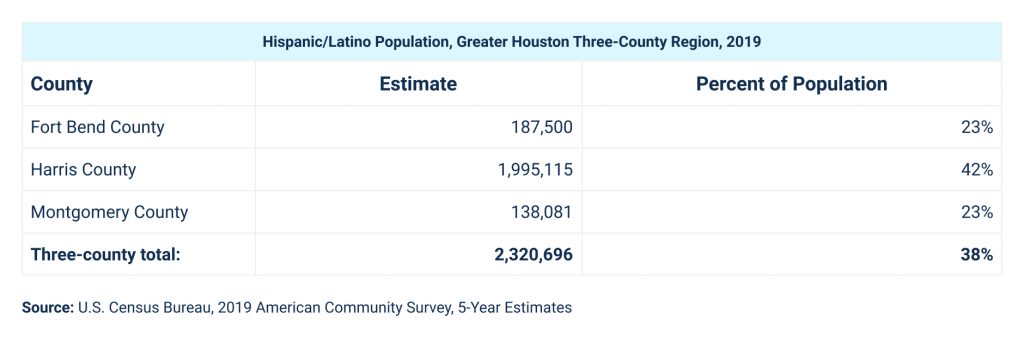
    What percent of Houston is Hispanic? Greater Houston is home to one of the nation’s largest Hispanic populations, numbering more than 2.3 million people throughout the region — meaning Houston’s Hispanic population percentage is currently about 38%.

    Hispanics are most likely to live in Harris County, where they comprise 42% of the population. In 1980, only 41 years ago, Hispanics made up only 15% of the county’s population. And this group is projected to continue growing — both within Greater Houston and throughout the state. According to the Texas Demographic Center, the Hispanic/Latino1 population in Texas is projected to reach 12.3 million by 2022 — becoming the largest ethnic group in the state. By 2030, the population is expected to reach 14.5 million. Let’s take a look at how the Hispanic/Latino community has shaped —and will continue to shape — the Houston we know and love

    Houston’s Latino population is diverse

    Because the general terms “Hispanic” or ”Latino” are used to describe a group of people who originate from a wide variety of Spanish-speaking or Latin American countries, and who understand their identity in different ways, the diversity within that broad group can often go unnoticed. Houston’s Hispanic/Latino population is not a monolith and can trace its heritage to many different countries and indigenous tribes. 

    Moreover, many people whose ancestors identified as Hispanic/Latino, may not describe themselves that way. According to the Pew Research Center, Hispanic self-identification varies across immigrant generations. Among people who report Hispanic ancestry, almost all the foreign born identify as Hispanic, whereas only half of those who are fourth generation Hispanic/Latino Americans or higher do.

    While a majority of the Hispanic population in Houston originates from Mexico, we find incredible diversity among all residents of Hispanic/Latino origin as well as among those with Mexican and Indigenous ancestry. As such, Mexican Texans, also known as “Tejanos,” have a long history in the state and in our region. 

    Dr. Jesus Jesse Esparza, an Assistant Professor of History at Texas Southern University, showcases the past and present of Houston’s Mexican American community in his piece La Colonia Mexicana: A History of Mexican Americans in Houston

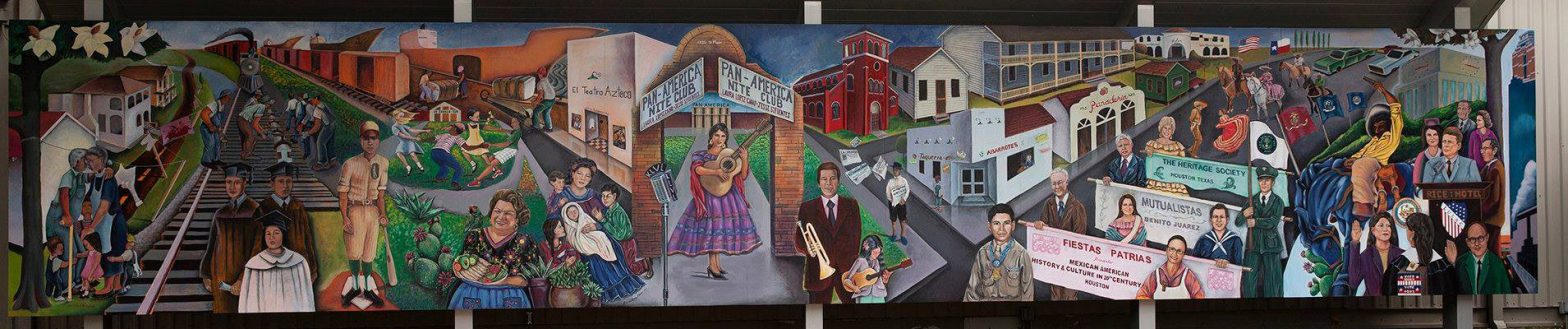
    The end of the Texas Revolution in the mid-1830s marked a significant turning point in Mexican-American settlement in Houston and the booming economy and culture we celebrate today. Historically Hispanic neighborhoods in Houston, including Segundo Barrio in the Second Ward and Magnolia Park Neighborhood in the East End, were areas of early settlement and quickly became hotspots for the community to grow.

    Magnolia Park in particular –– named after the beautiful magnolia trees that line the neighborhood –– became the city’s largest Mexican-American community and was given the nickname “Little Mexico.” Mexican-American residents of the Magnolia Barrio, as it was called, worked on dredging the Houston Ship Channel in the early 1910’s. The important role Mexican Americans played in deepening the Channel allowed larger cargo ships to enter the port, which is why the Port of Houston is consistently the largest in the nation (measured by domestic and foreign waterborne tonnage) and contributes an estimated $339 billion in economic value to the state of Texas.

    Houston’s Mexican-American population established a variety of social, cultural, religious, and political organizations that advocated for the community and paved the way for its residents to thrive. From the Second Ward came Our Lady of Guadalupe Church, the first Mexican-American church in Houston and the first religious institution to offer services in Spanish. This church also ran one of the earliest schools for Mexican-American children in the region and provided food and shelter to those in the community.

    From even before Houston’s founding to today, Mexican Americans have been and continue to be the largest Hispanic group in our region, and cultural staples such as civil rights organizations, theatre companies, and art exhibits that were established around the 1980s still exist and thrive in present-day Houston.

    “Houston is so blessed with the richness of our Hispanic Heritage and our multifaceted cultures. This vast Texas city of opportunity coupled with warm Texas hospitality, kindness and charm make Houston, in my opinion, the greatest city in the world. Our fusion of flavor, color, music, and art are the spice that makes Houston so desirable and unique.
    In one family gathering, which because of our heritage are quite often, we easily represented Cuban, Mexican, Panamanian, Nicaraguan, Argentinean, Costa Rican, Dutch and Spanish cultures—and this is just the beginning. Our people, history, warmth and love are the greatest assets to our city and to our future.”

    – Mayte Sera Weitzman, 2021 President and Board Chair, Institute of Hispanic Culture of Houston

    Houston’s Latino community has supported our economy for decades

    The passage of the Immigration and Nationality Act of 1965 established a new immigration policy based on reuniting immigrant families and attracting skilled labor to the United States. This policy change enabled thousands of people from Latin American, Asian, and African countries to move into the Houston region, causing a population boom that has propelled our economy into one of the largest in the nation today. As sociologist Stephen Klineberg has written, “No city has benefited more from immigration than Houston, Texas.” This population boom also paved the way for our metropolitan area to be one of the most ethnically diverse places in the nation and one of only four with a Latino plurality.2 

    “As a life-long resident of the greater Houston area, I have seen a tremendous amount of impact from our Latino population. But it hasn’t always been easy for Latinos. Everything I do today, including in my community work around housing and education, is in remembrance of the role models my parents were. They were extremely humble but extremely loving. They worked hard to instill a strong work ethic and to provide for our family and my education. They loved life despite the hardships. My parents are my inspiration, but so many successful Houston Latinos continue to lead the way as well and should absolutely be celebrated. I’m proud of my heritage and culture and aspire to relay that to the younger generation.”

    Laura Jaramillo, Greater Houston Community Foundation Board Member

    While immigration is central to the story of Houston, some make the mistake of believing that most people of Hispanic origin are recent immigrants or newcomers. In fact, as of 2019, the majority of Hispanic/Latino residents in our region were born in the U.S. (61%). And, about half of Hispanic residents that were born outside the U.S. have been in the country since before the year 2000. Only about 20-26% entered the U.S. in 2010 or after.

    Hispanic/Latino workers are integral to Houston’s workforce and economic growth. In addition to participating in the labor force at higher rates than the overall region3, Hispanic workers continue to fill critical workforce gaps in labor-short industries such as agriculture, construction, and healthcare in Houston, according to bipartisan research from New American Economy

    Latinos comprise 35% of the Houston metro-area labor force, but hold 62% of jobs in construction, extraction and maintenance, 47% in service, and 45% in production and transportation, according to research from the University of Houston’s Center for Mexican American Studies (CMAS). These jobs tend to pay less than the regional average and were among the sectors hit the hardest during the pandemic. It is not surprising then that Hispanic households have experienced the highest rates of job and income loss since COVID-19 forced shutdowns.

    Continue reading about Houston unemployment and income inequality

    Educating the region’s future workforce

    Educational attainment rates for Latinos as a whole tend to lag that of other groups, despite recent improvements. The share of Latino adults in the region with at least a high school diploma has increased from 44% in 2000 to 63% in 2017. More recent data shows that nearly two-thirds of Latino adults have at least a high school diploma or equivalent in 2019.

    There are differences in the levels of education between Latinos who are foreign born versus native born, and even among the foreign born as well. For example, 12% of Hispanic immigrants in the three-county region have a bachelor’s degree or higher compared to 20% of Hispanic adults born in the U.S. 4 Research from CMAS found that recent Latino immigrants are more likely to be better educated than those who arrived before them. For example, 27% of immigrants who have arrived in the last five years have a bachelor’s degree or higher. For those who have been here for at least 11 years, that drops to less than 10%.

    Access to quality education is critical to maintaining a skilled workforce in our knowledge-based economy. However, nationally and locally, Hispanic students are five times more likely to attend a high-poverty school than white students, resulting in very unequal educational experiences. Given the fact that more than 575,000 Hispanic students are enrolled in the three-county region’s public schools (52%), our collective future success depends on the investments we make today. 

    The civic and cultural contributions of Houston’s Hispanic/Latino population

    Full citizenship is something one possesses as well as what one does. And, they are not mutually exclusive. While certainly not the only way, one of the most fundamental ways to exercise one’s citizenship is to vote. Hispanic voters are increasingly making up a larger share of the Texas electorate. Nearly 17 million adults in Texas were registered to vote in 2020, and census data estimates about 30% of those are Hispanic/Latino. About 60% of Hispanic citizens in the Houston Metro Area were registered to vote in the 2020 Presidential election.

    “Voting is learned through example, in the family and the community, and as larger numbers of Hispanics feel empowered to go to the polls, our share of the electorate will grow to properly represent our demographic size.”

    – Dr. Cecilia Ballí, an anthropologist and Visiting Scholar at the University of Houston’s Center for Mexican American Studies  

    Hispanic Houstonians have a strong history in civic leadership, whether leading the third-most-populous county in the nation, working toward educational parity, fighting for social and political justice, to promoting cultural food, music, and arts, their contributions enrich our community. Read about eleven Hispanic community leaders who are making a difference by visiting our Hispanic Heritage Month 2020 blog.

    One notable Hispanic leader in the Greater Houston area is Harris County Judge Lina Hidalgo, a native Colombian who moved to Houston at the age of 15. Judge Hidalgo is the first woman and the first Latina to be elected County Judge and the second to be elected to the Commissioners Court. For some time in 2019 and part of 2020, the Harris County Judge (Lina Hidalgo), Houston Police Chief (Art Acevedo), and Harris County Sheriff (Ed Gonzalez) were all Latino. 

    “In 1955, League of United Latin American Citizens (LULAC) Council 60-members purchased a building on an odd-shaped parcel of land that became their “clubhouse” and the de facto national headquarters for LULAC until 1996. This clubhouse served as a launchpad for creating  transformational social programs for Houston’s Hispanic community in education, workforce development and housing.”

    – Jesus Davila, Founder at Landing Advisors

    Latinos have also played an instrumental part in building Houston’s strong reputation for incredible food and culture. Legendary Houston small business Ninfa’s was started as a small taco stand by Maria Ninfa Rodríguez Laurenzo, a Mexican-American woman, in 1973. “Mama Ninfa” is widely credited with popularizing fajitas among Houstonians. Chefs and restaurateurs, David and Michael Cordúa elevated the profile of Latin American cuisine in Houston through famous establishments like Américas and Churrascos. Irma Galvan and Hugo Ortega, helped put Houston on the culinary map with Irma’s and Hugo’s, Caracol and Xochi. On the art scene, Colombian-American, Andrés Orozco-Estrada, became Houston’s first Latino music director for the Houston Symphony in 2014, and Venezuelan Karina Gonzalez is Houston’s first Latina Principal Ballerina.

    In addition to notable leaders, incredible organizations in the region work to preserve the culture, history and language of Hispanic communities, particularly the collaborative effort to establish a major Latino cultural center in our region.

    The Institute of Hispanic Culture of Houston is a local nonprofit organization that serves the Hispanic community through educational, cultural, and networking activities in collaboration with other Houston organizations and universities to keep the vibrant culture alive. Located in the East End, Talento Bilingüe de Houston is a bilingual, non-profit cultural center that strives to enhance Houston’s Latino arts experience through collaboration, education. and preservation. Not only do they provide workshops and exhibits to enrich the Hispanic/Latino population, but they aim to spread their passions with the rest of the Greater Houston area.

    One of the largest cultural organizations in Houston, the Multicultural Education and Counseling through the Arts, or MECA, still exists today thanks to the vision, passion, and dedication to community and youth of Alice Valdez. Read more about her decades of impact. 

    Casa Ramirez Folkart Gallery is not just a gallery. This vibrant shop on 19th Street showcases Mexican and Latin folk and art works, sells books on cooking, culture, and language for children, and is a community pillar for teaching cultural traditions. 

    Finally, the Museum of Fine Arts, Houston showcases the Latin American Art collection that hosts a vast collection of modern and contemporary art with more than 550 works from Mexico, Central and South America, the Caribbean, and works by Latino artists in the United States.

    Celebrating a rich past, present, and future 

    In no uncertain terms, the greater Houston region would not be where it is today without the presence, perspectives and contributions of members from our Hispanic/Latino community. As a vital part of our region’s history and future, Latinos in Houston continue to enrich and better our region in countless ways that we celebrate today. 

    Check out special events from Hispanic Houston, Institute of Hispanic Culture of Houston, and attend a free special Fiesta Sinfónica concert at Jones Hall on October 2. Read about the nominees of Mayor Sylvester Turner’s 2021 Hispanic Heritage Awards and hear more from notable leaders themselves. Happy Hispanic Heritage Month!

    Continue reading about social and community context in Houston’s three-county region

    Helpful Articles by Understanding Houston:

    Photo credit: The Heritage Society

    References:

    1Understanding Houston utilizes the U.S. Census term, “Hispanic,” “Latino” or “Hispanic/Latino” when referring to the overall population. For the purposes of this article, we will use these terms interchangeably depending on the nomenclature used in our cited sources.

    2Understanding Houston analysis of the 20 most populous Metropolitan Statistical Areas (MSA) from the U.S. Census Bureau, 2019 American Community Survey data. Other MSAs with a Latino plurality include (in descending order): Riverside MSA, Miami MSA, and Los Angeles MSA. Houston-The Woodlands-Sugar Land, TX (MSA) is a region that includes the following counties: Austin, Brazoria, Chambers, Fort Bend, Galveston, Harris, Liberty, Montgomery, and Waller.

    3Analysis of data from the U.S. Census Bureau, 2019 American Community Survey.

    4Understanding Houston analysis of data from the U.S. Census Bureau, 2019 American Community Survey, 5-year estimates, Public Use Microdata Sample (PUMS) for the population 25 years and older.